
AnyRecover is probably one of the very few tools that doesn’t offer free recovery at all. There is no recovery limit, no small file allowance, no real way to restore data before payment. That makes reviews far more important than usual. We know how risky it is to pay first and test later. That is why we decided to put the tool under closer inspection and, based on that, create a full AnyRecover data recovery review.
This review covers the basic PC Data Recovery application, not the complete AnyRecover Toolkit, which also includes separate modules for iOS, Android, messaging apps, and AI-powered file repair.



Main Features
The desktop application supports internal and external hard drives, SSDs, USB flash drives, SD cards, and many other storage devices. According to the developer, it works with more than 2,000 devices and supports over 1,000 file types, including photos, videos, documents, archives, and other common formats. Available features depend on the license tier. The Basic version provides PC data recovery, while Android recovery, messaging app recovery, and most AI repair features require the Full Toolkit plan.
Core Data Recovery Capabilities
AnyRecover handles typical data loss scenarios such as accidental deletion, emptied Recycle Bin, quick formatting, lost partitions, corrupted file systems, and RAW drives. It offers Quick Scan for recently deleted files and Deep Scan for more thorough signature-based analysis.
The program supports major file systems, including NTFS, FAT16, FAT32, exFAT, ReFS, APFS, and HFS+, allowing it to operate across both Windows and macOS environments. It can also attempt recovery from unbootable or RAW partitions, and it includes a bootable media creation option for crashed systems.
Despite the broad compatibility and extensive marketing claims, real-world recovery depth remains moderate. In more complex scenarios such as fragmented video files, damaged document structures, or heavily corrupted partitions, detection consistency is not always strong. The advertised “1000+ file signatures” do not consistently translate into superior recovery performance when compared to more specialized recovery solutions.
Bootable Media Creation
One of the more valuable features is the ability to create a bootable USB drive. This allows users to recover data from a computer that no longer starts. Instead of loading Windows, the system boots into a lightweight recovery environment. From there, users can access the internal drive and extract files before reinstalling the operating system.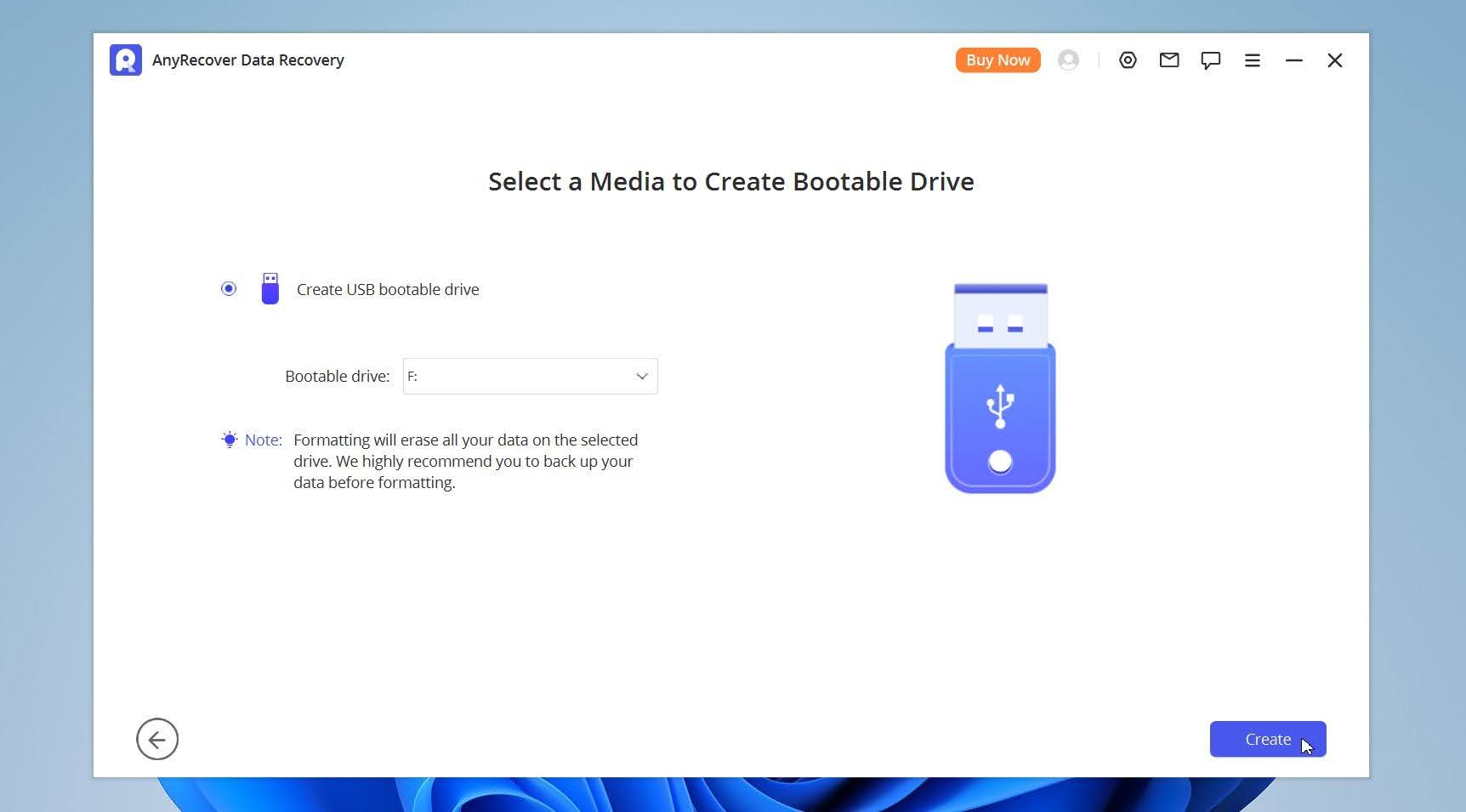
This feature is especially helpful in system crash scenarios where normal OS access is not possible.
How We Tested AnyRecover
To evaluate AnyRecover in realistic conditions, we used two different USB flash drives: a 32 GB SanDisk Cruzer Blade (FAT32) and a 128 GB Kingston DataTraveler (exFAT). Both drives were freshly low-level formatted before testing to eliminate any leftover artifacts from previous use.
We prepared one identical dataset and copied it to both drives. The dataset included 120 files: JPG and PNG images, several MP4 videos of varying sizes, PDF documents, DOCX and XLSX files, and a few ZIP archives. The mix was designed to reflect typical everyday storage content rather than artificially optimized recovery samples.
- On the 32 GB SanDisk Cruzer Blade (FAT32), we simulated accidental deletion. We deleted all files from the USB drive, which on Windows bypasses the Recycle Bin for removable storage by default. No new data was written afterward to avoid overwriting. We then connected the drive to a Windows test system and scanned it using AnyRecover’s PC Data Recovery module. We allowed the scan to complete fully and reviewed detection count, preview behavior, and recovery integrity after restoring the files to a separate internal disk.
- On the 128 GB Kingston DataTraveler (exFAT), we simulated a more complex loss scenario. After we copied the same dataset, we performed a quick format of the entire drive using the same file system to replace as much of the previous file system metadata as possible without overwriting the user data. We did not copy any new files to the drive afterward. We then scanned the formatted partition, checked how the software categorized the results, tested the preview feature, and recovered the detected files to another storage device to verify that they remained usable.
In both scenarios, we measured total scan time, number of files detected, and most importantly, whether recovered files were actually usable. The goal was not just to see if the software could list deleted files, but whether it could restore them intact.
AnyRecover Data Recovery Process
AnyRecover follows a simple scan > preview > recover process. The interface looks modern and guided, with clear buttons and visible progress indicators. During our tests, we followed almost the exact same process below when recovering deleted files from a formatted FAT32 drive. No advanced configuration was required.
- Download and install AnyRecover from the official site.
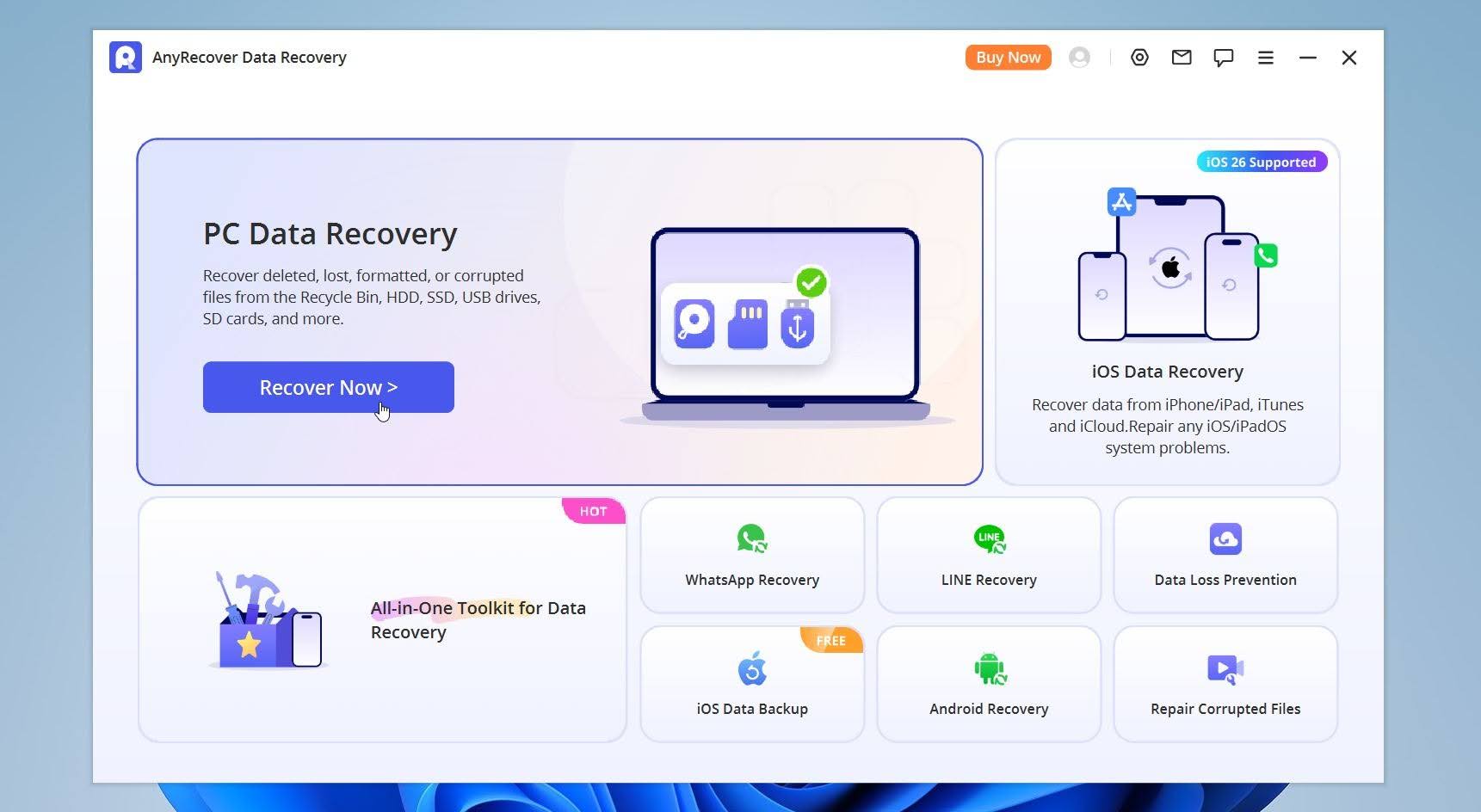
- Open the program and click PC Data Recovery. Then press Recover Now. The dashboard clearly separates modules for PC, iOS, Android, and messaging apps, but drive recovery begins from the PC section.
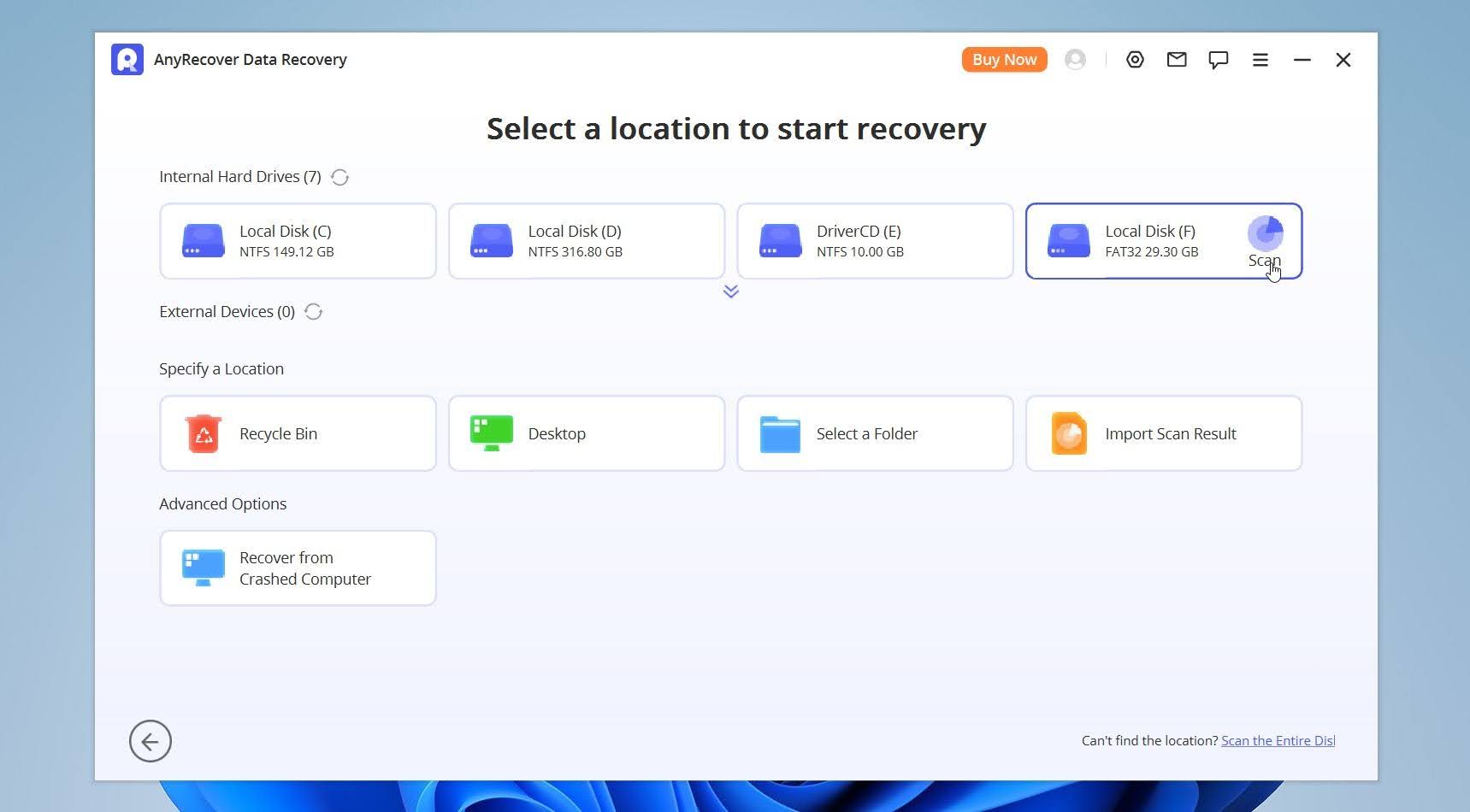
- Choose the target drive, partition, external device, Recycle Bin, or specific folder. Click Scan to start analysis. In our test, we selected a FAT32 partition directly from this screen.
- The scan starts immediately and displays a progress percentage, elapsed time, and number of files found. Files populate in real time while scanning continues. You can pause the process, but we allowed it to complete for full results.
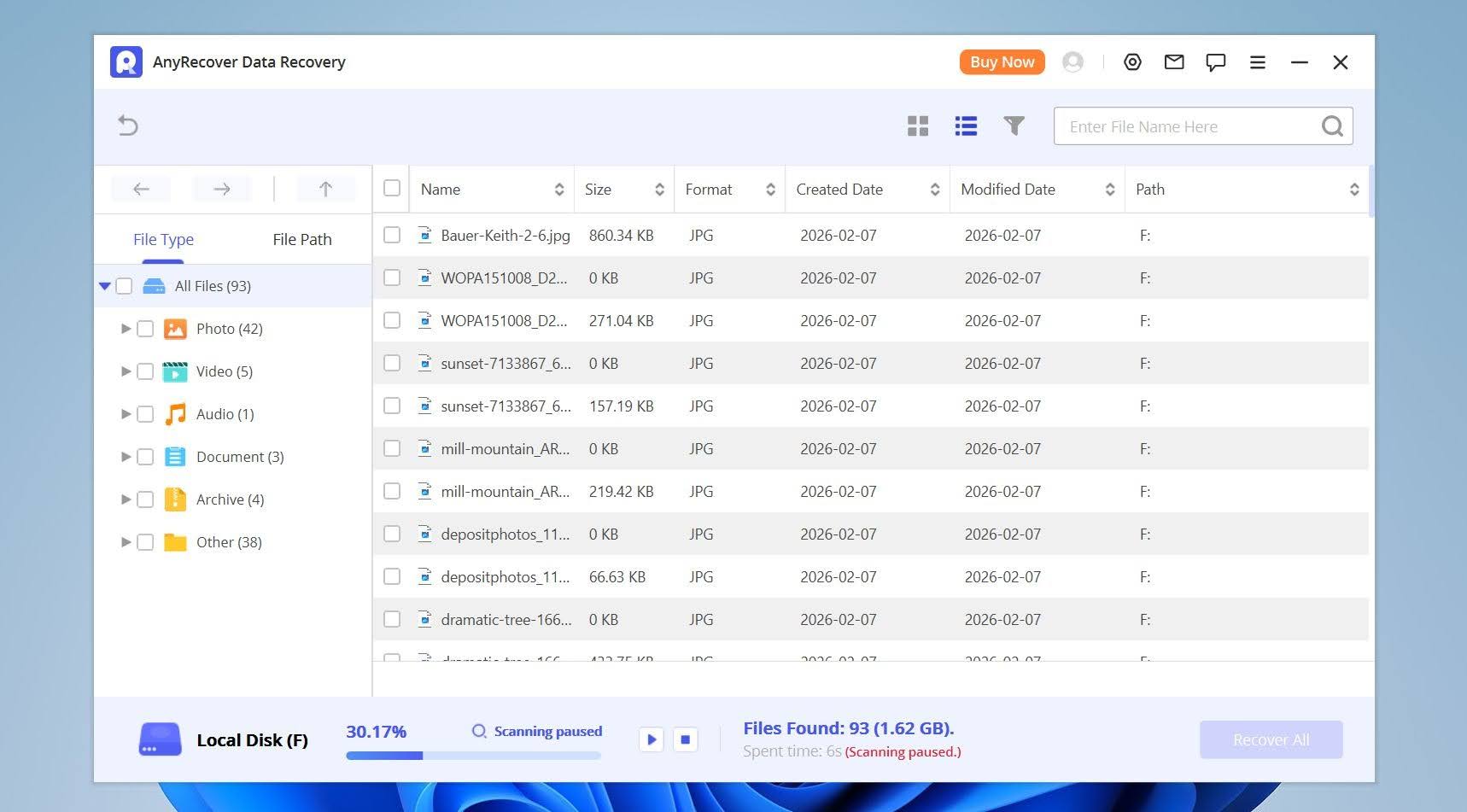
- After scanning, results appear grouped by categories such as Photos, Videos, Documents, and Others. You can sort by name, size, date, or path. During our testing, deleted files were clearly separated and counted.
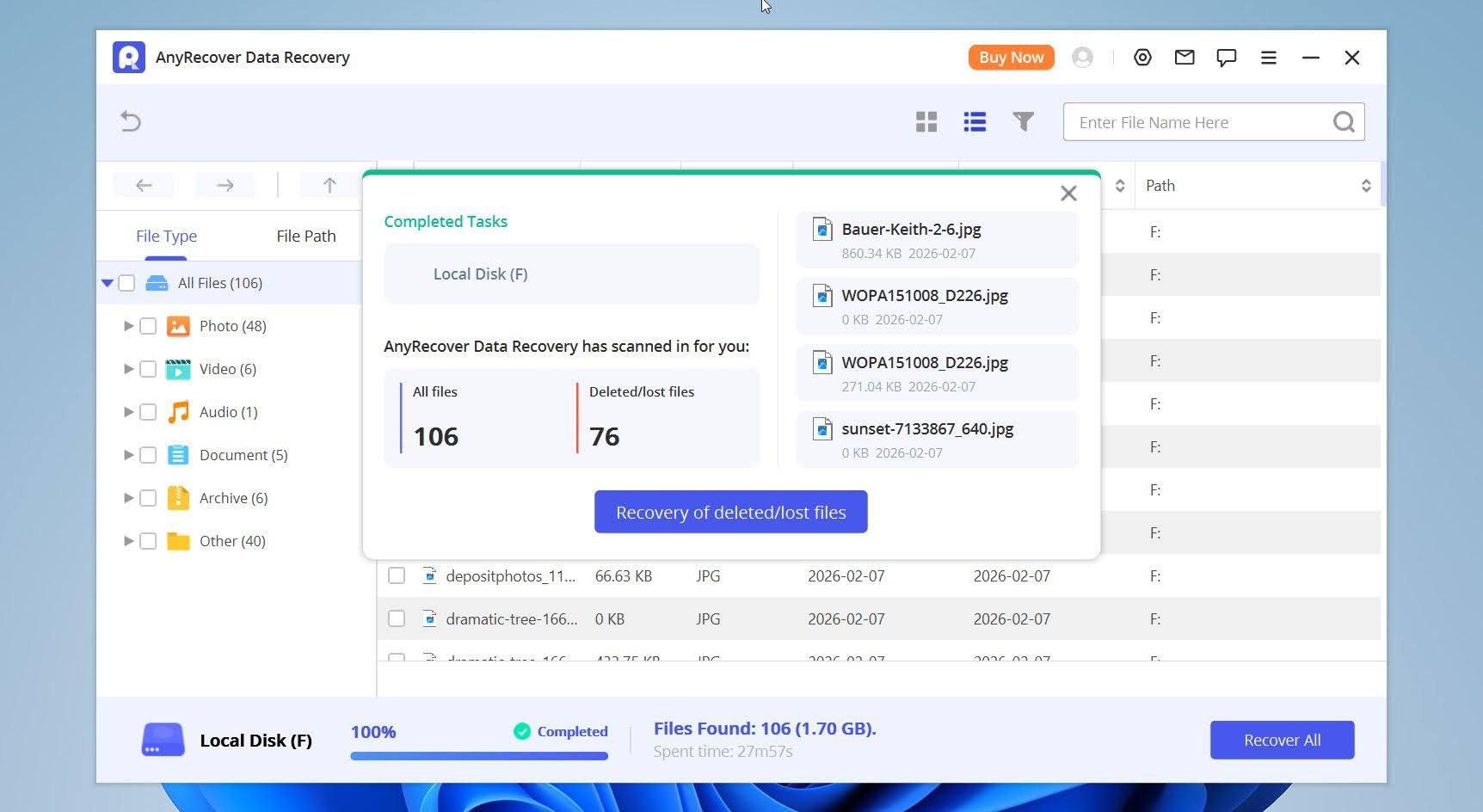
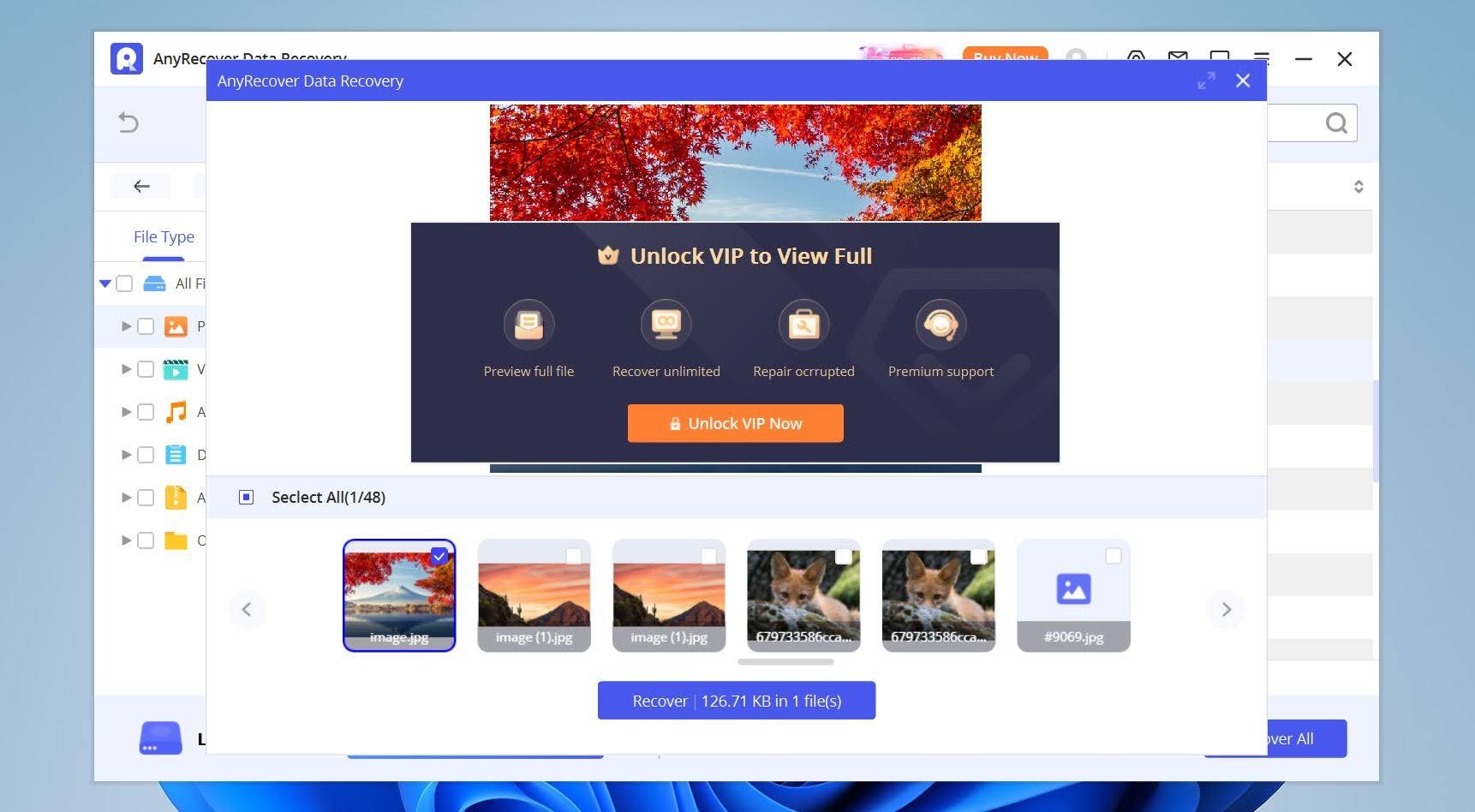
- Click any file to open the preview window. Image thumbnails load correctly, but full preview and unlimited recovery trigger a VIP unlock prompt in the free version.
- Check the files you want to restore and click Recover. Choose a new storage destination, never the original drive. The software then completes the recovery and confirms the process.
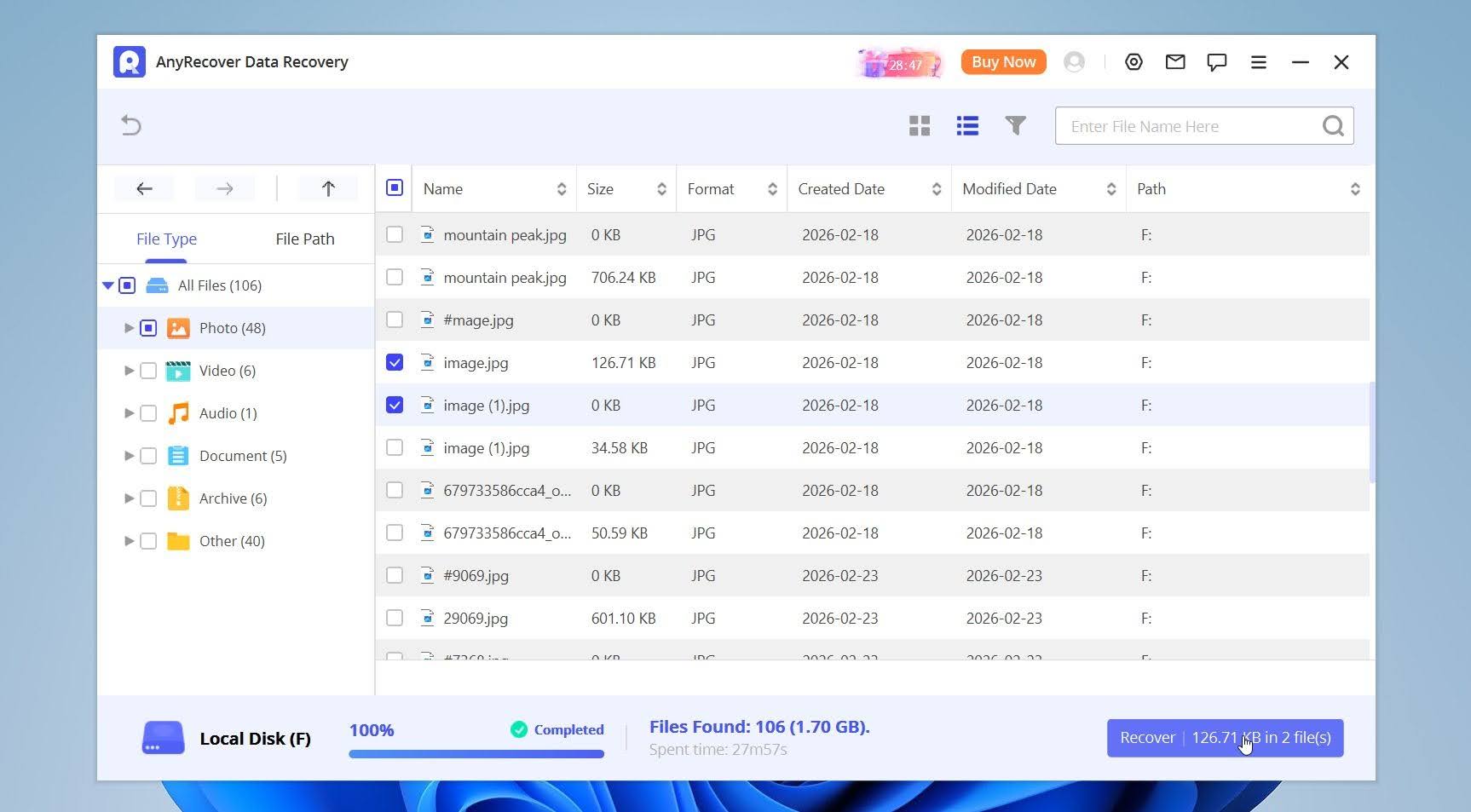
The recovery process itself is pretty simple. You pick a drive, click scan, wait, then sort and recover. AnyRecover does most of the work for you, and the interface feels clean and guided. We followed this exact flow during our tests without touching any advanced settings.
But that’s also part of the limitation. AnyRecover does not let you choose between a quick scan and a deep scan. There’s no visible control over scan modes, file signatures, or advanced filters. You click “Scan,” and that’s basically it. For beginners, this makes things easy. For more experienced users, it can feel restrictive because there’s very little to customize or fine-tune.
Now… about the upgrade prompts.
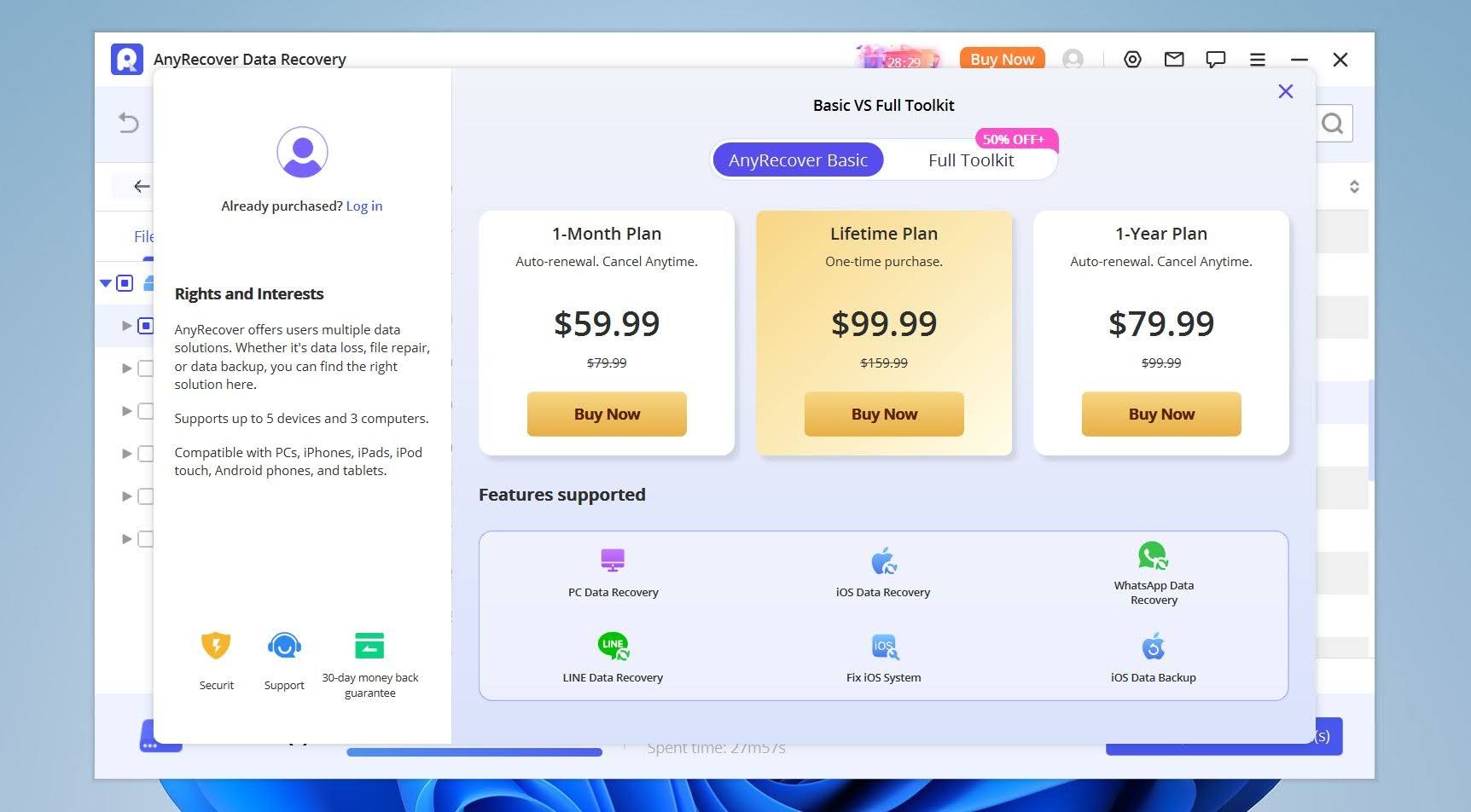
Once you get close to actually recovering files, the software suddenly remembers it would really like you to become VIP. Full preview? VIP. Unlimited recovery? VIP. Try to click something interesting? Hello, discount banner. During our tests, popups and “limited-time” offers showed up more than once, especially when previewing files or selecting them for recovery. It’s not subtle.
Test Results
On the 32 GB FAT32 drive, the full scan completed in 28 minutes, which is acceptable for a flash drive of this size. Out of 120 test files, AnyRecover detected 112 files. After recovery, 98 files were fully usable. Most JPG images and office documents opened correctly. A few ZIP archives were extracted without issues. However, several MP4 videos either failed to play or showed visible corruption during playback.
The original folder structure was only partially preserved. Some files were grouped correctly, but many appeared inside generalized “Deleted” or file-type categories rather than their exact original paths.
On the 128 GB exFAT drive, the full scan took just over one hour. For a formatted 128 GB device, this duration is competitive and slightly faster than some other recovery tools we have tested under similar conditions. Out of the same 120 test files, AnyRecover detected 105 files. However, only 79 files were fully usable after recovery.
Images recovered at a moderate success rate, though some lost metadata. Office documents had mixed results. Video files were the most problematic: several detected MP4 files either would not open or stopped playback halfway through. In this formatted scenario, the original folder structure was not preserved at all. Files were reorganized purely by type.
Pricing
AnyRecover no longer sells completely separate licenses for Windows, Mac, iOS, and Android as standalone products in the traditional sense. Instead, it now presents two tiers inside the same ecosystem: AnyRecover Basic and Full Toolkit. The Basic version focuses on core recovery functionality for desktop and selected mobile scenarios.
| Plan | Discounted Price | Regular Price | Devices Supported | Key Notes |
|---|---|---|---|---|
1-Month Plan |
$59.99 |
$79.99 |
3 mobile devices + 2 PCs |
Auto-renewal, cancel anytime |
1-Year Plan |
$79.99 |
$99.99 |
3 mobile devices + 2 PCs |
Auto-renewal, better value than monthly |
Lifetime Plan |
$99.99 |
$159.99 |
5 mobile devices + 3 PCs |
One-time purchase, lifetime upgrades & support |
All plans include:
- PC Data Recovery
- iOS Data Recovery
- WhatsApp Data Recovery
- LINE Data Recovery
- iOS System Fix
- iOS Data Backup
Basic focuses primarily on computer recovery and iOS-related workflows. It does not include Android recovery or AI repair features.
At first glance, the pricing seems excellent for the number of features offered. It is a versatile solution, but it lacks the deep algorithms that separate top-tier recovery tools from general-purpose utilities. AnyRecover is good at many things, but it is not outstanding in any single category.
Another important limitation is evaluation before purchase. The free version does not allow real recovery, and preview access is restricted. Users cannot fully verify file integrity or test complete recovery results before paying. Many competing tools either allow limited free recovery with a size cap or provide unlimited previews so users can properly assess performance. With AnyRecover, it is difficult to accurately judge recovery quality without committing financially.
For users who want an all-in-one solution, the price can make sense, especially with the Lifetime plan. For users who prioritize maximum recovery depth and advanced technical performance, more specialized tools may deliver stronger results.
User Feedback
At first glance, AnyRecover’s Trustpilot score looks strong, with an overall rating of 4.7/5. A closer look shows that many positive reviews focus on customer service rather than raw recovery power.
For example, one user writes:
“The response of my request was fast and accordingly. The process was so smooth, Kathy was very helpful and made me the refund and reordering for another product in an easy way.”
Another reviewer shares:
“I purchased this product to recover my files… Thankfully this app was a lifesaver. I was able to recover all of my files!! Thank you!”
There are also multiple comments praising support representatives by name for quick replies and polite communication. In several cases, even when recovery failed, users still gave high ratings due to responsive refund handling. The general pattern in positive feedback is clear: customer support is often described as fast, friendly, and professional. When issues arise, the company tends to respond publicly and offer assistance.
However, negative reviews focus on a different set of concerns. One Trustpilot user writes:
“It’s not a proper demo. They let you install the software and scan it for hours, just to let you know at the end that you have to pay to get your files.”
Reddit discussions tend to be more skeptical, especially among technically experienced users. In one thread, a commenter writes:
“This software is horrible… the amount of usable files that were recovered were maybe 30%… If you wanted to repair a file, you have to purchase a different app for that.”
Across platforms, the divide is consistent. Positive reviews often highlight helpful support and successful simple recoveries. Negative reviews focus on unusable recovered files, refund negotiations, subscription confusion, and limited trial functionality.
How AnyRecover Compares to Other Data Recovery Tools
AnyRecover does not compete as a narrow, technical recovery utility. It competes as a multi-purpose recovery platform. To understand its real position in the market, it makes sense to compare it directly with tools that focus primarily on recovery depth rather than feature variety.
Below is a structured comparison with several widely used recovery solutions.
| Feature / Tool | AnyRecover | Disk Drill | MiniTool Power Data Recovery | DiskGenius | PhotoRec |
|---|---|---|---|---|---|
Free Recovery |
No |
Yes (100 MB on Windows) |
Yes (limited 1 GB) |
Very limited (files <64 KB) |
Yes (fully free) |
Preview Before Purchase |
Limited |
Full preview |
Full preview |
Limited preview |
No preview |
Deep Scan Control |
Automatic only |
Advanced control |
Basic control |
Advanced + custom signatures |
Signature-based only |
Disk Imaging (Byte-to-Byte) |
No |
Yes |
No |
Yes |
No |
AI Repair Tools |
Yes (Full Toolkit only) |
No |
No |
No |
No |
Advanced Diagnostics (S.M.A.R.T., hex view) |
No |
Yes |
No |
Yes |
No |
Overall Recovery Depth |
Moderate |
Strong |
Moderate |
Strong |
Strong (raw recovery) |
When evaluating raw recovery depth and technical flexibility, tools like Disk Drill and DiskGenius offer stronger control. They provide disk imaging, more transparent scan modes, and advanced diagnostics that help in complex recovery cases. They also allow users to test functionality before committing financially.
MiniTool Power Data Recovery sits closer to AnyRecover in simplicity but still offers limited free recovery for testing. PhotoRec remains a powerful free option for signature-based recovery, though it lacks a graphical interface and preview functionality.
Note: To know more, check our list of the best AnyRecover alternatives.
Verdict
AnyRecover is a good tool, if you’re ready to pay upfront. It offers a broad feature set, covers desktop and mobile recovery, and presents everything in a clean, beginner-friendly interface. However, the weaknesses are hard to ignore.
There is no free recovery. You cannot properly test real restoration before purchase. Some features advertised in the interface require the Full Toolkit or even separate downloads. Recovery depth is moderate rather than exceptional, especially in complex cases such as fragmented videos or heavily corrupted partitions. Advanced utilities like disk imaging, S.M.A.R.T. monitoring, RAID reconstruction, and deep scan customization are missing.
There are stronger alternatives available. If your priority is actual recovery depth, transparency, and the ability to test before you pay, we recommend Disk Drill. It offers limited free recovery on Windows, disk imaging, better advanced controls, and stronger consistency in complex scenarios.
Our Rating: 4.0/5
Pros
- Broad feature coverage (desktop + mobile + messaging)
- Clean, guided interface suitable for beginners
- Bootable media creation for crashed systems
- Responsive customer support (based on many user reviews)
- Lifetime license option available
Cons
- No free recovery at all
- Limited preview functionality
- Recovery depth is moderate
- Many features locked behind Full Toolkit tier
- AI repair requires additional download or higher license
- No disk imaging or S.M.A.R.T. monitoring
- No RAID or advanced low-level tools
- Frequent upgrade prompts during recovery
FAQ
Where can I get the full version of AnyRecover?
You can purchase and download the full version directly from the official AnyRecover website. The site lets you choose between the Basic and Full Toolkit plans before checkout.
Is AnyRecover any good?
AnyRecover is a solid all-in-one recovery tool, especially for beginners or users who want a combined desktop + mobile recovery experience. It covers PC drives, iOS and Android devices, messaging apps, and even offers AI repair tools.
However, in real-world use its recovery depth is moderate, and it often struggles with harder cases like severely corrupted files or fragmented videos. Some advanced recovery tools deliver better results in complex scenarios. Additionally, you must pay before you can genuinely test its recovery performance, unlike many competitors.
Is AnyRecover free?
No. AnyRecover does not offer free recovery of files. You can scan and preview limited results in the trial, but actual file restoration requires a paid plan. This makes it hard to test the software fully before purchase.
What is the price of AnyRecover?
AnyRecover pricing is tiered. At minimum there is a Basic license (monthly, yearly, or lifetime) for core recovery and iOS tools. The Full Toolkit tier adds Android recovery, cloud backup, and AI repair modules and is more expensive. Prices vary depending on the plan and promotional discounts.
Is AnyRecover safe?
Yes, the software itself is generally considered safe to install; it is widely distributed and does not contain malware. However, some users report antivirus warnings for false positives, which is common with recovery utilities. Make sure you download AnyRecover only from the official website to avoid bundled adware or unofficial copies.
Is AnyRecover legit?
Yes, AnyRecover is a legitimate data recovery program available for Windows and macOS. However, recovery results depend on the condition of the storage device, whether the lost data has been overwritten, and the type of data loss. It is best to scan the device and preview recoverable files before purchasing a license.
How to use AnyRecover?
To use AnyRecover, install and open the program, select the drive or storage device that contained the lost files, and start a scan. Once the scan finishes, browse or filter the results and preview the files you want to restore. Select the files you need, click Recover, and save them to a different drive to avoid overwriting recoverable data.
This article was written by Princess Lescan, a Staff Writer at Handy Recovery Advisor. It was also verified for technical accuracy by Andrey Vasilyev, our editorial advisor.
Curious about our content creation process? Take a look at our Editor Guidelines.