

Tenorshare 4DDiG markets itself as a reliable data recovery app for various use cases. It’s one of the few options on the market that requires users to pay before they can recover even a single file, and we’re not entirely surprised. After all, data recovery can certainly get pricey.
But do its performance and features justify the price tag? We tested the software on real hardware and common data loss scenarios to make this Tenorshare 4DDiG review realistic. Below, you’ll see what it actually offers, from features and pricing to extra tools and real user feedback, so you can decide whether it’s worth paying for. Let’s get started!
TL;DR: Tenorshare 4DDiG is an easy-to-use recovery tool with useful extras such as disk imaging, bootable recovery, and media repair, but our tests showed mixed performance. It found 117/120 deleted files on our USB drive, but only 71/120 after a quick format, while the preview worked for just a handful of files. Scans were also relatively slow, with a 32GB USB drive taking 28 minutes.
Overall, 4DDiG is adequate for basic deleted-file recovery, but its weak previews and sharp performance drop after formatting make it harder to recommend for more difficult cases. Disk Drill is our preferred alternative, with more advanced recovery features, S.M.A.R.T. monitoring, disk imaging, and up to 100 MB of free recovery on Windows.
Want to help make our content better? Please vote for the best alternative to Tenorshare 4DDiG:



Main Features of Tenorshare 4DDiG Data Recovery
Tenorshare 4DDiG presents itself as a powerful all-in-one recovery tool, and the official website highlights bold numbers like “99% Recovery Rate” and “5 min Average Recovery Time.” These kinds of claims sound impressive, but in the data recovery industry, they are usually marketing statements.
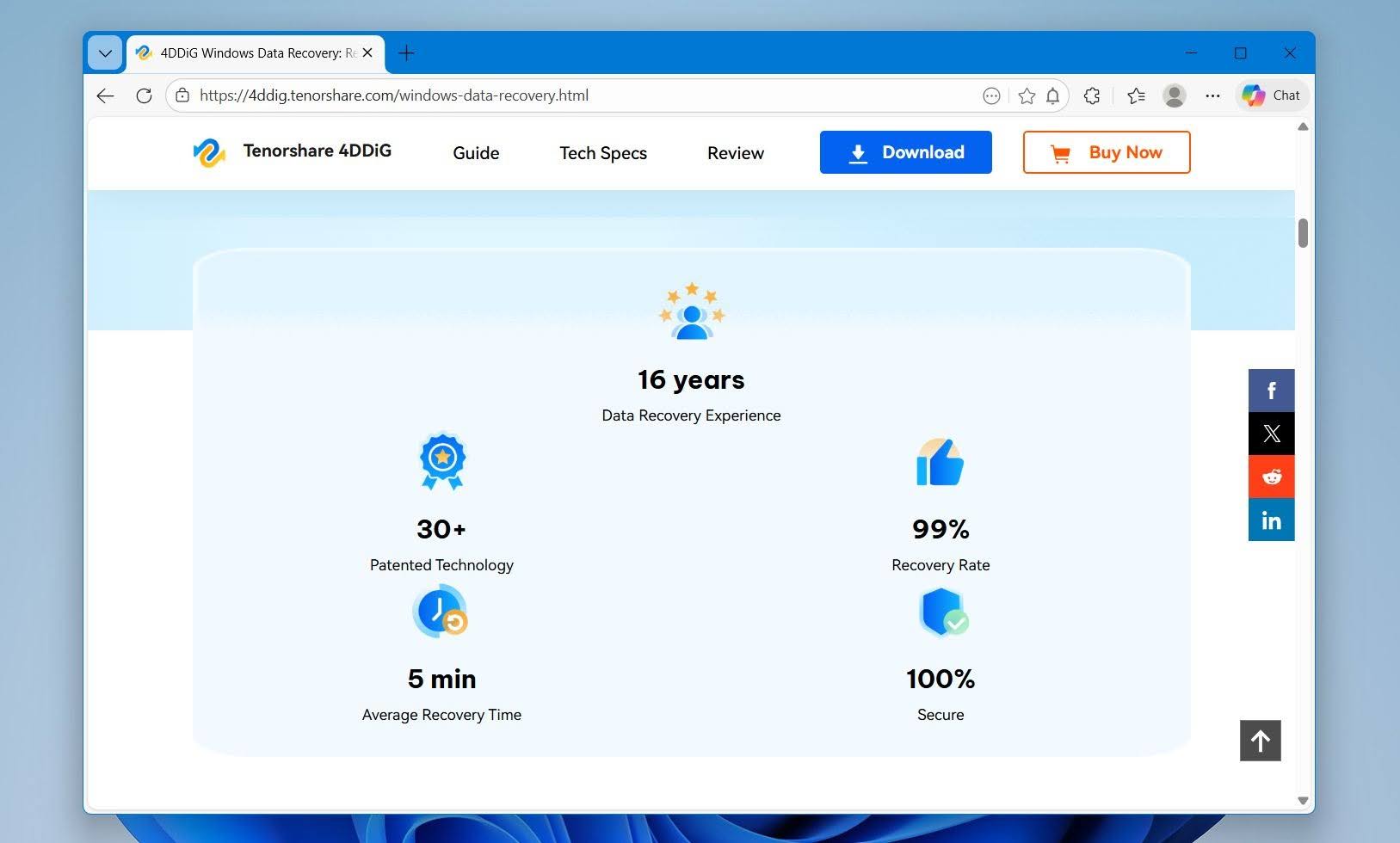
We’ll put those claims to the test in our evaluation. But in general, percentages like “99% recovery rate” and fixed time estimates are rarely backed by transparent, real-world data. In data recovery, results are highly case-dependent, and no tool can realistically guarantee near-perfect success or universal five-minute recovery times across different scenarios.
With that in mind, let’s take a closer look at what the tool actually promises.
Free Scan + No Free Recovery
4DDiG allows you to scan your storage device for free and preview found files before upgrading. This part is important because no recovery software can promise results without first scanning the drive.
However, despite what the website suggests about 2GB of free recovery, in practice, the free version mainly functions as a preview tool. You can scan and see what’s recoverable, but actually restoring files beyond a small limit requires upgrading to a paid plan. So while the 2GB figure sounds generous, it doesn’t fully translate into unrestricted recovery.
4DDiG Applications and Compatibility
This software can recover deleted files on Windows and files that have been lost due to formatting, computer crashes, lost partitions, and corrupted hard drives. Moreover, Tenorshare 4DDiG also boasts that it can recover more than 1000 different data types for you, including various photo, video, audio, document, and archive files. It’s not as versatile as competing software that also supports data recovery from Android and iOS, but it should work well in recovering files from flash drives, external hard drives, SD cards, and computers.
Quick Scan + Deep Scan (Automatic)
Tenorshare 4DDiG includes both quick and deep scanning modes. Quick scan targets recently deleted files that are still marked as recoverable, while deep scan performs a full sector-level scan to locate files by structure and signature.
However, you don’t manually choose between them. When you click “Scan,” the software starts with a quick scan and automatically transitions into deep scan if needed. This simplifies the process for beginners, but advanced users might prefer more control over scan types and depth.
Not sure what the real difference between Quick and Deep Scan is? We recommend reading this community discussion where users and our specialists break down how both modes actually work behind the scenes and when each one makes sense.
Extra Features
Beyond standard file recovery, 4DDiG includes a few additional tools that aim to make it feel more “all-in-one”:
- 4DDiG includes a built-in media repair tool that lets you attempt to fix corrupted photos and videos after recovery. It supports common formats like JPG, MP4, MOV, and several camera-based files. The tool can repair certain structural issues (such as damaged headers), but it won’t restore lost image quality, remove blur, or fix heavy pixelation. If the file data itself is missing or fragmented, repair options are limited.
- Recent versions allow users to create and scan disk images. This can help protect unstable drives by avoiding repeated direct scans on failing hardware. It’s a useful addition, but the imaging tools remain fairly basic compared to advanced forensic-grade recovery software.
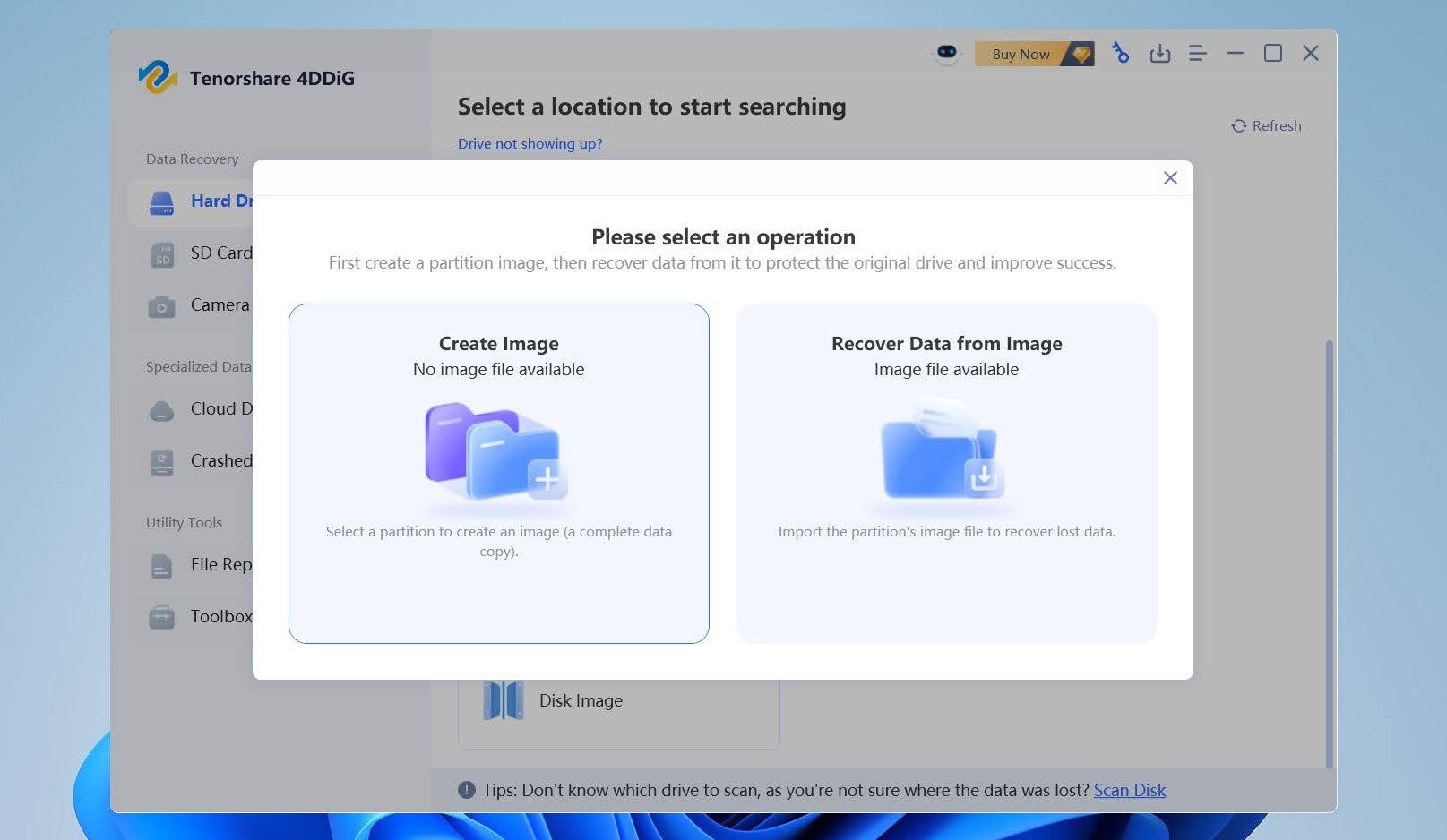
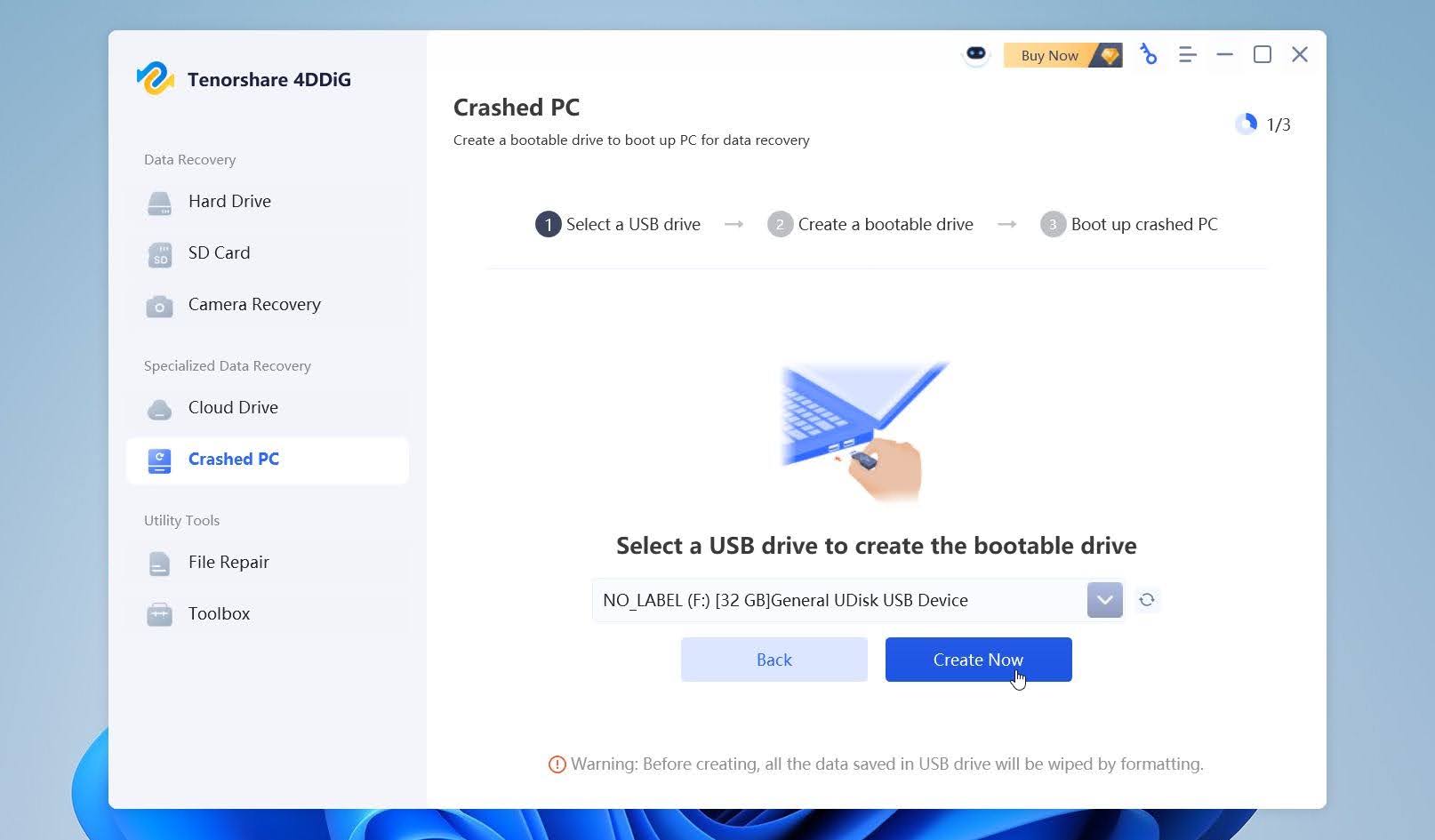
- 4DDiG can create a bootable recovery disk, which is helpful if Windows won’t start. This allows you to access your drive and attempt recovery outside the operating system. It’s a practical feature for home users dealing with crashes or startup failures.
- The software includes limited support for recovering files from cloud services like OneDrive and Dropbox. It attempts to restore lost data from synchronized cloud storage, but it does not replace full version history or backup systems. Recovery still depends on how the cloud platform handled the deletion.
Overall, these extra features add some practical value and make 4DDiG more versatile than a bare-bones recovery tool. The media repair option and bootable recovery support are especially useful for everyday users. At the same time, none of these additions feels particularly advanced. They cover common scenarios, but they don’t push the software into professional territory.
How We Tested Tenorshare 4DDiG
To keep things fair and consistent, we tested 4DDiG on real hardware using the same data set across all scenarios. All recovery tests were performed on a Windows 11 laptop, since this review focuses on the Windows version of the software.
We used two storage devices:
32GB SanDisk Ultra USB 3.0 flash drive (exFAT)
- In Scenario 1, files were deleted normally (Shift+Delete, bypassing Recycle Bin).
- In Scenario 2, the same drive was quick formatted in exFAT after copying the test data.
500GB Western Digital (WD) My Passport external hard drive (NTFS). Files were deleted permanently (Recycle Bin emptied).
We chose exFAT for the USB drive because it’s commonly used for flash drives and SD cards, while NTFS reflects typical Windows external storage.
To make the results comparable, we copied the exact same data set onto both devices before each test. The data set contained 120 files (around mixed real-world content), including:
- Photos: JPG, PNG, Canon CR2 (RAW), Nikon NEF
- Videos: MP4 (H.264), MOV
- Documents: DOCX, XLSX, PDF, TXT
- Audio: MP3, WAV
- Archives: ZIP, RAR
This mix allowed us to evaluate how well 4DDiG handles common file types, along with a few RAW formats and compressed files.
4DDiG Data Recovery Process
Some Tenorshare 4DDiG reviews call it one of the best recovery tools out there. But what does actually using it feel like? Here’s how the process goes:
- Head to the official website (or the Microsoft Store if you’re on Windows) and download the installer. It’s lightweight and doesn’t try to bundle random extras. Installation takes just a couple of minutes, and you don’t need to create an account just to start scanning.
- Once installed, open the app, and you’re greeted with a beginner-friendly layout.
- When 4DDiG launches, it automatically lists your drives and common folders like Desktop or Recycle Bin. Just click the location where your files were lost. Hit Scan, and you’re off.
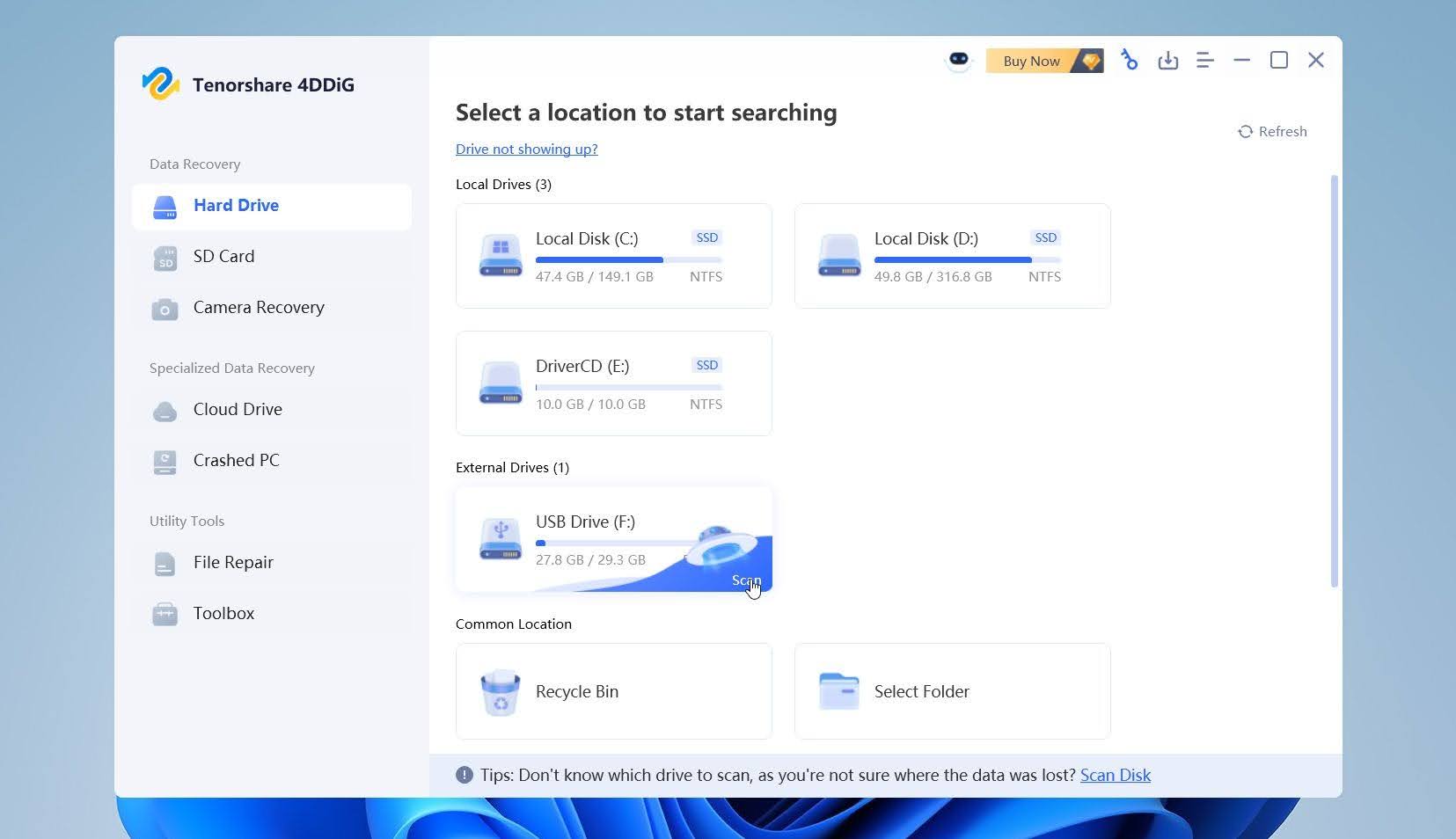
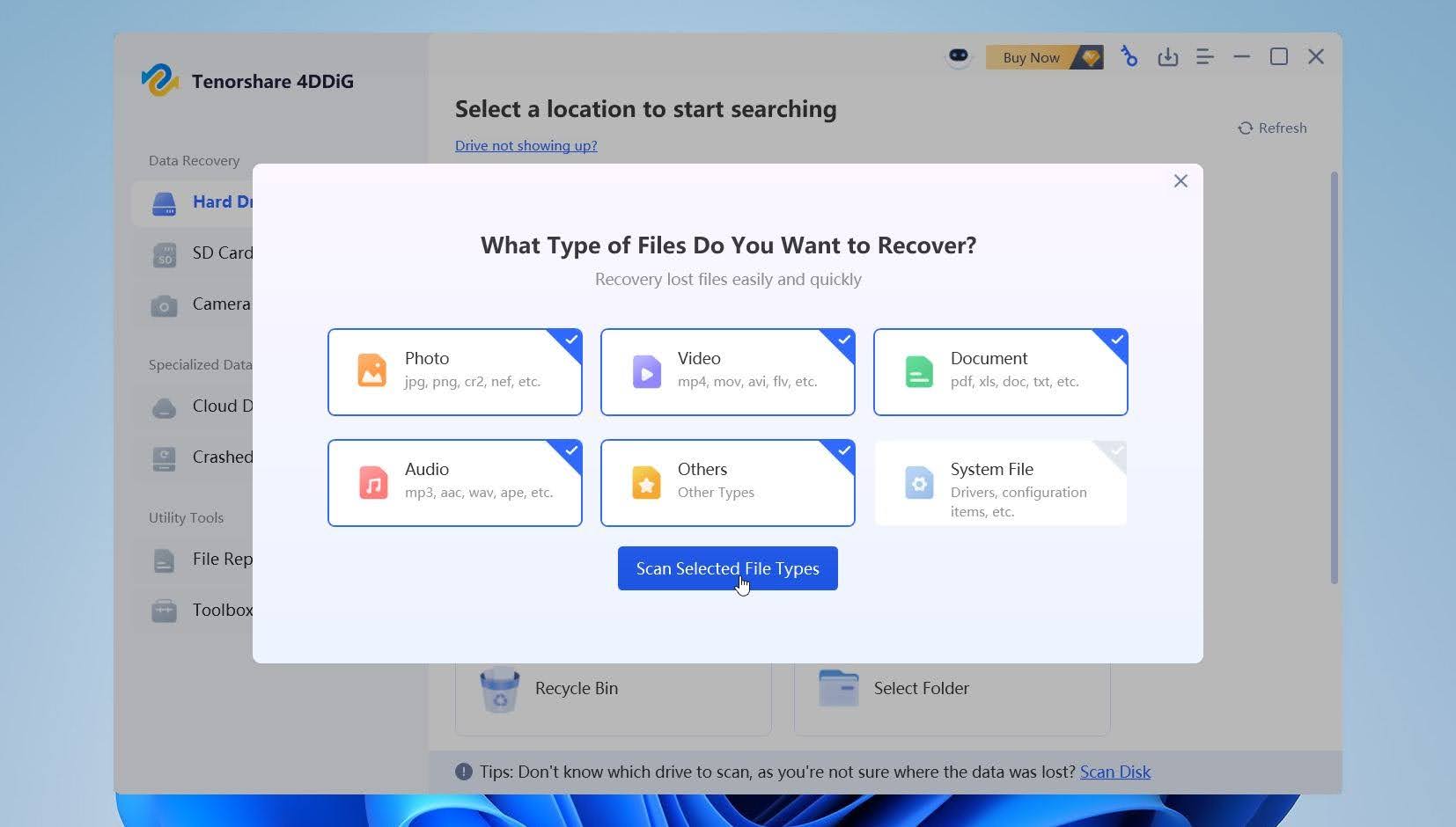
- Before the scan starts, you can select specific file types like photos, videos, documents, etc. This can make things a little faster if you know exactly what you’re looking for. Most people will probably just leave everything checked. The scan begins automatically. You don’t get to choose between a quick or deep scan; it just runs both in sequence. It keeps things simple, but you don’t have much control either.
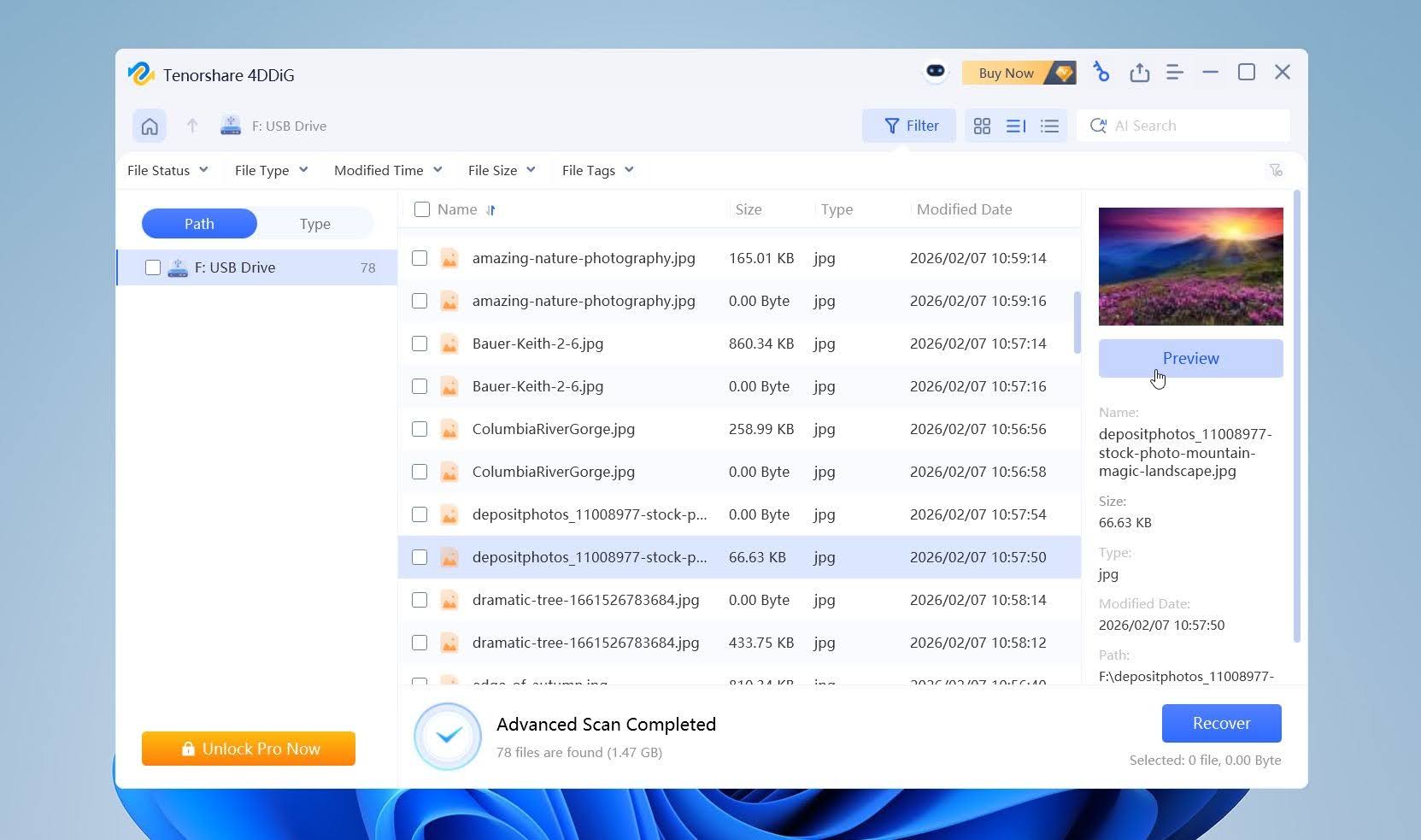
- You can use filters at the top to narrow things down by file type or date. Preview is important because recovered files often don’t keep their original names or folder structure. Unfortunately, this is also where things can get frustrating. Sometimes previews take a long time to load, and sometimes they don’t load at all.
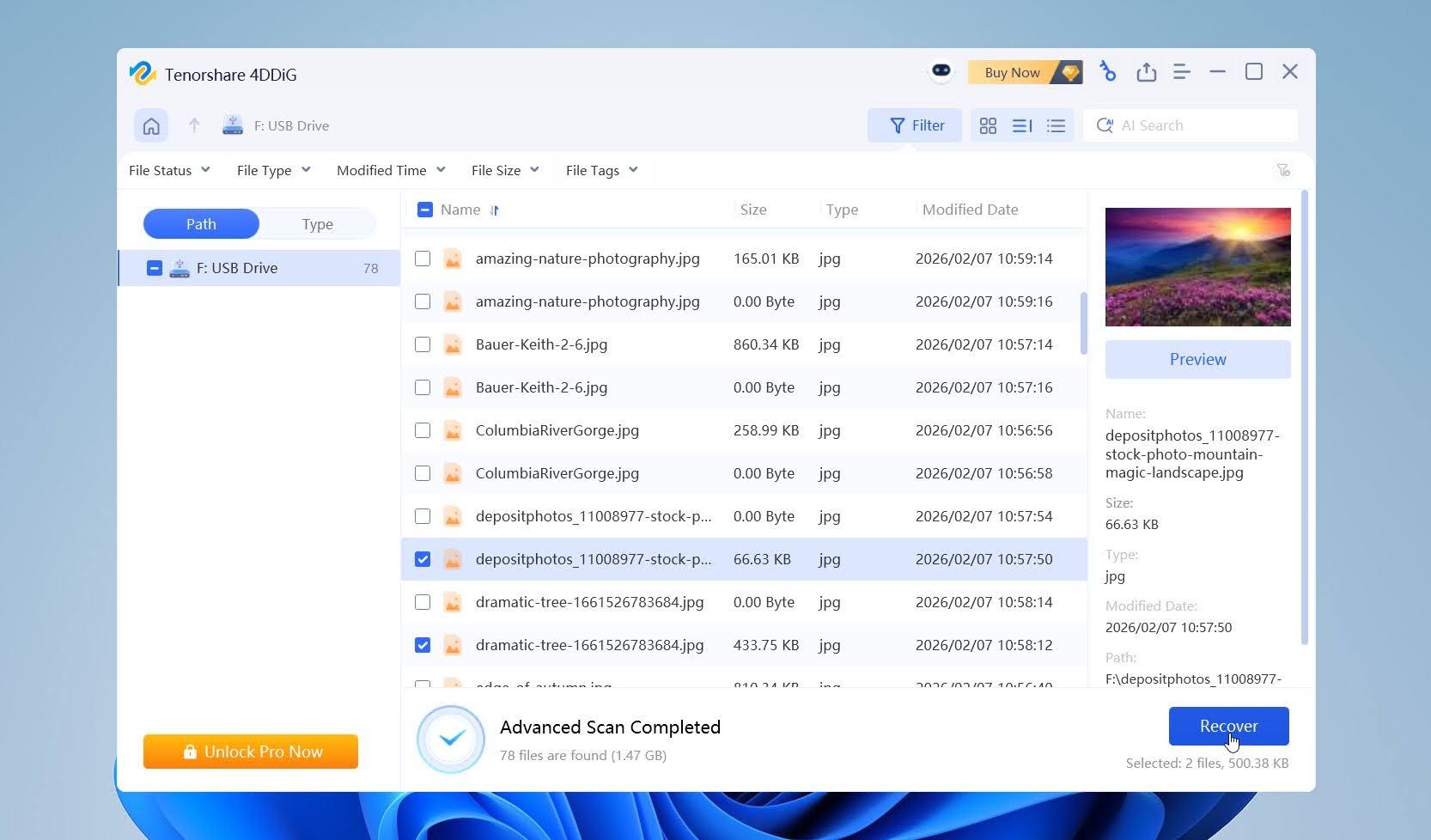
- Once you find what you need, select the files and click Recover. Make sure to save them to a different drive (not the one you’re recovering from).
Test Results
The full scan of the 32GB USB drive took 28 minutes, which honestly feels long for a relatively small flash drive with only 120 test files.
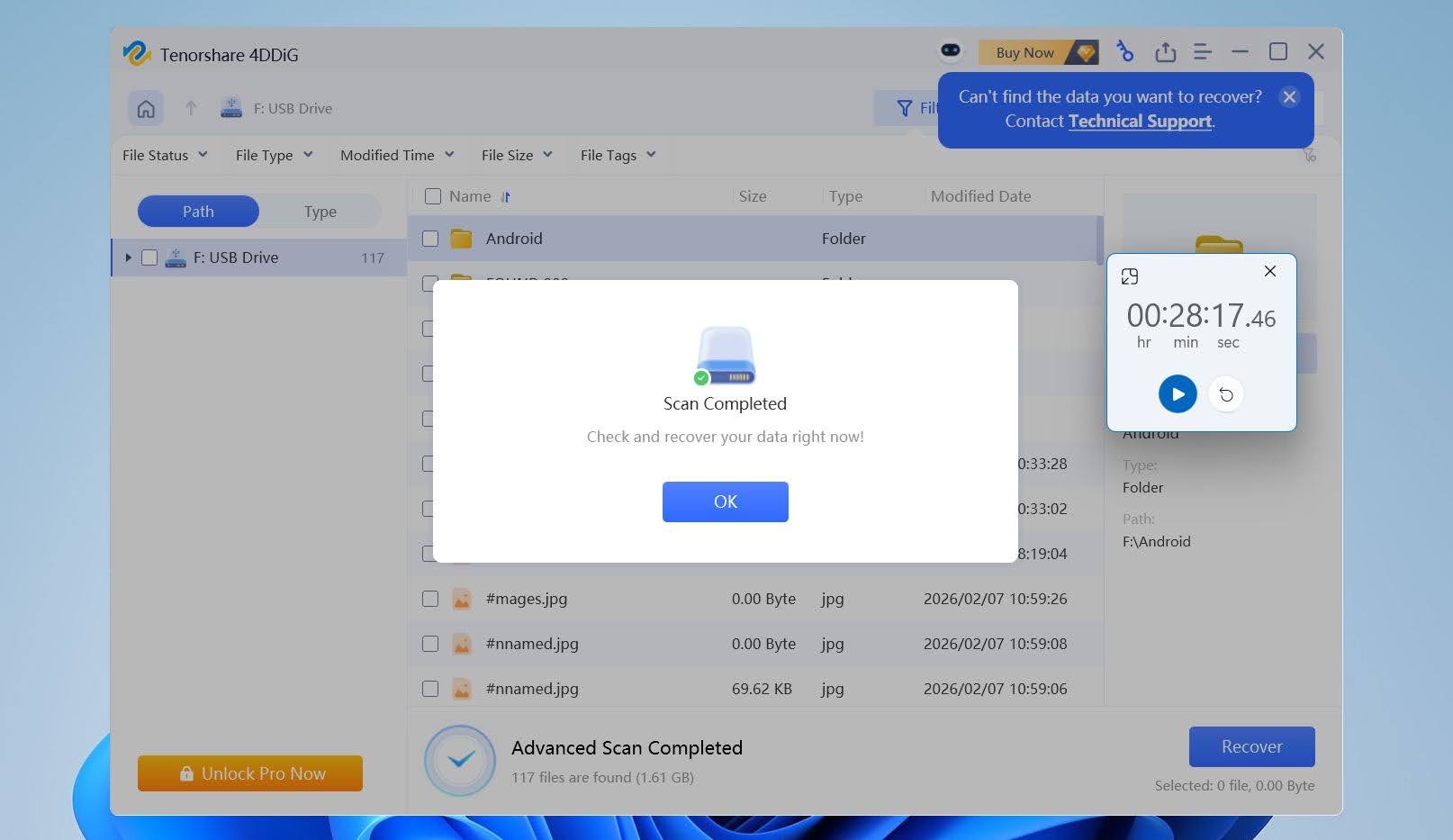
Out of the 120 deleted files, the software detected 117 files. At first glance, that sounds decent. However, preview functionality was a major issue. Only 2 image files actually loaded in preview. The rest either showed a loading screen or failed to render at all. Since many filenames were missing, preview becomes important, and when that fails, it slows down the decision process a lot.
After quick formatting the same drive and repeating the test, results dropped noticeably. This time, 4DDiG detected 71 out of 120 files. RAW photo formats were inconsistent, and several files were partially restored but unusable. Preview behavior did not improve. Again, only a couple of images were successfully rendered, and most previews failed or stalled.
On the larger 500GB NTFS external hard drive, we tested permanent deletion only. Since this was a healthy NTFS drive with no formatting or corruption involved, expectations were higher. The scan took noticeably longer due to the drive size, around 43 minutes, even though only 120 files had been deleted. 4DDiG detected 109 out of 120 files. That’s the best result among our scenarios.
Preview worked slightly better here compared to the USB drive, but still not consistently. Some standard JPGs and documents loaded correctly. Larger video files were hit or miss. Recovered files from this test were generally more usable than in the formatted USB scenario. Common document and image formats came back intact. However, several RAW files were either missing or partially corrupted.
Post-Testing Tenorshare 4DDiG Review
4DDiG handled simple deletion on a healthy NTFS drive reasonably well. Once formatting entered the picture, recovery rates dropped, and usability became less consistent. The biggest weak point across all scenarios was preview reliability and scan time. For a 32GB USB drive to take 28 minutes and still struggle with previews raises questions about optimization.
It works, especially in basic cases. But performance and consistency clearly depend on the situation.
Tenorshare 4DDiG pricing
Tenorshare 4DDiG data recovery uses a subscription-style pricing model, with monthly, yearly, and lifetime options for Windows users. The monthly and lifetime licenses cover 1 PC, while the yearly plan is also available for 5 or 10 PCs. Prices listed below exclude tax, and the company frequently advertises discounts, so the “original” price is often shown crossed out:
| Plan | Current Price | Original Price | License Duration | Upgrades Included |
|---|---|---|---|---|
1 Month License |
$45.95 |
$89.95 |
1 PC / 1 month |
1-month free upgrades |
1 Year License |
$59.95 |
$99.95 |
1 PC / 1 year |
1-year free upgrades |
Lifetime License |
$79.95 |
$119.95 |
1 PC / lifetime |
Lifetime free upgrades |
The monthly plan feels expensive unless you only need it once and recover everything in a single session. The yearly option makes more sense if you expect future data issues. The lifetime license is the most reasonable long-term choice, especially since it includes lifetime upgrades, but it’s still tied to one PC only.
That said, while the pricing isn’t outrageous, it’s not cheap either. Considering the competition in this space, you’re paying mid-range pricing for mid-range performance. If you only need to recover a small amount of data, the free version (with its recovery limit) may be enough. But for larger jobs, you’ll need one of these paid plans.
How 4DDiG Compares to Popular Recovery Tools
To give you a better idea of where Tenorshare 4DDiG stands, we decided to compare it with some of the most popular data recovery tools on the market.
| Tool | Best For | Free Recovery | Advanced Features | Our Take |
|---|---|---|---|---|
Tenorshare 4DDiG |
Beginners, simple deletions |
Scan + limited preview |
Bootable media, basic disk imaging, media repair |
Easy to use, but preview issues and no real free recovery make it mid-range overall |
Disk Drill |
Home users & advanced cases |
Up to 100 MB (Windows) |
Disk imaging, S.M.A.R.T., partition search, better RAW support |
More reliable and technically mature; better value |
R-Studio |
Professionals & RAID recovery |
Demo (recovery size limited, recovers files <1024 KB) |
RAID rebuild, custom signatures, hex view |
Powerful but complex; aimed at specialists |
Recuva |
Simple recent deletions |
Free version available |
Basic deep scan |
Lightweight and accessible, but limited in complex cases |
After comparing the tools side by side, it becomes clearer where each one fits, and which alternative makes the most sense for most users.
- Disk Drill is the most balanced alternative to 4DDiG. It allows up to 100 MB of actual free recovery on Windows, not just preview, which reduces purchase risk. It generally delivers stronger results on formatted, RAW, and partially corrupted drives. Features like disk imaging, S.M.A.R.T. monitoring, Advanced Camera Recovery, and lost partition search give it an edge in more complex situations, while the interface remains beginner-friendly.
- R-Studio is another good solution with RAID reconstruction, custom file signatures, and hex-level diagnostics. Powerful, but clearly aimed at technicians and advanced users rather than everyday recovery scenarios.
- Recuva is a lightweight free option that works well for recent deletions on healthy drives. However, it struggles with formatted disks, RAW partitions, and deeper corruption cases, and lacks modern optimization and advanced tools.
Tenorshare 4DDiG Reviews from Real Users
We checked Trustpilot, G2, and multiple Reddit threads, and can say that Tenorshare 4DDiG has a very mixed public perception. The overall impression is that it works well for simple recovery cases, especially deleted photos or SD card files, but becomes much more controversial when users deal with complex recovery situations, licensing limits, or refund policies.
Most discussions describe it as a mid-range recovery tool that performs fine in basic scenarios and less impressively in advanced ones.
On Trustpilot, for example, user Taoufik Hassan left a 5-star Tenorshare 4DDiG review, saying:
“My experience was good with the company. I had the chance to get back memories from my damaged SD card.”
This reflects a common theme in positive reviews: recovery of deleted or damaged SD card data, straightforward process, and relief after getting files back.
While the tool isn’t a malware, it’s also not universally trusted. On the same platform, user wiseman left a 1-star review stating:
This is the worst data recovery software I have ever encountered, BAR NONE! This is ransomware packaged to appear legitimate.”
His complaint focused on the slow recovery progress on a 128GB drive and frustration around payment before actual recovery. Reviews like this usually center around expectations vs. limitations rather than proven malicious behavior.
On G2, where the overall rating sits high at 4.8/5, the tone is generally more positive, but not without criticism. For instance, Patrick S. (President, Small Business) wrote:
“Scummy company that embodies the Enshitification movement.”
Interestingly, he admitted the software “did a fine job of recovering files,” but strongly criticized the lifetime license being locked to a single PC and not easily transferable.
Reddit discussions tend to be more technical and somewhat balanced. In one thread asking if 4DDiG is malware, user Micronlance commented:
They’re definitely not a virus or malware, but they’re really bad at recovering data, even compared to free programs.”
That kind of opinion shows up frequently: not malware, but not the strongest performer either. Some users also report high RAM usage during scans, especially on older systems with 8GB of memory, which sometimes leads to confusion about system slowdowns.
Verdict
Tenorshare 4DDiG looks easy to use, but once you dig deeper, it’s pretty average. It handles simple deletions fine, yet struggles with tougher cases like corrupted drives or RAW photo formats. File names and folder structure are often lost, and important features like S.M.A.R.T. monitoring and lost partition search are missing.
Rating: 3.4/5
Pros
- Beginner-friendly interface and simple recovery workflow
- Good results with recently deleted files
- Built-in disk imaging
- Bootable recovery option for computers that won’t start
- Photo and video repair tools
- Supports a broad range of common file types and storage devices
Cons
- Recovery results dropped sharply after formatting
- File preview was very unreliable in our tests
- Relatively slow scans
- RAW photo recovery was inconsistent
- Limited control over scan modes
- No S.M.A.R.T. monitoring or advanced lost-partition tools
- Paid plans are relatively expensive for the recovery performance offered
If you want something more reliable, Disk Drill is a better pick. It usually recovers more data, includes disk imaging and S.M.A.R.T. tools, and even lets you restore up to 100 MB for free on Windows. For more reviews and recommendations, you can also check our list of the best data recovery tools and compare options side by side.
FAQ
What is Tenorshare 4DDiG?
Tenorshare 4DDiG is a data recovery and repair tool designed to restore deleted, formatted, or corrupted files from various storage devices. It claims to support over 1,000 file types, including documents, photos, videos, audio files, and archives. The software works with computers, laptops, external hard drives, USB flash drives, memory cards, and some RAID setups.
How do I use 4DDiG?
Here is how to recover files using Tenorshare 4DDiG:
- Download and install the application on your computer.
- Launch the program and select the drive or location where your files were lost.
- (Optional) Choose specific file types to speed up the scan.
- Start the scan. The tool automatically performs both quick and deep scanning.
- Preview the found files.
- Select the files you want to restore and click Recover.
- Choose a different storage location to save the recovered files to avoid overwriting data.
The interface is beginner-friendly and walks users through the process step by step.
Is Tenorshare 4DDiG free?
Tenorshare 4DDiG is not truly free. The free version allows you to scan your drive and preview recoverable files, but it does not provide full data recovery without payment. Although the website promotes free recovery, the trial mainly functions as a detection and preview tool. To actually restore files without restrictions, you need to upgrade to one of the paid plans.
How much does 4DDiG cost?
Tenorshare 4DDiG offers several pricing plans (tax excluded), depending on how much recovery access you need:
- The 1 Month License, priced at $45.95, provides unlimited data recovery for one PC. It includes 24/7 technical support, a 30-day money-back guarantee, and one month of free upgrades during the license period.
- The 1 Year License, currently priced at $59.95 (discounted from $99.95), covers one PC for a full year. It includes unlimited data recovery, 24/7 technical support, a 30-day money-back guarantee, and one year of free upgrades. This plan sits in the middle and makes more sense if you expect to use the software more than once but don’t need lifetime access.
- The Lifetime License, currently discounted to $79.95, offers unlimited data recovery for one PC with lifetime free upgrades. Like the monthly plan, it includes 24/7 technical support and a 30-day money-back guarantee, making it the more cost-effective option for long-term use.
Is Tenorshare 4DDiG safe?
Yes, Tenorshare 4DDiG is generally safe to use when downloaded from the official website. It is a legitimate product developed by Tenorshare, a company operating since 2007. The software does not contain malware, and it provides a money-back guarantee for paid plans.
Does 4ddig file repair work?
Yes, 4DDiG File Repair can repair some corrupted photos, videos, documents, and audio files, but success depends heavily on the type and extent of the damage. It can be useful when a file is partially corrupted or has a damaged structure, but it cannot reconstruct data that is completely missing or overwritten. For severely damaged files, repair results may therefore be incomplete or unsuccessful.
Can 4DDiG recover deleted photos?
Yes. 4DDiG Data Recovery can recover deleted photos from hard drives, SSDs, USB drives, memory cards, and other supported storage devices. Recovery success depends on whether the deleted data has been overwritten and, with SSDs, whether TRIM has already cleared it. For the best chance of recovery, stop using the affected drive and save any recovered photos to a different device.
This article was written by Christelle Africa, a Author at Handy Recovery Advisor. It was also verified for technical accuracy by Andrey Vasilyev, our editorial advisor.
Curious about our content creation process? Take a look at our Editor Guidelines.