

Puran File Recovery is a lightweight software for recovering deleted or lost files from your PC. It looks rather old-school at first, but it still works just fine on the latest Windows OS. However, the official website hasn’t switched to HTTPS, which can give users the impression that the tool may be unsafe. That said, we didn’t find any security concerns with the app itself.
Puran’s data recovery utility can help you recover files for free. However, it’s not as popular as a lot of the other data recovery software out there, so we decided to take it for a spin, see how it performs, and share our Puran File Recovery review.
TL;DR: Puran File Recovery is a completely free, lightweight Windows recovery tool, but its age shows. It has a simple interface, several scan modes, and support for common Windows file systems, but it lacks many features found in modern recovery software.
More importantly, its recovery performance was disappointing. In our test, it found only 47 of 100 deleted files, and none of the detected files had a working preview. Its biggest advantage is unlimited free recovery for personal use, but if recovery results matter more than having a completely free tool, Disk Drill is our preferred alternative. It offers a more modern recovery engine, broader file system support, disk imaging, advanced scanning options, and much more reliable previews.
Want to help make our content better? Please vote for the best alternative to Puran File Recovery:



Main Features of Puran File Recovery
Puran File Recovery is a small Windows utility designed to restore deleted files from different storage devices. It belongs to the broader Puran Utilities suite, a collection of freeware tools that has been available for many years.
While its long presence in the utility space gives it some credibility, the program itself shows its age compared with modern data recovery software. Below are the main characteristics users can expect when installing and using Puran File Recovery.
An Easy-to-Use Interface
The interface of Puran File Recovery is extremely simple. All actions take place inside a single window where users select a drive, choose a scan mode, and review the results. This simplicity can make the tool approachable for beginners.
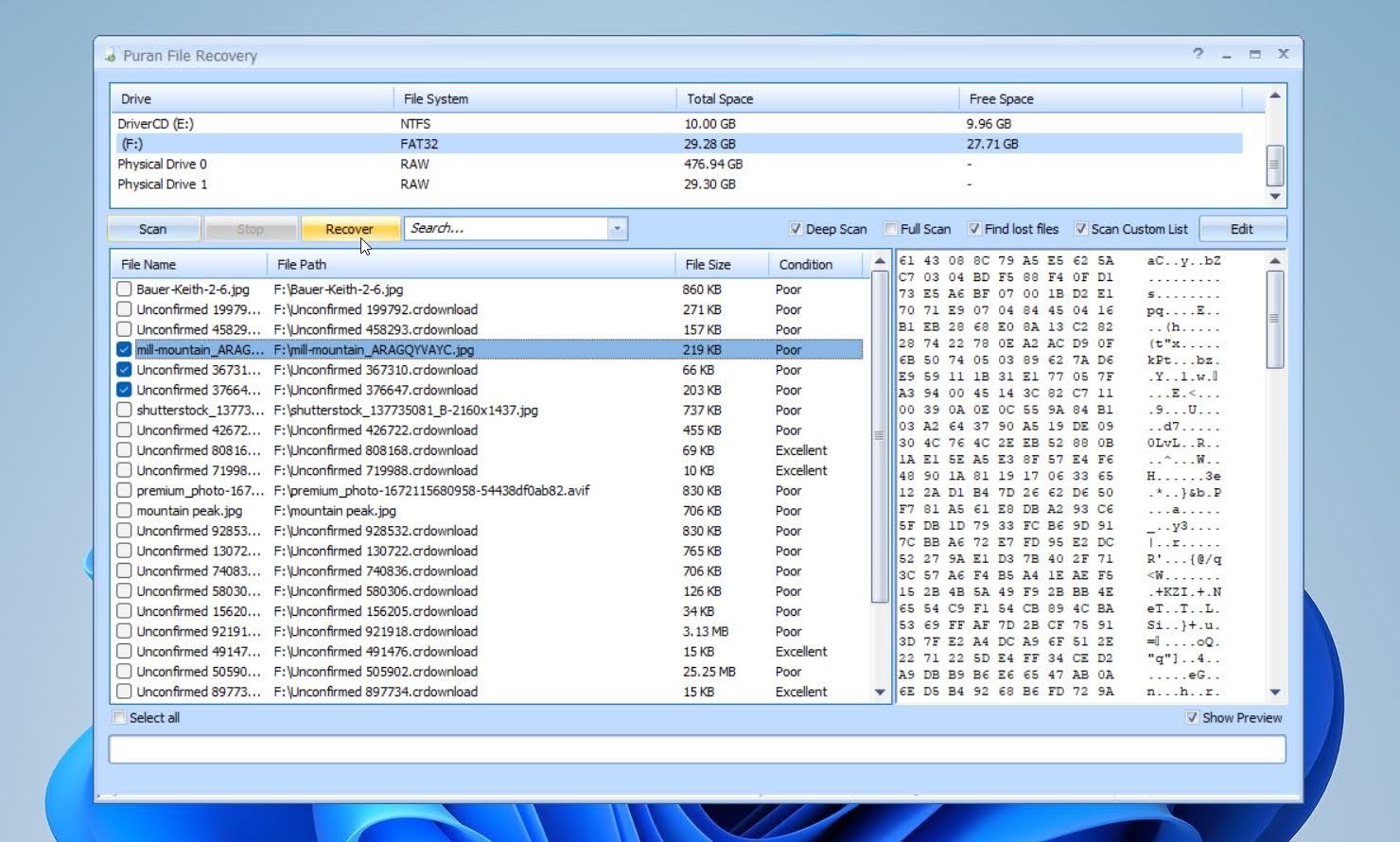
At the same time, the design feels outdated and lacks many conveniences found in modern recovery applications. Navigation options are minimal, and the program does not provide much guidance during the recovery process. Users who expect a more structured workflow or visual indicators during scanning may find the interface somewhat limited.
Scan Controls
Puran File Recovery offers three scan modes: Quick Scan, Deep Scan, and Full Scan.
- Quick Scan checks file records to locate recently deleted files.
- Deep Scan earches free space sector by sector and detects files based on file signatures.
- Full Scan attempts to locate lost partitions and recover files from formatted drives.
While these options sound good on paper, the scanning process itself lacks flexibility. The software does not allow users to pause scans or view results in real time. Once a scan begins, users must wait until it finishes or cancel it entirely. On large drives, this can make the process inconvenient.
Custom Scan List Feature
One of the more unusual features in Puran File Recovery is the Custom Scan List, which works only during deep scans. It allows users to select specific file types they want the scan to target. For example, users can choose formats such as PSD or DOC to limit the results.
The program also allows advanced users to manually define file signatures by specifying header and footer byte patterns. While this capability adds flexibility, it requires technical knowledge that most casual users will not have. As a result, the feature may remain unused by many people.
Supported File Formats, File Systems, and Operating Systems
Puran File Recovery can scan most devices that Windows detects as storage drives. You can recover documents, compressed files, photos, audio, and video files.
It also supports scanning RAW physical drives and all major file systems, including NTFS, exFAT, and FAT32. This means you can use the freeware utility to restore files from all devices, including hard drives, SSDs, SD cards, and flash drives.
We used the utility on Windows 11 and it worked perfectly fine. Also, the website mentions that Puran File Recovery helps recover data on Windows 10, Windows 8, Windows 7, Windows Vista, and Windows XP.
Search and Preview Options
After scanning, Puran File Recovery lists the detected files and allows users to search results using a basic search box that supports wildcard queries. The program can also preview some file types before recovery.
These features help identify the correct files before restoring them, but the preview system itself is fairly limited. Many modern tools provide richer previews and faster filtering options, which makes the process of locating specific files easier.
Portable Versions
Puran File Recovery provides portable versions for both 32-bit and 64-bit Windows systems, which means it can run without installation. This can be useful in certain troubleshooting environments such as WinPE.
How to Use Puran File Recovery
We scanned a drive with previously deleted files and followed the same steps a typical user would take. Below is the exact process we used with Puran File Recovery to find and restore those files during our tests.
Step #1: Download and install the utility
Download and install a file recovery tool on your device from its official website. If you decide to use the Puran File Recovery portable version, you’ll need to extract the files into a folder instead of installing the utility and run “Puran File Recovery.exe”.
Step #2: Scan the device
Once you launch the exe file, you’ll see a “Things you should know” window that gives you a brief overview of the tool’s features.
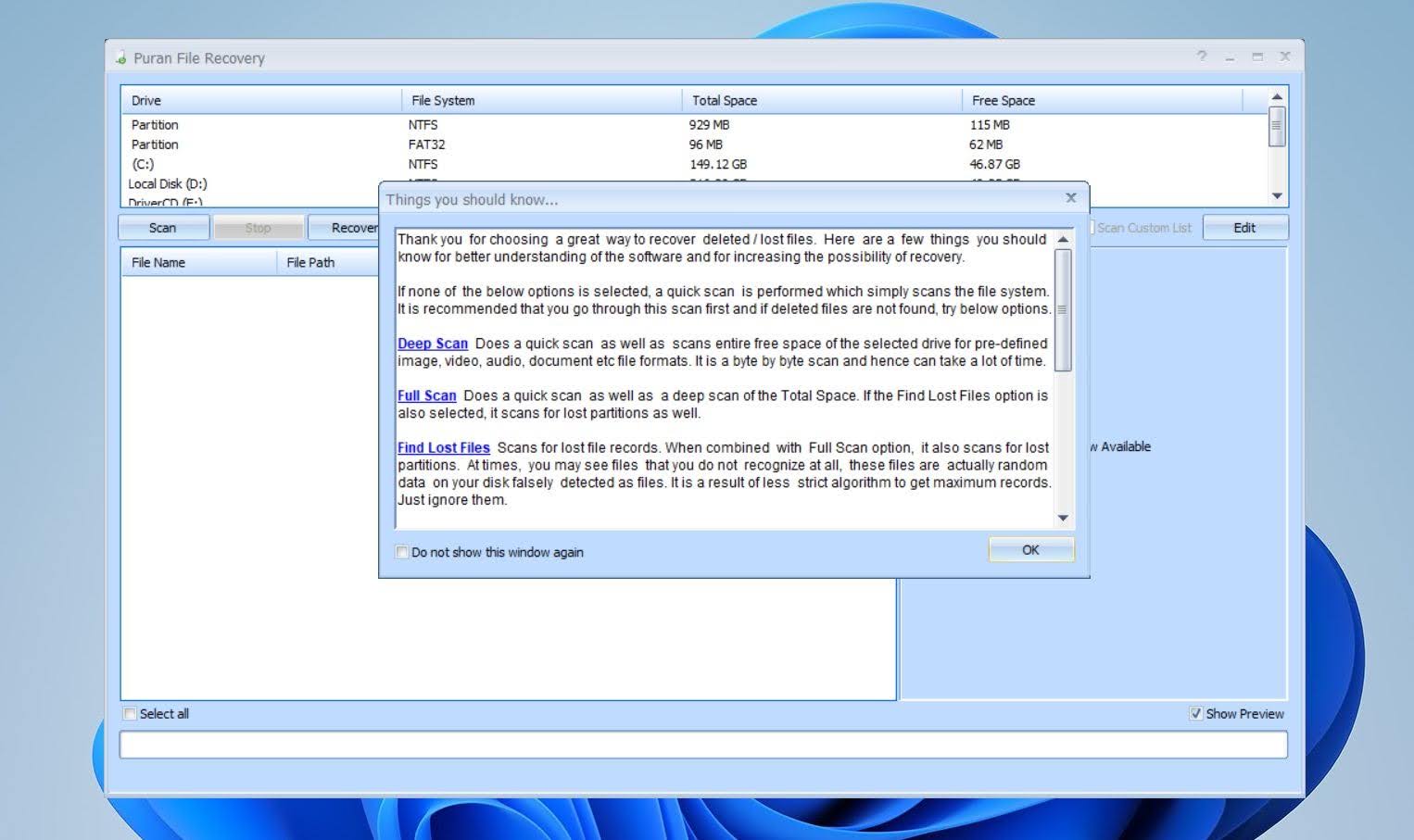
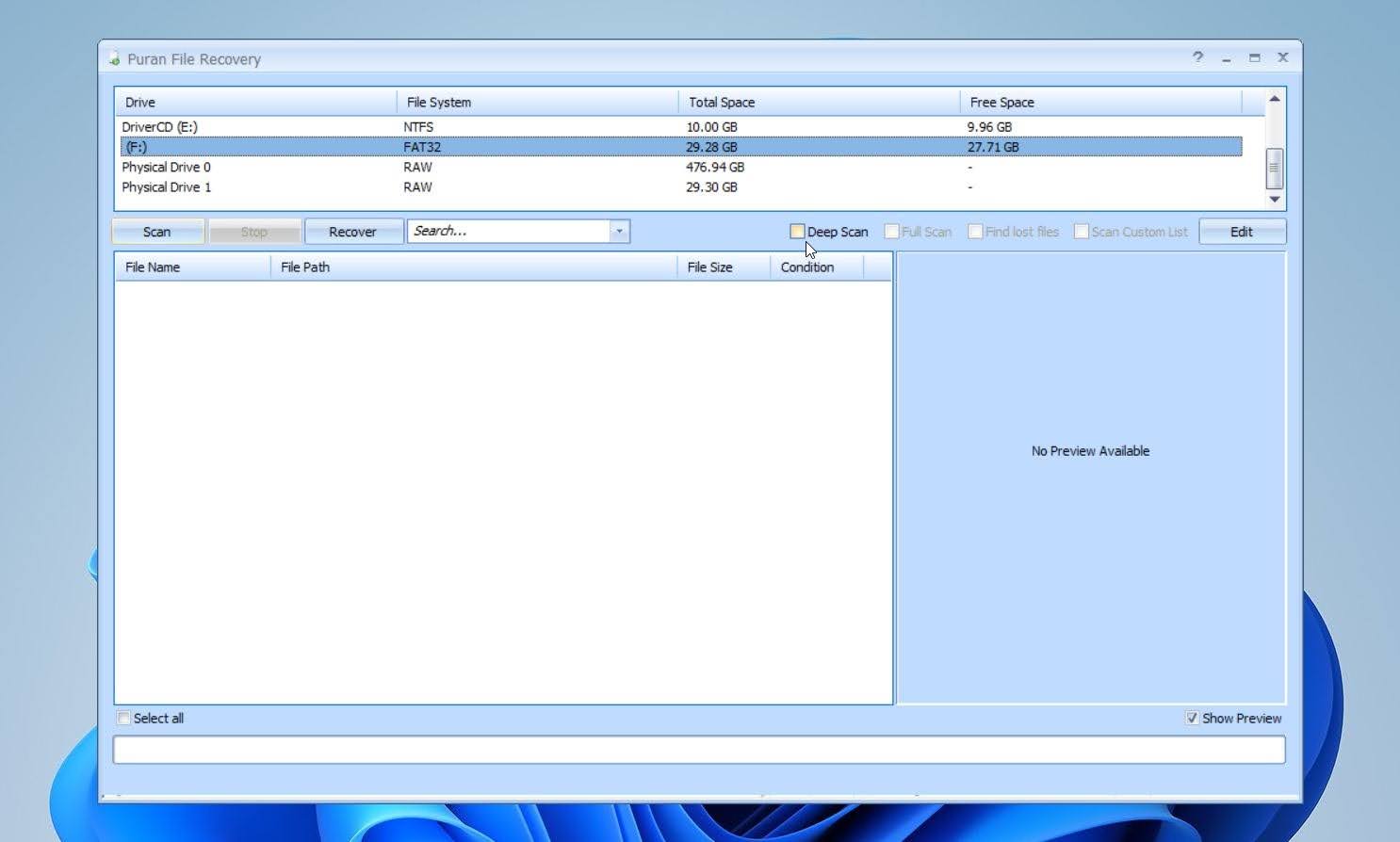
Click OK, and you’ll see the drives listed at the top. Click on the drive you want to scan.
When you select a drive, you’ll then see the Deep Scan on the right. It’s recommended to run a regular scan first to see if it finds the files you’re looking for and helps recover them. It’s fairly fast, so you won’t end up wasting a lot of time. If a regular scan doesn’t work, you can always run a deep scan.
Step #3: Recover the files
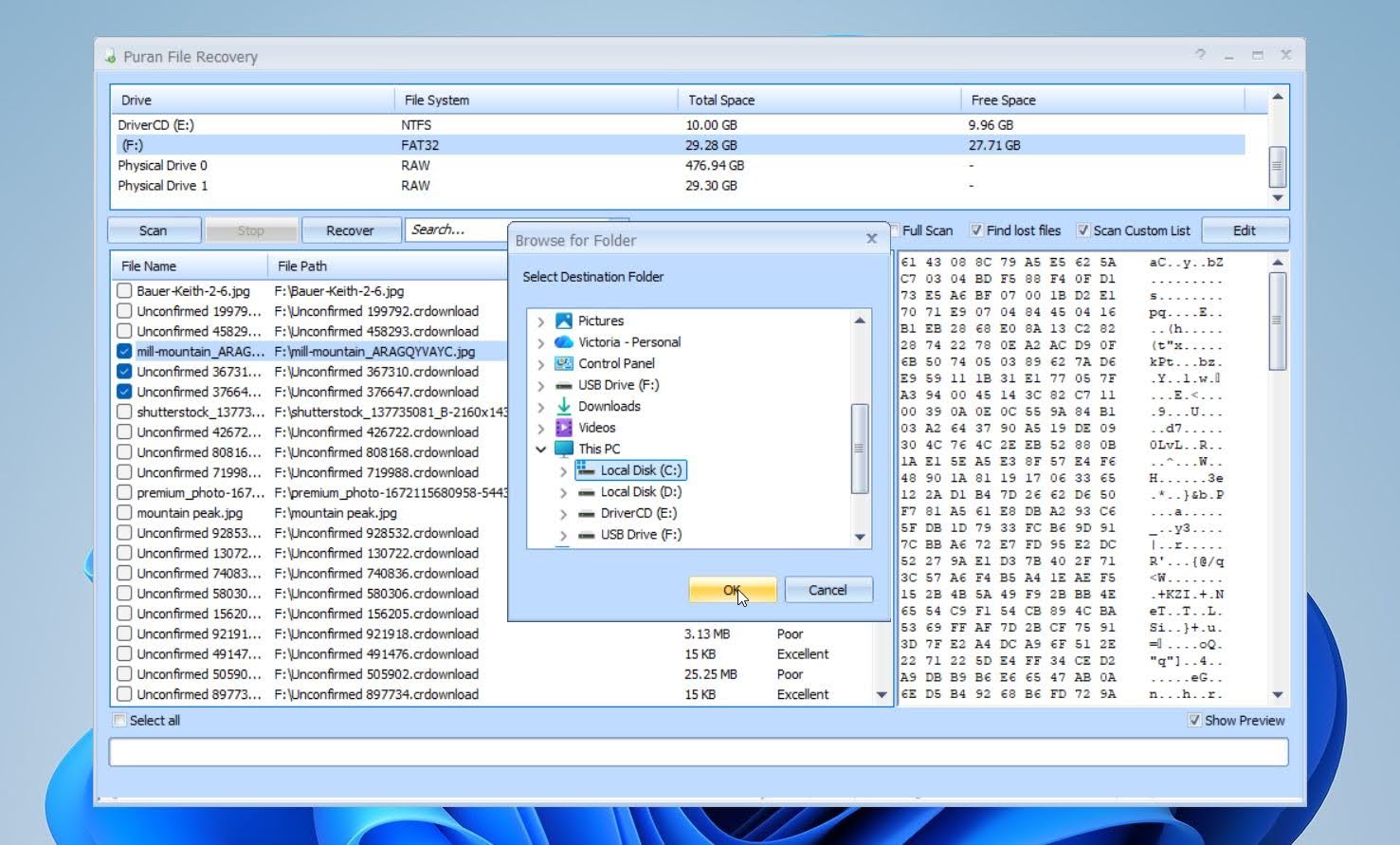
You’ll see the files that the scan finds. If you found the file you’re looking for, select the files you want to recover, and click on Recover. If you want to recover all files, check the box beside Select all at the bottom-left and then click on the Recover button.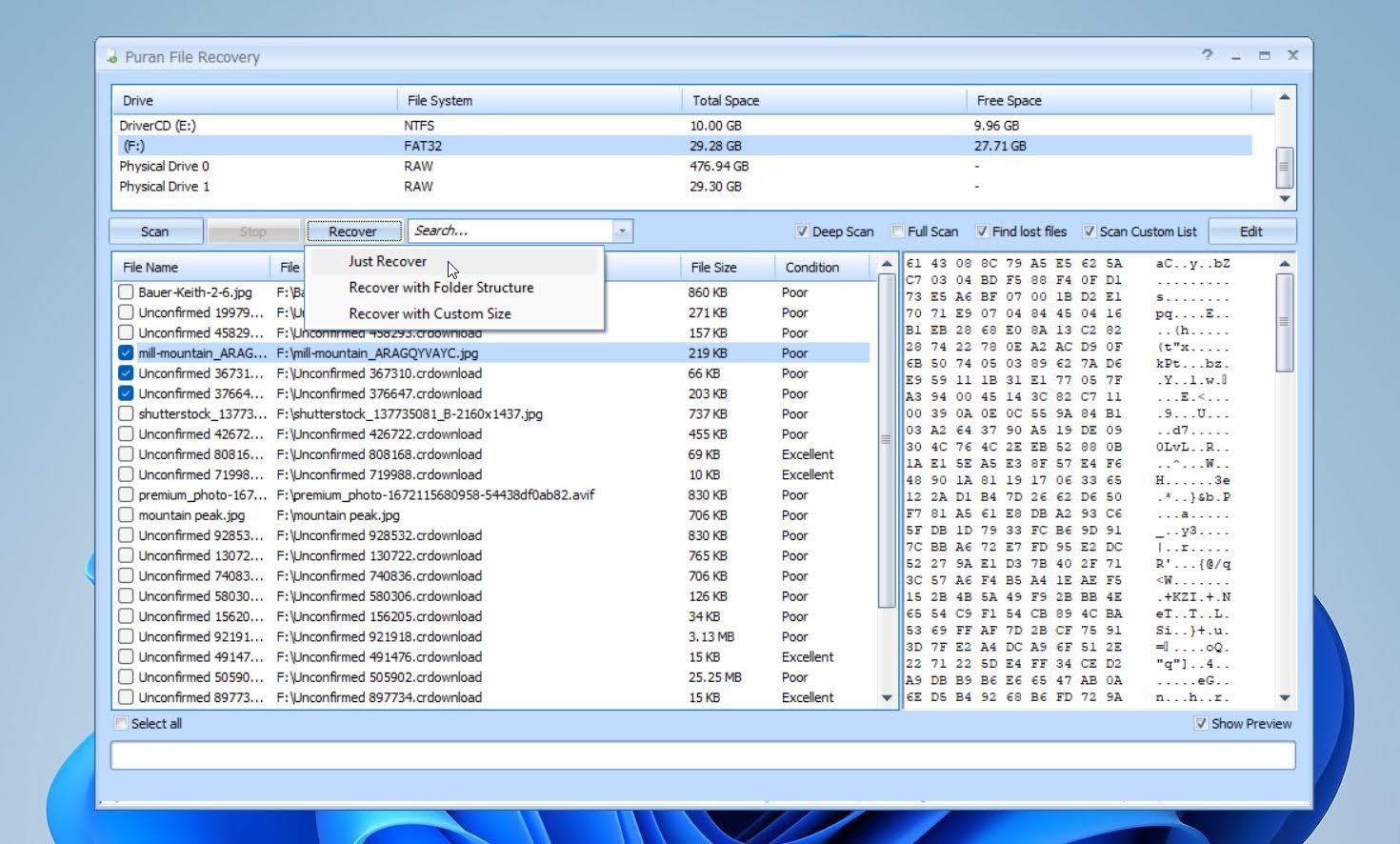
You’ll see three options:
- Click Just Recover to recover the file at a selected location on the PC or an external device.
- Select Recover with Folder Structure to retain the original folder path in the recovery location.
- Choose Recover with Custom Size if you have reason to believe that the file size as shown by the utility is inaccurate; use this option to enter a larger file size. This will give you better odds of recovering the complete file.
Then you need to select where you want to save your recovered files:
How We Tested Puran File Recovery
Puran File Recovery offers a fairly limited feature set compared with many modern recovery tools. Because of that, we focused on a single realistic scenario that reflects one of the most common data loss situations: accidental deletion.
For this test, we prepared a 32 GB SanDisk USB flash drive and copied our standard recovery dataset onto it. The dataset contained 100 files representing typical data users store on removable drives. After confirming that all files were accessible, we deleted the entire dataset from the USB drive to simulate accidental deletion.
Our dataset included the following file types:
- Images: JPG, PNG, TIFF, RAW
- Documents: DOCX, PDF, TXT
- Videos: MP4, MOV
- Audio: MP3, WAV
- Archives: ZIP
After deleting the files, we connected the USB drive to the test computer and ran Puran File Recovery to scan the device and attempt to restore the deleted data. This simple test allowed us to test how the tool performs in a basic recovery situation, which is the type of scenario most users would realistically rely on this program for.
Test Results and Overall Impression
The scan itself finished relatively quickly. 32 GB SanDisk USB drive took about 20 minutes, which is reasonable for a tool of this type. However, the actual recovery results were far less impressive.
Out of the 100 deleted files in our dataset, Puran File Recovery detected only 47 files, which means less than half of the deleted data was found. Even more concerning, we were not able to view working previews for any of the files, which made it difficult to verify whether the recovered files were usable before restoring them.
The overall experience confirms that Puran File Recovery is a very basic recovery utility. It can attempt simple undelete tasks, but it lacks many of the capabilities expected from modern data recovery tools. Features such as advanced filtering, reliable preview support, and stronger recovery algorithms are either limited or missing.
Another factor that reflects the tool’s age is its slow update cycle. While the recent updates show that the software is still maintained, the long gaps between releases and the limited improvements in recovery performance suggest that development moves slowly compared with more actively maintained recovery tools.
What Users Say About Puran File Recovery
As we already mentioned, Puran File Recovery is a relatively unpopular tool, which means user feedback is also limited. On G2, it has a good rating of 4.7/5 based on 18 reviews, but almost all of them date back to 2019. It is rarely mentioned on tech forums or Reddit and never as a first option for data recovery.
Still, the few available reviews are generally positive. Users often highlight the simple interface and recovery process. One reviewer described it as:
“Awesome Data recovery with Puran” (4/5)
The reviewer noted that the software allows users to choose exactly which drive or location to scan and praised the intuitive interface that makes the tool easy to learn. However, they also mentioned that deep scans can take a long time and that the program is limited to Windows, with no support for Linux or other platforms.
However, there is negative feedback too. On Reddit, a user tried to recover old FlashPix (.fpx) photos from a 15–20-year-old laptop using Puran File Recovery. The software allows users to search for custom file types, but it requires entering file signatures such as start bytes or offset values in HEX or ASCII, which the user did not know.
One response summed up the frustration quite bluntly:
“Use a better program.”
Instead of helping configure Puran, commenters suggested alternative tools.
Overall, the general opinion about Puran File Recovery in community discussions is mixed. Some users appreciate the tool because it is free and simple, but many comments point out its limitations. Puran File Recovery is a simple and lightweight utility that can work for small recovery tasks, but not necessarily a tool people rely on for larger drives or more complex recovery scenarios.
How Puran File Recovery Compares With Popular Alternatives
As you can see, Puran File Recovery is a very simple tool with almost no additional utilities or advanced features. It focuses mainly on basic file recovery and does not include many of the extra capabilities that modern recovery software provides, such as disk imaging, SMART monitoring, or more advanced scan controls.
Because of this, there are many better alternatives available today, even among free tools. Paid solutions go even further by offering better recovery algorithms and additional tools designed for more complex recovery scenarios.
Here is how Puran File Recovery compares with several commonly recommended alternatives:
| Tool | Supported Platforms | File Systems | Key Strengths | Limitations |
|---|---|---|---|---|
Puran File Recovery |
Windows |
NTFS, FAT12/16/32, exFAT |
Completely free, small download size, simple interface |
Outdated interface, limited updates, Windows-only, limited visibility in reviews |
Windows, macOS |
FAT16/FAT32/exFAT, NTFS, NTFS5, ReFS, HFS, HFS+, APFS, EXT2/EXT3/EXT4, BTRFS and any RAW disk |
Strong recovery engine, modern interface, preview features, disk imaging |
Free version has recovery limits |
|
Windows |
NTFS, FAT, exFAT |
Easy to use, fast scans, lightweight |
Less capable with complex recovery cases |
|
Windows, macOS, Linux |
Works independently of file systems |
Powerful file carving, open-source, supports many formats |
Command-line style interface, no folder structure recovery |
|
Windows, macOS, Linux |
NTFS, FAT, exFAT, EXT, APFS, HFS+ |
Professional-level recovery, RAID support, advanced scanning |
Complex interface, paid software |
Verdict
After we tested Puran File Recovery and compared it with other recovery tools, it became clear why many users recommend alternatives. Even for basic recovery scenarios, the tool shows clear limitations. In our test, it recovered less than half of the deleted files, and preview functionality did not work properly. This suggests that its recovery engine is fairly limited compared with modern data recovery software.
Because of this, Puran File Recovery only makes sense in a very narrow use case. It may still be useful when working with older or vintage Windows systems, where lightweight freeware utilities are sometimes easier to run. However, even in those situations, there are usually better and more reliable alternatives available.
Our top alternative recommendation is Disk Drill. It offers a much more modern recovery engine, supports a wider range of file systems, and provides useful features such as disk imaging, advanced scanning modes, and reliable file previews. These capabilities make the recovery process easier to manage and increase the chances of restoring lost data.
Pros
- Completely free to use, which makes it accessible to anyone.
- Very small and lightweight program that installs quickly.
- Simple interface that beginners can navigate easily.
- Runs on older Windows systems, including Windows XP, Vista, and later versions, which can make it useful for recovering files from legacy computers.
- Can scan many storage devices detected by Windows, including USB drives, hard drives, and memory cards.
Cons
- Limited recovery performance compared with modern tools.
- Preview functionality and filtering options are basic, which makes it harder to verify files before recovery.
- Outdated interface and minimal workflow guidance.
- Windows-only, with no macOS or Linux versions.
- Development appears slow, with long gaps between updates, which suggests the tool evolves more slowly than competing recovery software.
FAQ
How to find a file using Puran File Recovery?
You can find the files by skimming through the list once the scan completes. If the Puran data recovery tool finds a lot of files, you can use the Search feature to filter the files. It will allow you to look for pictures, music, documents, videos, and compressed files. This will narrow down the list of files to only one category and make it easier to find the file.
How to recover photos with Puran File Recovery?
You can find photos with Puran File Recovery the same way you would find any other file. You scan the device for lost or deleted files, and then look for the photo you want to recover. However, if the Puran data recovery process shows a long list of files that can be recovered, you can make the process simpler by selecting Pictures using the Search function. You’ll then only see images in the list.
How long does Puran File Recovery take to scan & recover your data?
Puran File Recovery takes less time for regular scans, but takes longer for a deep scan. The time that a scan takes also depends on the size of the device you’re scanning. Scanning a 1TB device takes much longer than scanning a 100GB device.
How do I recognize the file I want after Puran File Recovery scans a drive?
Puran File Recovery preserves the original file name in most cases. However, if the file name doesn’t make sense, you can find a specific file by filtering the list using the Search function. For instance, if you’re looking for an image, use the Search function and select Pictures to filter out all files except images.
If you happen to remember the file size (just a ballpark number), you can sort the filtered results according to file size to make your search easier. Plus, if you remember where you had stored the file, you can also look at the File Path in the search results. To make this easier, select the Tree View option at the bottom left.
How safe is Puran File Recovery?
Puran File Recovery is generally considered safe to use when downloaded from a trusted source. It works primarily in read-only mode while scanning for lost files, so it should not intentionally modify the data you are trying to recover. As with any recovery software, avoid installing it or saving recovered files to the same drive that contains the lost data.
Is Puran File Recovery free to use?
Yes. Puran File Recovery is free for personal and non-commercial use, and unlike many freemium recovery tools, it does not impose a recovery-size limit.
This article was written by Arjun Ruparelia, a Contributing Writer at Handy Recovery Advisor. It was also verified for technical accuracy by Andrey Vasilyev, our editorial advisor.
Curious about our content creation process? Take a look at our Editor Guidelines.