
If you’ve been researching data recovery software, you’ve probably stumbled across Stellar Data Recovery, also called Stellar Phoenix. This recovery tool was first released in 2000, and it quickly became one of the most popular applications of its kind for Windows and Mac.
We take a close look to see if it still gets the job done. For this review, we looked at its features, supported file systems and formats, interface, scan speed, recovery results, pricing, and differences between the Windows and Mac versions. Most importantly, we tested it ourselves with common data loss scenarios, including deleted files and a formatted drive, and checked how many recovered files were actually usable.
TL;DR: Stellar Data Recovery is an easy-to-use recovery tool for Windows and Mac with broad file system support and several useful extras. It performed reasonably well with simple deletion, recovering 96 of 120 files, but results dropped after a quick format, and Deep Scan took around 10 minutes on a 32 GB USB drive. Recovery of MP4, HEIC, TIFF, and some MOV files was inconsistent.
The free version recovers up to 1 GB, while paid plans add features such as lost partition recovery, disk imaging, S.M.A.R.T. monitoring, and media repair. Our take: Stellar is fine for basic recovery, but its slower scans, inconsistent results in harder cases, and relatively expensive higher tiers keep it from being one of our top choices.
Want to help make our content better? Please vote for the best alternative to Stellar Data Recovery:



Stellar Data Recovery Features
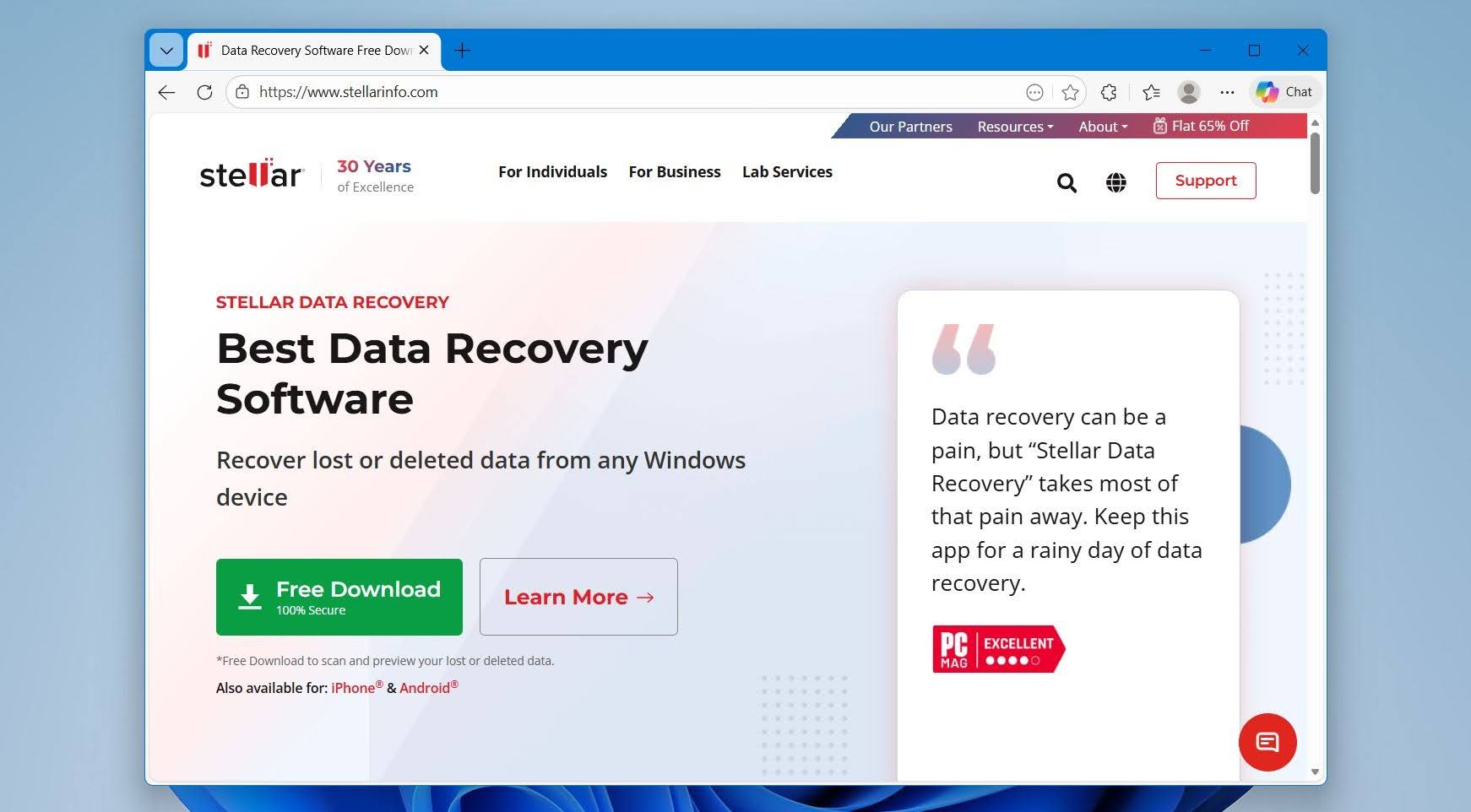
On its site, Stellar Data Recovery claims it can recover lost or deleted data from any Windows device. The company also highlights an impressive milestone—over 130 million downloads. With numbers like that, it’s clear this tool has caught the attention of users worldwide. Let’s break down the main features to see what makes it so popular.
File System and File Type Support
According to the developer, Stellar Data Recovery supports major Windows, macOS, and Linux file systems, including NTFS, FAT/FAT16/FAT32, exFAT, APFS, HFS/HFS+, and Ext2/Ext3/Ext4, although exact file system support depends on the platform and edition.
Stellar currently advertises support for 300+ file types, including photos, videos, audio files, documents, archives, emails, and other common formats. You can find their complete list on their website.
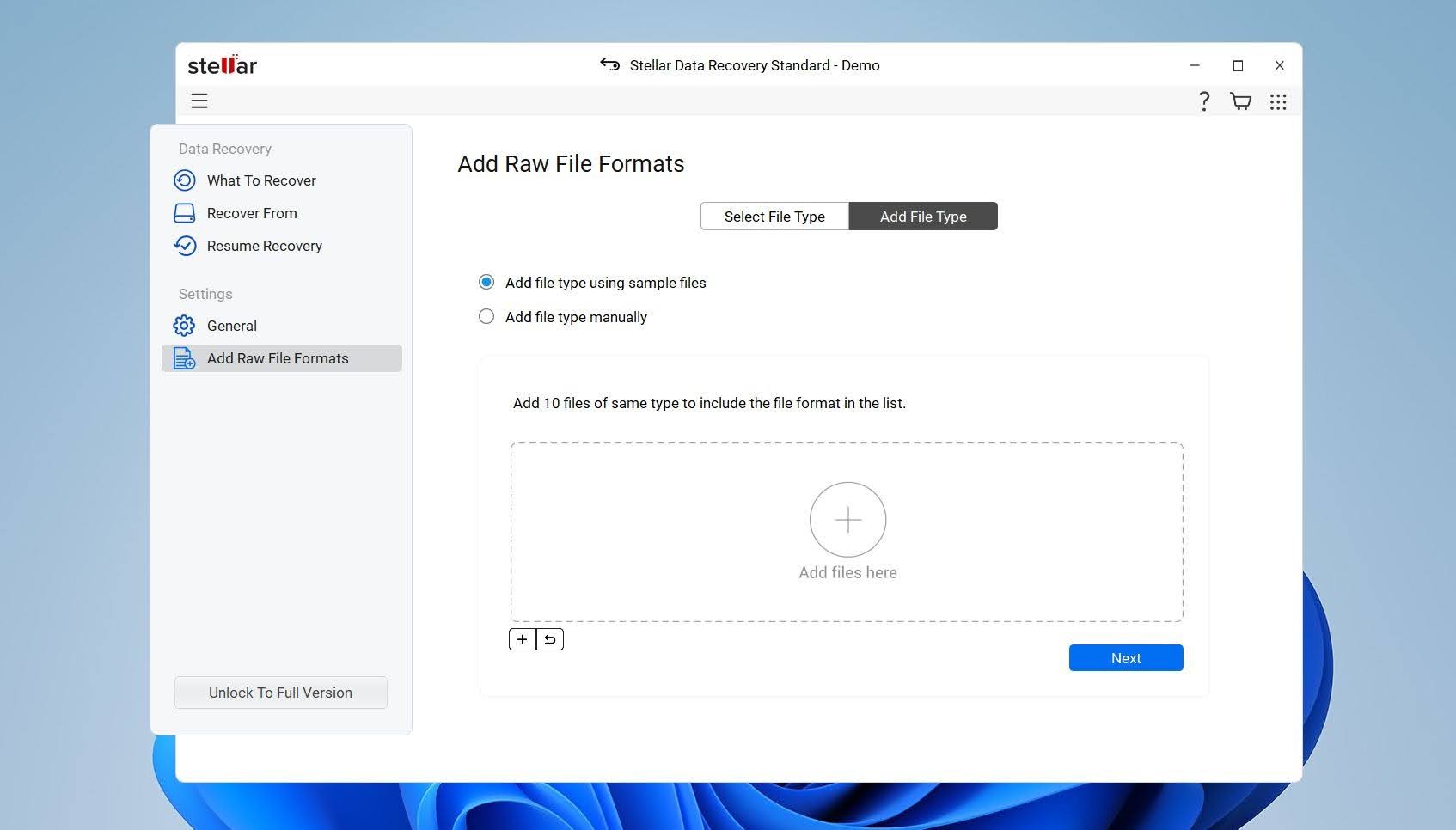
If a format is not included by default, Stellar also provides an Add File Type feature that can create a new file signature from sample files. This expands the range of formats the software can identify during signature-based scans, although it is a fairly specialized feature that most regular users are unlikely to need.
User Interface
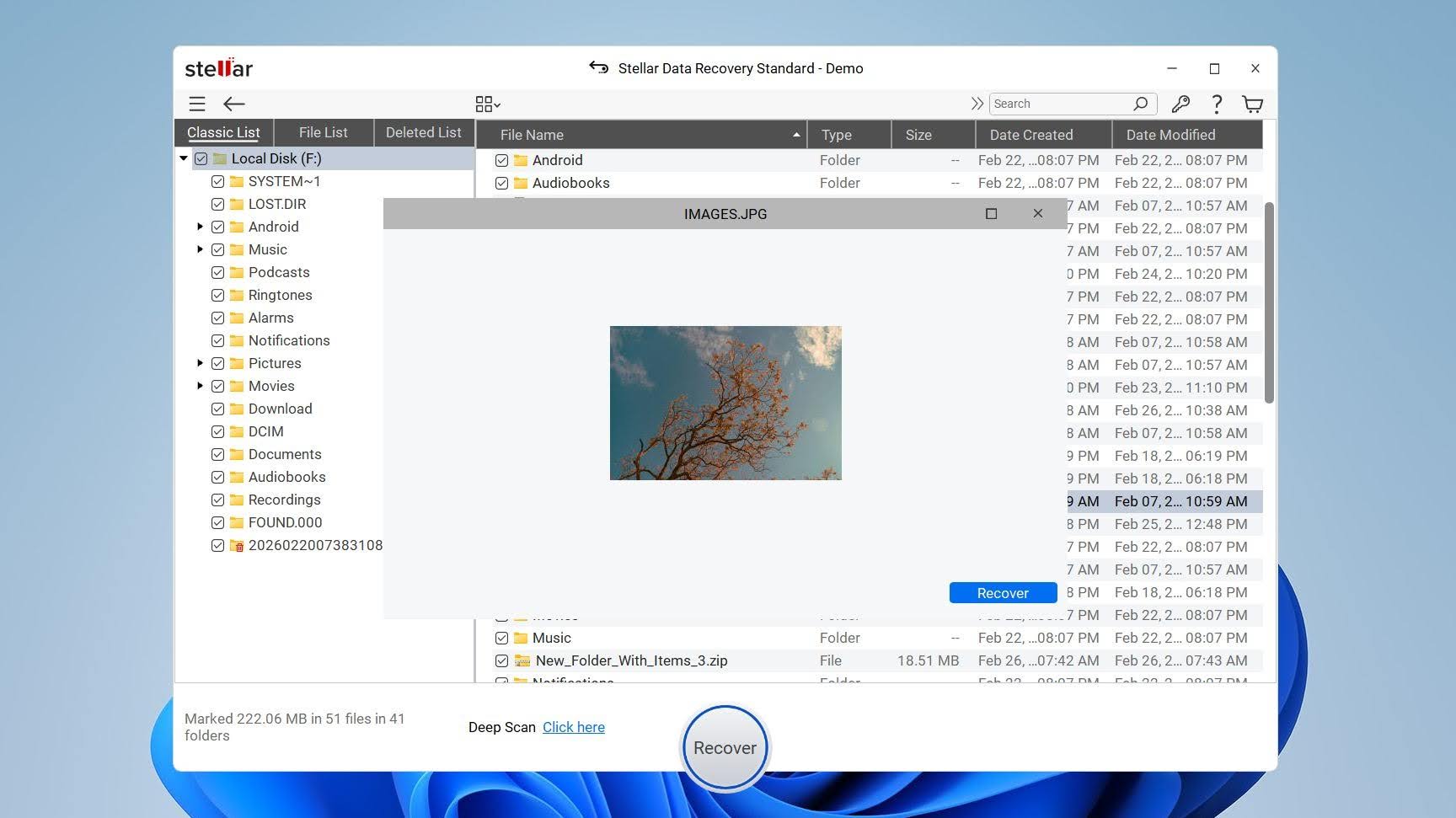
If there’s one thing users almost universality like about this data recovery software, then it has to be its user interface. While not particularly modern, its simple layout and clearly described options make it obvious which action the user is supposed to take next.
The recovery process itself, which we describe in detail in the next chapter.
Extra Features
The extra features you get with Stellar Data Recovery depend heavily on the edition. Professional adds several useful tools for more difficult recovery cases, including lost partition recovery, recovery from unbootable systems, disk image creation, drive cloning, and S.M.A.R.T. drive monitoring. On Windows, it can also recover data from damaged optical media such as CDs and DVDs.
The Premium edition adds photo and video repair. It can attempt to repair corrupted formats such as JPEG, CR2, TIFF, MOV, MP4, AVI, and MKV, including multiple damaged files at once. This can be useful when a recovery tool restores a photo or video but the resulting file is corrupted or does not open correctly.
Higher editions expand the feature set further. Technician targets professional use and adds more advanced recovery options, while the Windows-only Toolkit extends support to additional file systems and more complex storage configurations.
Customer Support
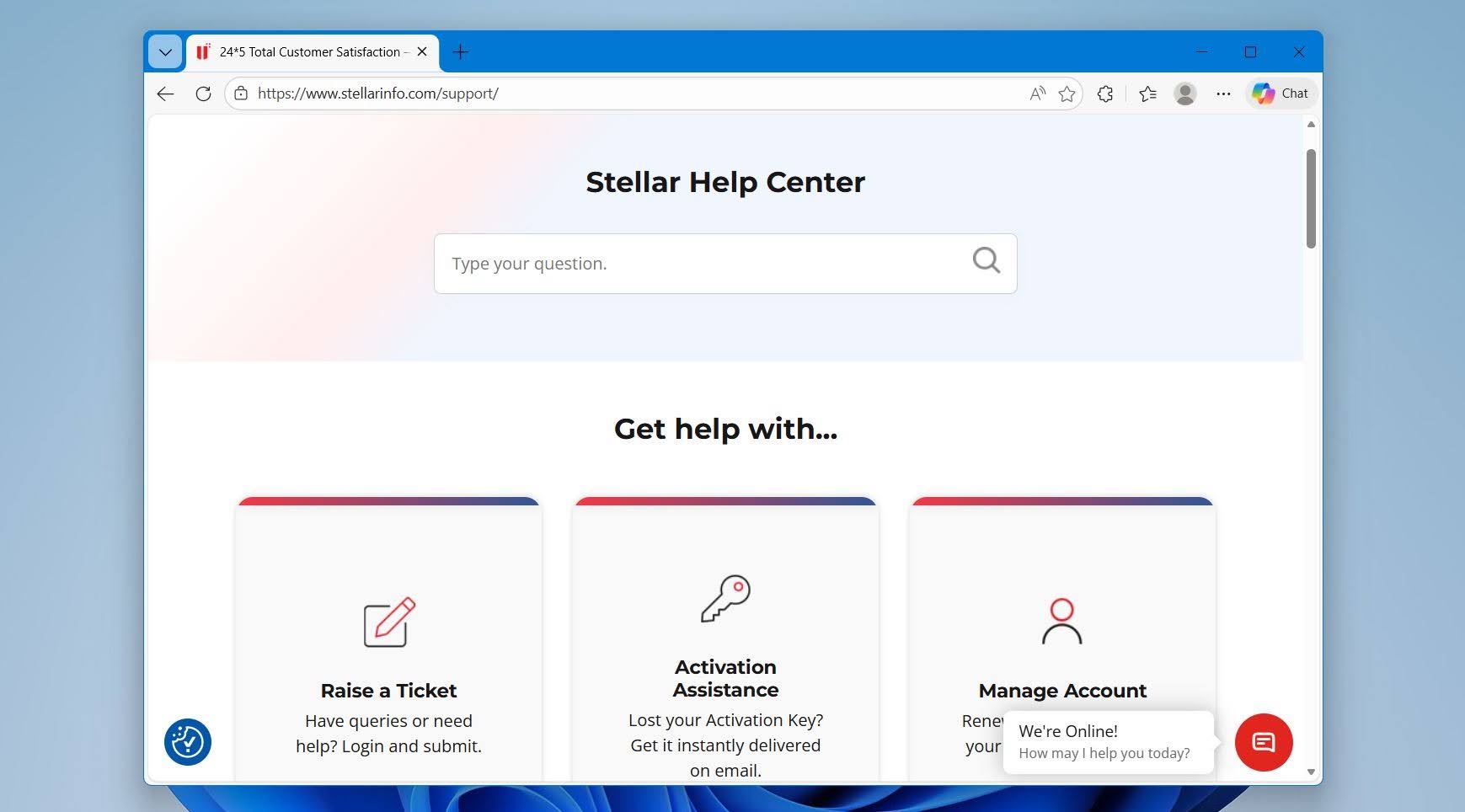
When Stellar Data Recovery users need help, they can contact one of the several provided customer support numbers or submit a ticket. There’s also an extensive knowledge base with data recovery-related articles and step-by-step solutions to common problems.
Unfortunately, it’s possible to find many negative online reviews that detail how unwilling Stellar is to resolve issues with refunds. Some reviews also criticize the technical skills of the India-based customer support staff.
Unfortunately, it’s possible to find many negative online reviews that detail how unwilling Stellar is to resolve issues with refunds. Some reviews also criticize the technical skills of the India-based customer support staff.
Is Stellar Data Recovery Safe?
Like any software we test, we ran the Stellar Data Recovery installer through a malware scan with VirusTotal. The latest result was clean: none of the 59 security vendors that analyzed the installer flagged it as malicious.
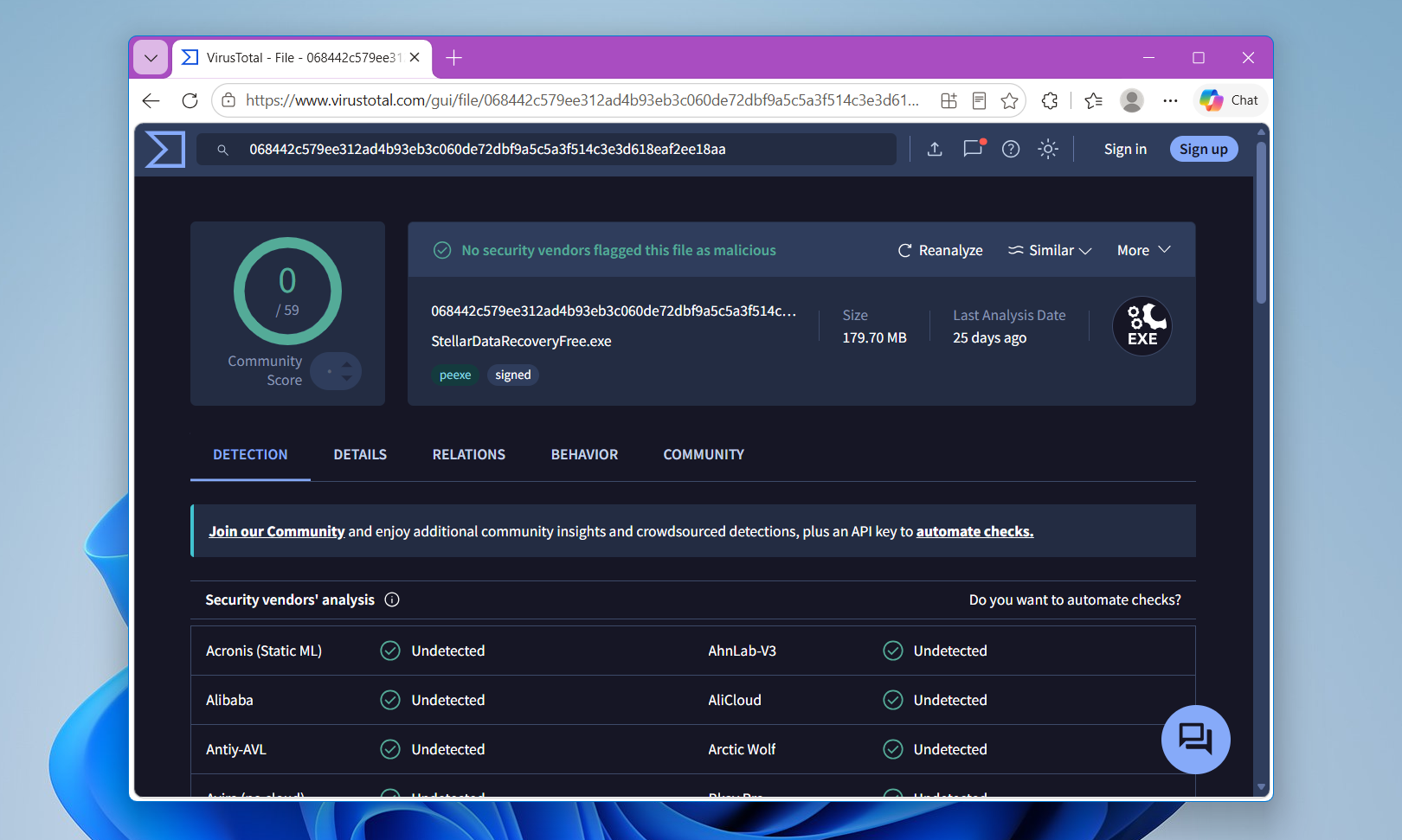
This is a much stronger result than what we saw in our previous test, where a few antivirus engines produced warnings. With the current installer returning 0/59 detections, we found no indication of malware or other obvious security threats during our check.
We also looked beyond the malware scan. Stellar has been developing data recovery and related software for decades, and the company publishes a detailed privacy policy. User feedback is also widely available through platforms such as Trustpilot.
Our recommendation: Download Stellar Data Recovery directly from the official Stellar website. Even when the software itself passes malware checks, installers from unofficial download sites may be outdated, modified, or bundled with additional software.
How We Tested Stellar Data Recovery
To evaluate Stellar Data Recovery fairly, we tested it under controlled but realistic data loss scenarios that reflect how people actually lose files. Instead of relying on vendor claims, we focused on measurable recovery results, usability, and performance consistency.
We performed all tests on a Windows 11 laptop using external storage devices to avoid system-level interference. The test devices included:
- 32 GB SanDisk USB flash drive (exFAT)
- 500 GB Seagate external hard drive (NTFS)
Each device contained the same structured dataset of 60 mixed files, including:
- JPG, PNG, and BMP photos, including RAW formats such as CR2 and HEIC
- MP4 and MOV video files, as well as AVI and WMV (including H.264 and CineForm HD variants)
- DOC and DOCX documents, plus PDF and PPTX files
- ZIP archives
- MP3 audio files
- TIFF image files
This allowed us to evaluate both general file recovery and media-specific performance. We ran Stellar through multiple recovery situations:
- Simple deletion (USB drive). This test measures how well the software handles standard accidental deletions.
- Quick format (USB drive). After loading the same 120-file dataset, we performed a quick format of the exFAT drive. This scenario tests metadata-based recovery and RAW signature scanning behavior.
- Deletion on large external HDD. We repeated a standard deletion test on the 500 GB NTFS external drive to measure scan speed, file preview reliability, and performance on larger storage.
During each test, we evaluated not just how many files Stellar detected, but how many were fully usable after recovery. We checked whether original file names and folder structure were preserved, tested video integrity for larger MP4 and MOV files, and measured scan time and system responsiveness. We also observed stability and assessed interface clarity.
How to Use Stellar Data Recovery
Stellar Data Recovery features a streamlined recovery process that boils down to three simple steps:
Step 1: Select the type of data you want to recover.
Step 2: Select the storage device you want to scan.
Step 3: Save recovered data.
But before you can get started, you first need to download the application from its website and install it on your computer. Stellar Data Recovery is compatible with Windows 11, 10, 8.1, 8, 7 (Service Pack 1), as well as macOS.
For the purposes of this Stellar Data Recovery Software review, we’re using the Windows version, but the Mac version is visually and functionally identical. Installation was simple enough since all we had to do was double-click the downloaded StellarDataRecovery.exe file and follow the instructions.
Remember, when you install recovery software, always do so on a different drive, or at least a separate partition, from the one where you lost your files. This way you don’t overwrite the very data you’re trying to recover.
After installing Stellar Data Recovery on, we launched it and landed on the “What To Recover” screen. The interface is clean and straightforward, with recovery categories clearly grouped and selectable before the scan begins.
Here’s how the options are organized:
- All Data, select this if you want the software to search for all supported file types without narrowing the scope.
- Office Documents targets common document formats such as Word, Excel, and other office-related files.
- Emails focuses on email data files, including Outlook mail archives.
- Audio scans specifically for music and other sound files.
- Photos searches for image formats, including common photo file types.
- Videos designed to locate video files across supported formats.
Once the desired categories are selected, you simply click Next to proceed to drive selection and start the recovery process.
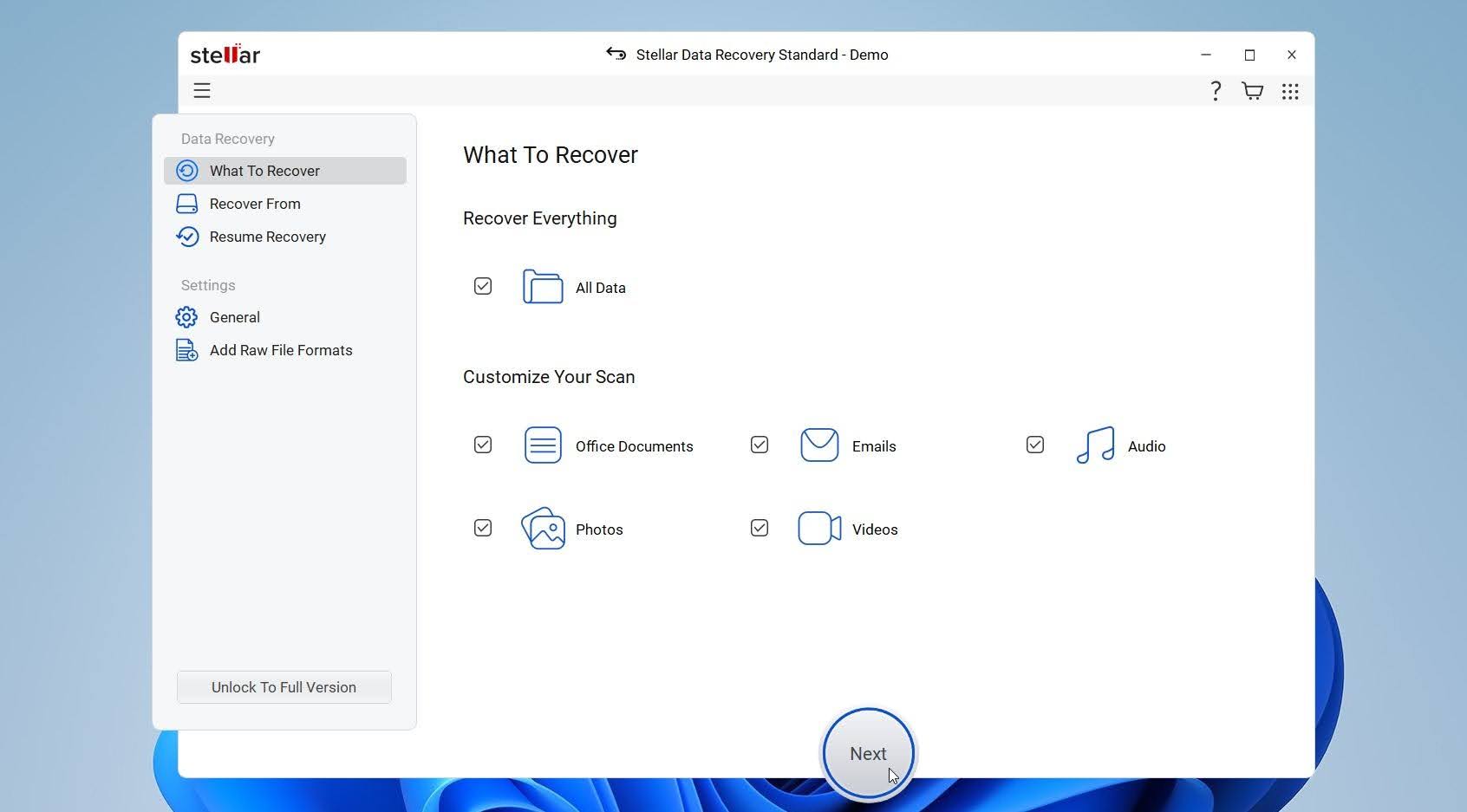
Since all file types are selected by default, we simply clicked Next and proceeded to the next step, choosing our storage device. If you don’t want to scan the entire storage device, you can choose a specific location, such as the Documents folder.
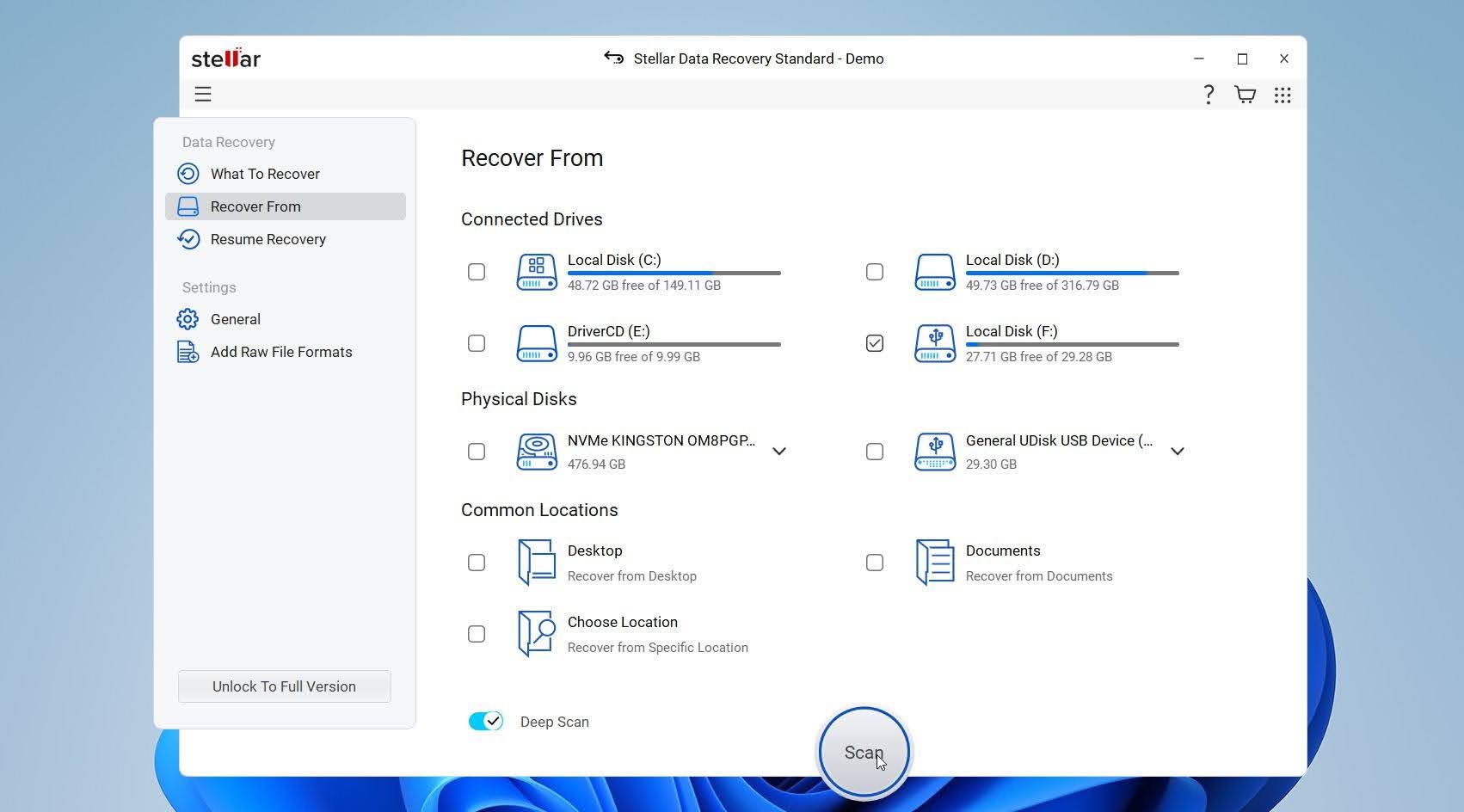
Before we clicked the Scan button, we made sure to activate the Deep Scan option located in the bottom-right corner because we wanted to perform a scan based on file signatures and find as many lost and deleted files as possible.
Like most recovery tools, Stellar Data Recovery has two scanning modes: Quick Scan and Deep Scan. Quick Scan is great for files that were recently deleted, like those removed with Shift+Delete or emptied from the recycle bin. In these cases, the file system is still intact, so file names and folder structures are usually preserved, and the software relies on the file table to recover all deleted files, regardless of type. Deep Scan, on the other hand, is designed for more complicated scenarios, such as formatted drives or missing file systems where the disk might appear as RAW. It digs deeper and can retrieve data even if the file system is damaged or replaced. Not sure which to use? Check the discussion on our forum.
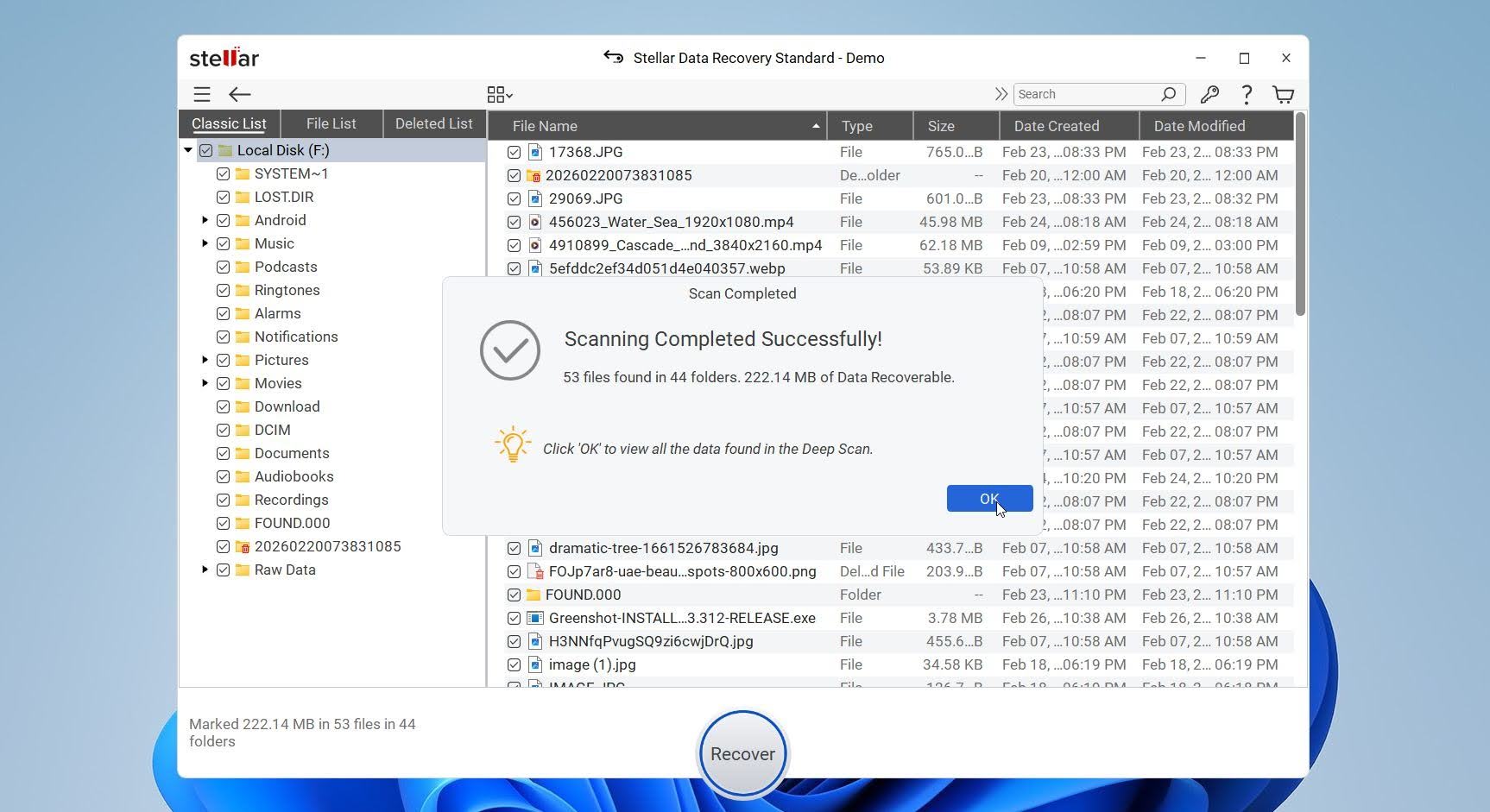
The scan itself took a while, around 10 minutes for a 32 GB drive, but that’s to be expected when performing a Deep Scan. What was somewhat unexpected was the fact that Stellar Data Recovery found 53 out of 60 files. After the scan completed, the software displayed a detailed results window with multiple navigation tabs at the top: Classic List, File List, and Deleted List.
Here’s how they work based on the interface shown:
- In the Classic List view, Stellar displays the recovered data in a tree-style folder structure that mirrors the original drive layout. The left panel shows directories such as SYSTEM, Android, DCIM, Documents, and others under the selected disk, while the right panel lists the contents of the selected folder with detailed columns.
- In the File List view, Stellar organizes results by file type instead of the original folder structure. The left panel shows categories such as Archive, Document, Photos, Video, and Others under the selected drive. When you choose a category, the right panel displays the files in a sortable table with details like file name, type, size, and dates.
- Deleted List filters the results to display only files marked as deleted. In this view, deleted entries are clearly labeled (e.g., “Deleted File”), which helps isolate recoverable items without sorting through existing data.
Selected files are marked with checkboxes, and the total selected size appears at the bottom before you proceed by clicking Recover.
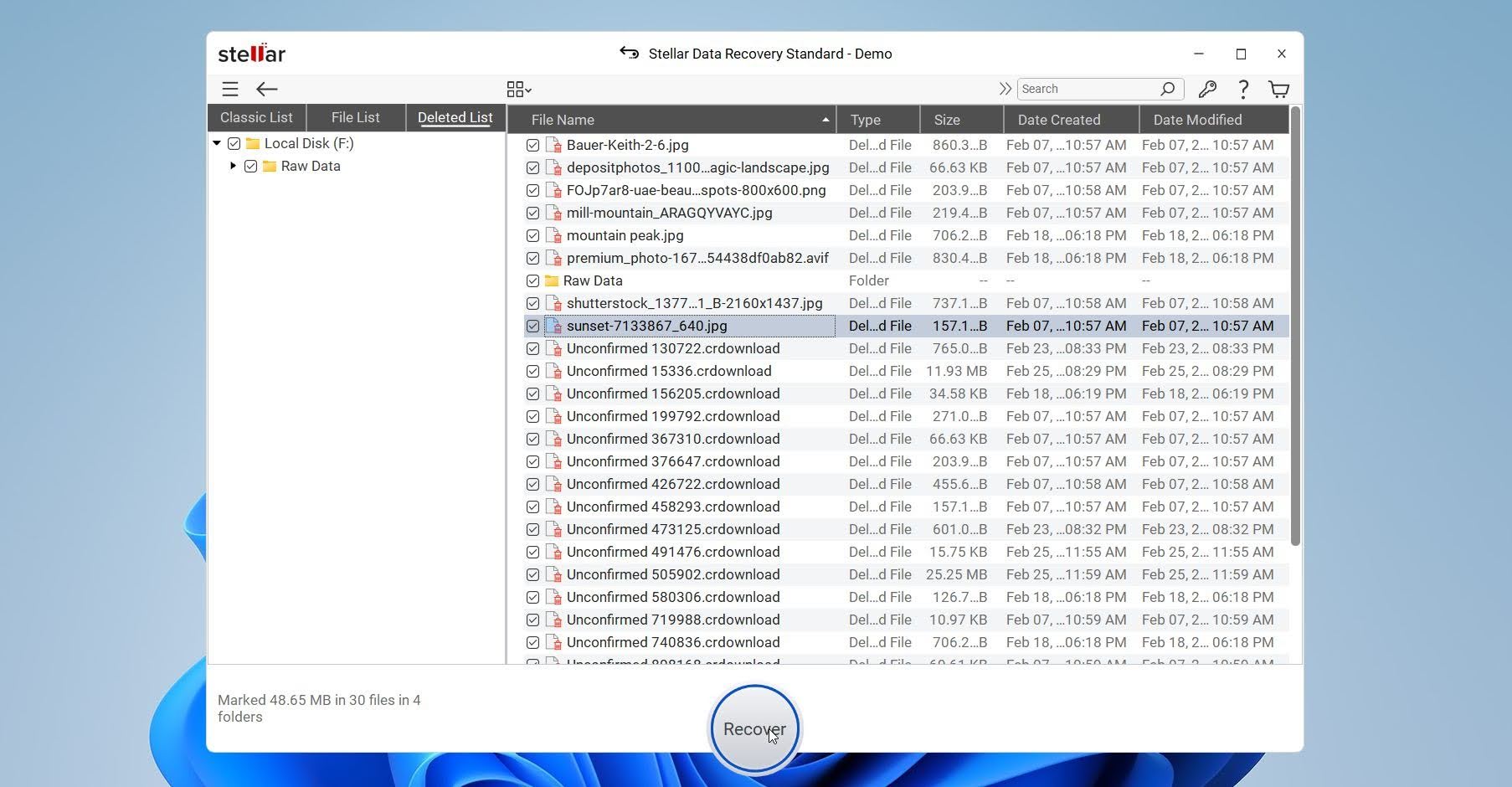
We switched to the Deleted List tab in the preview window and were quickly able to find our test images. Unfortunately, the preview feature didn’t work correctly, so we had to select them blindly.
Overall, the data recovery process is straightforward enough so that even users with no previous data recovery experience should be able to complete it without any trouble.
Stellar Data Recovery Recovery Performance
To be honest, we were not impressed with Stellar Data Recovery’s performance. While the navigation and interface are adequate (though not the best among its peers), the recovery results can only be described as average at best. Here’s what we found during testing:
- During simple deletion tests on our 32 GB SanDisk exFAT USB drive with a structured dataset of 60 mixed files (JPG, PNG, MP4, MOV, DOCX, PDF, ZIP, MP3), Stellar recovered 53 of recently deleted files. While the software recovered many recently deleted files, the success rate was inconsistent. Files deleted using Shift+Delete were restored with proper names and folder structures in most cases, but some recovered files were corrupted or incomplete.
- The differences became more noticeable after we performed a quick format on the same USB drive. Quick Scan finished quickly but recovered very little beyond surface-level results, 34 files.
- On the 500 GB Seagate NTFS external hard drive, scan time and responsiveness became even more noticeable factors. Deep scanning large storage volumes required patience, and processing results caused visible slowdowns in the interface. Standard documents and smaller images recovered reliably, but performance did not stand out compared to similarly priced competitors.
- As to its claimed broad file support, Stellar Data Recovery performed relatively well with common file types such as BMP, CR2, JPG, AVI, MOV (H.264 Codec), WMV, DOC, and DOCX. However, it struggled with widely-used formats such as PPTX, MP4, and HEIC, as well as others like TIFF and MOV (CineForm HD Codec). These types are far from uncommon. This inconsistency suggests that its signature scan could benefit from some improvements.
In the end, Stellar Data Recovery might be fine for basic recovery tasks, but its scan results and speed honestly left us underwhelmed.
Stellar Data Recovery for Mac
Mac users aren’t left out. Stellar Data Recovery for Mac has essentially the same core recovery workflow as the Windows version, but it is adapted to macOS storage and hardware. It supports APFS and HFS/HFS+, as well as NTFS and exFAT drives, and can recover files from internal Mac storage, external HDDs and SSDs, USB drives, SD cards, emptied Trash, Time Machine backups, and encrypted Mac volumes. It also runs natively on both Apple Silicon and Intel Macs.
The feature set depends on the edition. Professional adds lost partition and non-booting Mac recovery along with disk image creation. Premium adds photo and video repair, while Technician goes further with virtual machine recovery, EXT2/EXT3/EXT4 support, and online and offline NAS recovery. One notable difference from Windows is that the highest-end Toolkit is Windows-only; on Mac, Technician is the top edition.
We also tested the Mac version, and the overall recovery results were similar to what we saw on Windows. The interface and workflow differ slightly, but we didn’t find a major difference in recovery quality that would change our overall opinion of Stellar.
Stellar Data Recovery Pricing (Windows and Mac)
The prices listed are at the latest update of this article.
There are several different editions of Stellar Data Recovery, each offering a different set of features at a different price point:
| Edition | Key Features | Windows Annual | Windows Lifetime | Mac Annual | Mac Lifetime |
|---|---|---|---|---|---|
Free Edition |
Recover up to 1 GB of data. |
Free |
Free |
Free |
Free |
Standard |
Recover files from internal and external drives, formatted storage, and encrypted volumes. |
$69.99 $59.99/year |
$129 $99 |
$69.99/year |
$99 |
Professional |
All Standard features, plus lost partition recovery, unbootable system recovery, disk imaging, and S.M.A.R.T. monitoring. |
$99.99 $89.99/year |
$199 $149 |
$99.99 $89.99/year |
$199 $149 |
Premium |
All Professional features, plus corrupt photo and video repair. |
$209.99 $99.99/year |
$319 $199 |
$209.99 $99.99/year |
$319 $199 |
Technician |
All Premium features, plus additional professional recovery capabilities. |
$299 $199/year |
$597 $399 |
$299 $199/year |
$597 $399 |
Toolkit |
Advanced recovery toolkit with RAID support, disk cloning and imaging, and support for multiple file systems. |
$399 |
$799 |
– |
– |
As you can see, you can get started with Stellar Data Recovery without paying a single dollar, but if you need to unlock all of its features, it is far from affordable.
Stellar offers only 1-year licenses or lifetime licenses. There are no monthly or short-term plans, which can feel limiting since most people need data recovery software for a one-time emergency rather than ongoing use. The “lifetime” option significantly increases the upfront cost compared to the annual license, especially in higher-tier editions. Almost every edition is displayed as discounted, often with a crossed-out original price.
How Stellar Compares to Other Data Recovery Tools
To give proper context, it is always better to compare Stellar Data Recovery with competing tools rather than reviewing it in isolation. On its own, Stellar looks well-marketed and capable of handling basic recovery tasks. But once you place it next to other leading solutions, the differences become clearer.
| Tool | Best For | Recovery Depth | Media Recovery | Disk Imaging | Overall Value |
|---|---|---|---|---|---|
Stellar Data Recovery |
Simple deletions |
Medium |
Moderate |
Limited (higher tiers) |
Fair |
Mixed & complex cases |
VeryHigh |
Strong (fragmented video support) |
Yes (built-in) |
High |
|
RAID, damaged file systems |
VHigh |
Moderate |
Yes (advanced) |
High (technical users) |
|
Basic Windows recovery |
Low–Medium |
Basic |
No |
Moderate |
|
Severely damaged drives |
Raw-level |
Strong (unstructured) |
No |
High (fallback use) |
|
Partition & RAW recovery |
High |
Inconsistent |
Yes |
High (technical workflows) |
The first noticeable gap appears in recovery consistency. In straightforward deletion cases, Stellar performs adequately. However, in more demanding scenarios such as formatted drives, partially corrupted file systems, fragmented video files, or RAW partitions, some alternatives demonstrate stronger and more predictable results. Tools like Disk Drill, R-Studio, or DiskGenius often recover a higher percentage of usable files when metadata is damaged or the drive structure is unstable.
Another difference lies in how advanced features are structured. Stellar splits capabilities like RAID recovery, disk imaging, and media repair across multiple paid tiers. Several competitors integrate these tools directly into one application, which simplifies workflow and reduces the need for additional upgrades.
Stellar is not a weak product, but it is not always the strongest option for every scenario. If you are unsure which direction to take, we recommend our full list of the best Stellar Data Recovery alternatives, where we break down recovery depth, pricing models, and real-world test results in more detail.
Stellar Data Recovery Reviews
Stellar Data Recovery has been available for many years, so there’s no shortage of real user reviews published on various review sites, such as G2, Trustpilot, and Capterra.
The vast majority of Stellar Data Recovery users praise its graphical user interface, finding it intuitive and well-designed. The user-friendly nature of Stellar Data Recovery is especially appealing to people with little to no previous experience with data recovery, who enjoy the step-by-step data recovery process, which makes it possible to recover lost files with just a few simple clicks.
The GUI is intuitive, user-friendly and provides the tools and options to search and recover data you thought may be lost due to Windows not recognizing the drive, or portions of the drive being corrupted. The deep scan option often brings back additional data you may not have realized was lost or knew you wanted/needed. (Source)
On the other hand, Stellar Data Recovery users are less than thrilled with its pricing. As we’ve already explained, this data recovery software uses the subscription model to drive revenue, and users are required to renew their licenses on a yearly basis. Since renewals are not discounted, their cost quickly adds up and exceeds that of many other data recovery applications.
The basic con about this software is that it doesn’t suit a normal person’s pocket as their prices are much higher than other software. (Source)
In addition to its steep price, Stellar Data Recovery users also criticize the quality of customer support they receive. Apparently, Stellar is less than willing to adhere to its own terms and conditions and issue refunds to users who have purchased the software by mistake or changed their mind and decided to ask for a refund.
Poor customer service and conflicting terms and conditions which state you are eligible for a refund if the incorrect software is purchased – I have since been fobbed up by their customer service team. I will be seeking legal advice and will not let this drop. (Source)
Our Verdict on Stellar Data Recovery
Stellar Data Recovery is a decent tool for basic file loss. It is easy to use and works fine for simple deletions. But once things get more serious, such as formatted drives, RAW partitions, or larger video files, the cracks start to show. Deep Scan takes a long time without delivering clearly better results; recovery can be inconsistent, and many advanced features sit behind higher-priced tiers. The pricing model also feels geared toward yearly renewals, even though most people only need recovery software once.
If you want stronger results and fewer limitations, Disk Drill is the better choice. In our tests, it delivered more consistent recovery, handled fragmented video better, included built-in disk imaging, and offered clearer long-term value. Overall, it simply feels more reliable across different recovery scenarios.
Pros
- Simple, user-friendly interface.
- Repairs photos and videos that can’t be opened post-recovery.
- Preview in safe mode to avoid crashes with corrupted data.
- Allows byte-to-byte backup creation (Professional and higher tiers only).
- Manually add new file signatures using sample files.
- Configurable scan settings.
Cons
- Slow Deep Scan.
- Inconsistent recovery results.
- Free version limited to 1 GB of data recovery.
- Limited file type support.
FAQ
Is Stellar Data Recovery really free?
Stellar Data Recovery offers a Free Edition that allows you to recover up to 1 GB of data at no cost.
Can I save scan results in Stellar Data Recovery?
Yes, with Stellar Data Recovery Professional, you can save your scan results using the ‘Save Scan’ option. This feature lets you pause the process and pick up right where you left off, so you don’t have to rescan the entire drive.
How long does Stellar Data Recovery take to recover data?
That depends mainly on the size of your storage device and its speed. If you want to recover an old hard drive using the Deep Scan mode, you’ll likely need to be patient; it’s not the fastest tool out there.
What’s the difference between Stellar Data Recovery Standard and Stellar Data Recovery Premium?
The main difference between Stellar Data Recovery Standard and Stellar Data Recovery Premium is the additional features available in the Premium version. In addition to everything in the Standard edition, the Premium version includes tools for repairing corrupted photos and videos. Premium also offers more advanced recovery options, such as the ability to recover data from unbootable systems.
Is Stellar Data Recovery legit?
Yes, Stellar Data Recovery is a legitimate data recovery program developed by Stellar Information Technology, a company that has been in the data recovery industry for decades. The software is widely used for file recovery on Windows and Mac and is not malware. To avoid modified or unofficial installers, download it directly from the official Stellar website.
How much does Stellar Data Recovery cost?
Stellar Data Recovery has a free version that can recover up to 1 GB of data. Paid Windows plans currently start at $59.99/year, while the Mac Standard edition starts at $69.99/year. More advanced editions cost more and add features such as lost partition recovery, disk imaging, S.M.A.R.T. monitoring, and photo and video repair. Lifetime licenses are also available for several editions.<
This article was written by David Morelo, a Staff Writer at Handy Recovery Advisor. It was recently updated by Roman Demian. It was also verified for technical accuracy by Andrey Vasilyev, our editorial advisor.
Curious about our content creation process? Take a look at our Editor Guidelines.