

Did you delete important photos from your Panasonic camera, or did they disappear from the memory card? Fortunately, in many cases, they are not permanently lost. We walk through realistic ways to recover deleted photos from Panasonic digital cameras and explain which methods usually work, when recovery software makes sense, and when it is better to stop and look at professional options.
Common Reasons Behind Data Loss in Panasonic Cameras
Based on cases we see most often, the reason behind photo loss directly affects which recovery method makes sense and how likely recovery is to succeed. The table below outlines typical scenarios and what we usually expect in each case.
Cause of Data Loss |
Typical Situation |
DIY Recovery Chances |
What We Usually Advise |
Accidental deletion |
Photos removed in-camera or on a computer |
High |
Stop using the camera or SD card and run recovery software as soon as possible |
Accidental formatting |
SD card formatted in camera or on PC |
High |
Avoid further writes and scan the card with recovery software |
Improper removal of SD card |
Unsafe card removal |
Medium to High |
Do not format the card if prompted; scan it first |
Virus or malware activity |
Files disappear or turn inaccessible on PC |
Medium |
Clean the system, then attempt recovery from the card |
File system corruption |
Card shows RAW or unreadable state |
Medium |
Use software that supports corrupted or RAW file systems |
Full formatting (overwrite) |
Full format performed on a PC that rewrites sectors |
Impossible to Low |
If files were overwritten, recovery is generally not possible. Partial recovery may still happen in cases where the overwrite process was interrupted, but the result depends on how much data has already been replaced. |
Physical damage |
Bent SD card, water damage, controller failure |
Low |
Do not attempt DIY fixes, consult a professional data recovery lab |
High and medium-chance cases usually respond well to software-based recovery. Low-chance scenarios often involve hardware issues, where professional services become the safer path.
How to Recover Permanently Deleted Photos from Panasonic Digital Cameras
When it comes to recovering data from digital cameras, in most cases, we are actually dealing with memory cards rather than internal camera storage. Panasonic digital cameras store photos and videos on SD cards, CFexpress cards, or external SSDs. Older models could use internal storage, but those are now largely outdated.
For that reason, third-party data recovery tools are your best bet for a swift data recovery process. According to our data loss survey, 79% of people who tried data recovery software to restore lost files reported successful results, which shows that in many common scenarios, software-based recovery offers a strong chance of retrieving deleted photos.
We cover two methods based on dedicated recovery software that can restore deleted photos from a Panasonic camera. The first option is the best choice for most cases, while the second serves as a solid alternative. Both tools showed strong results during our testing of SD card recovery software, so if you want a broader comparison and more context, it’s worth checking out our full breakdown.
Method 1: Disk Drill
Disk Drill is a renowned data recovery tool that can recover lost or deleted files from your Panasonic camera. Disk Drill supports various photo and video formats (including the RW2, Panasonic LUMIX raw image file). The process stays simple: install the software, connect the SD card, run a scan, and review what can be recovered.
To start the recovery, connect the device that contains the lost or deleted files to your PC, whether it is an SD card, CFexpress card, or even an external SSD, since some Lumix models can record directly to SSD storage.
Here’s how to recover deleted photos from a Panasonic camera using Disk Drill:
- Download, install and launch Disk Drill.
- Launch Disk Drill.
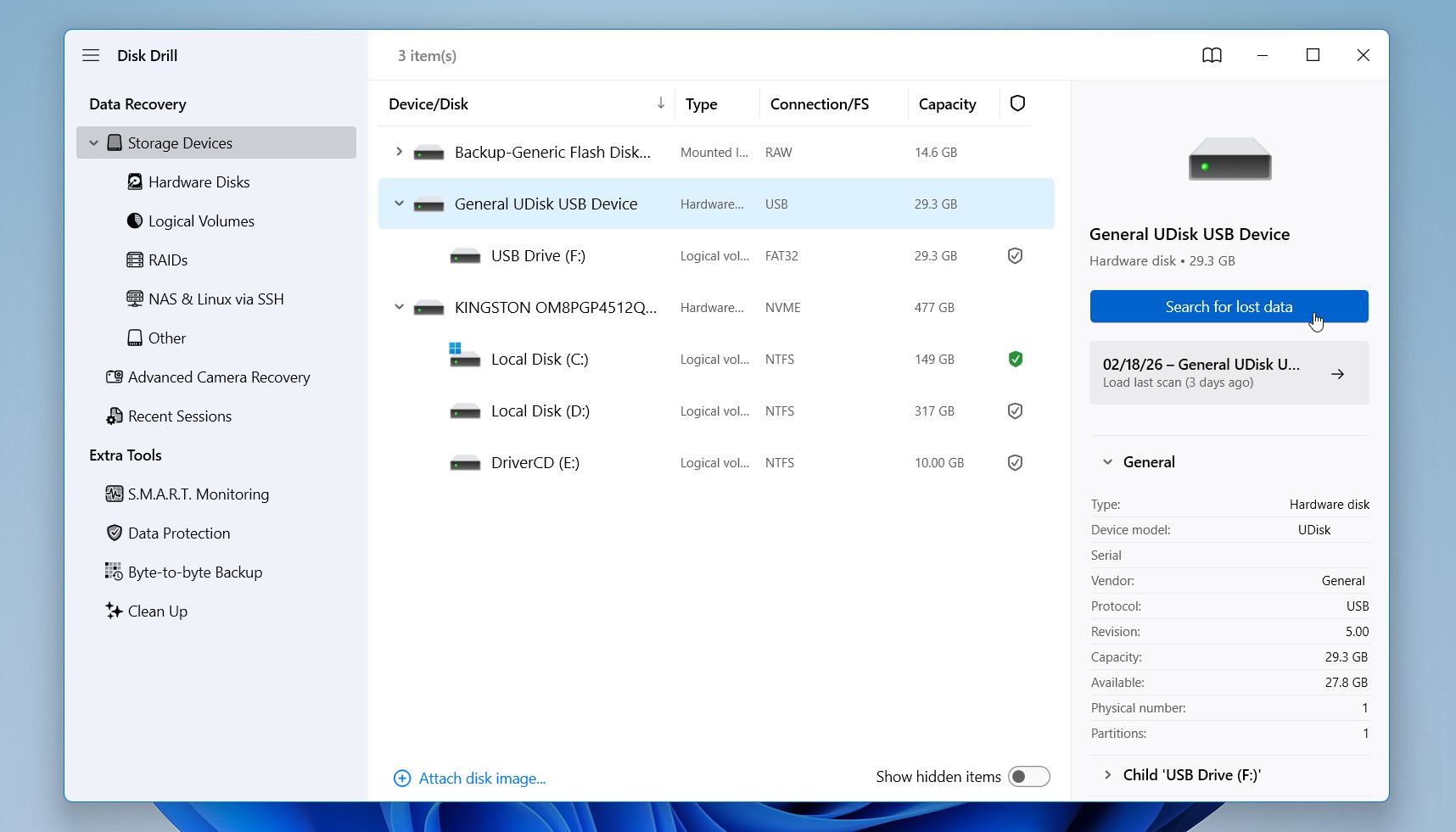
- Select your SD card from the list of available disks and click on Search for Lost Data.
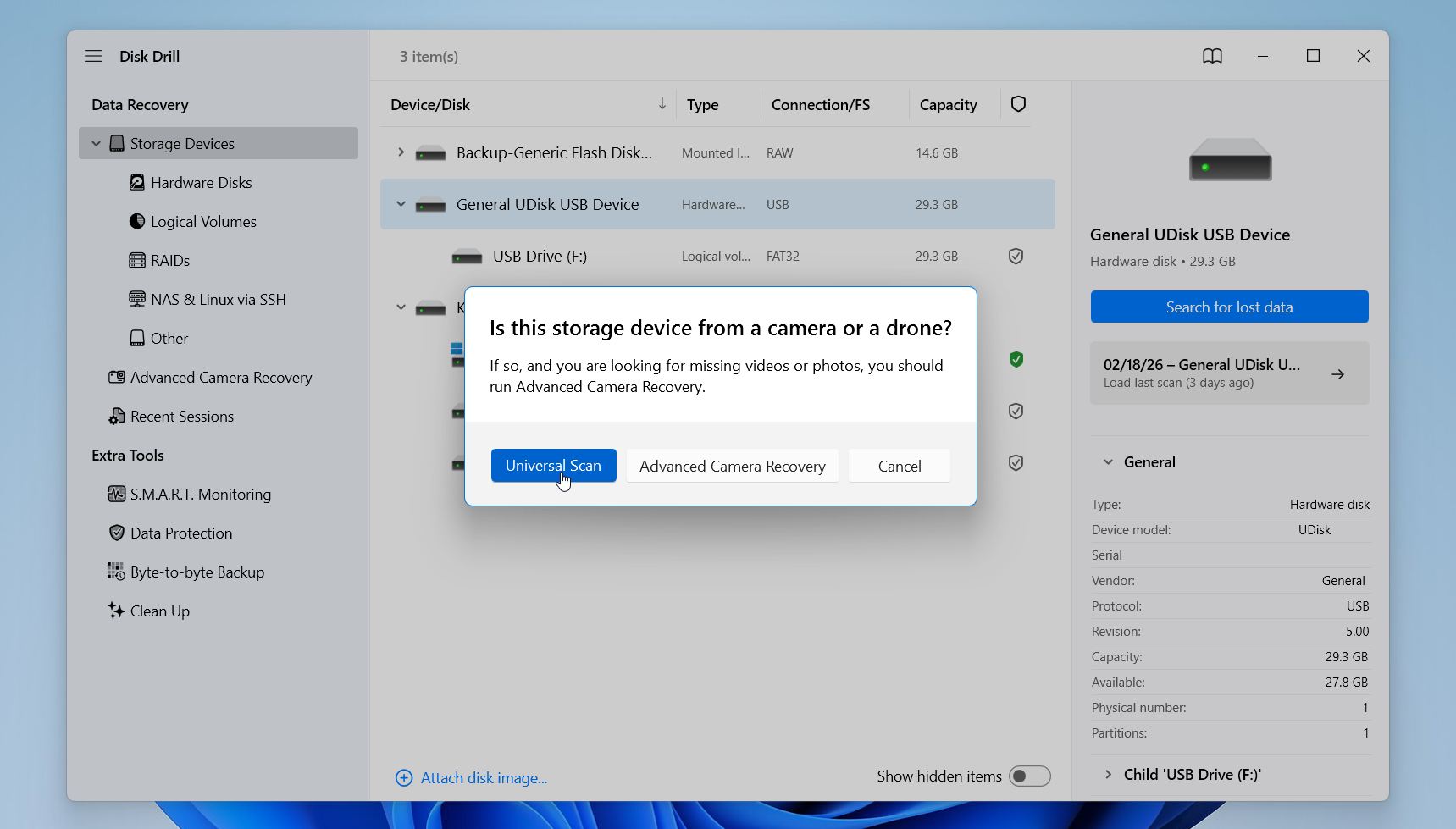
- Disk Drill will then ask you to choose between two recovery modes. If you only need to recover photos, select Universal Scan, which covers standard deletion, formatting, and file system issues. If you also want to recover videos, choose Advanced Camera Recovery, as this mode focuses on video footage, especially fragmented clips from cameras and drones.
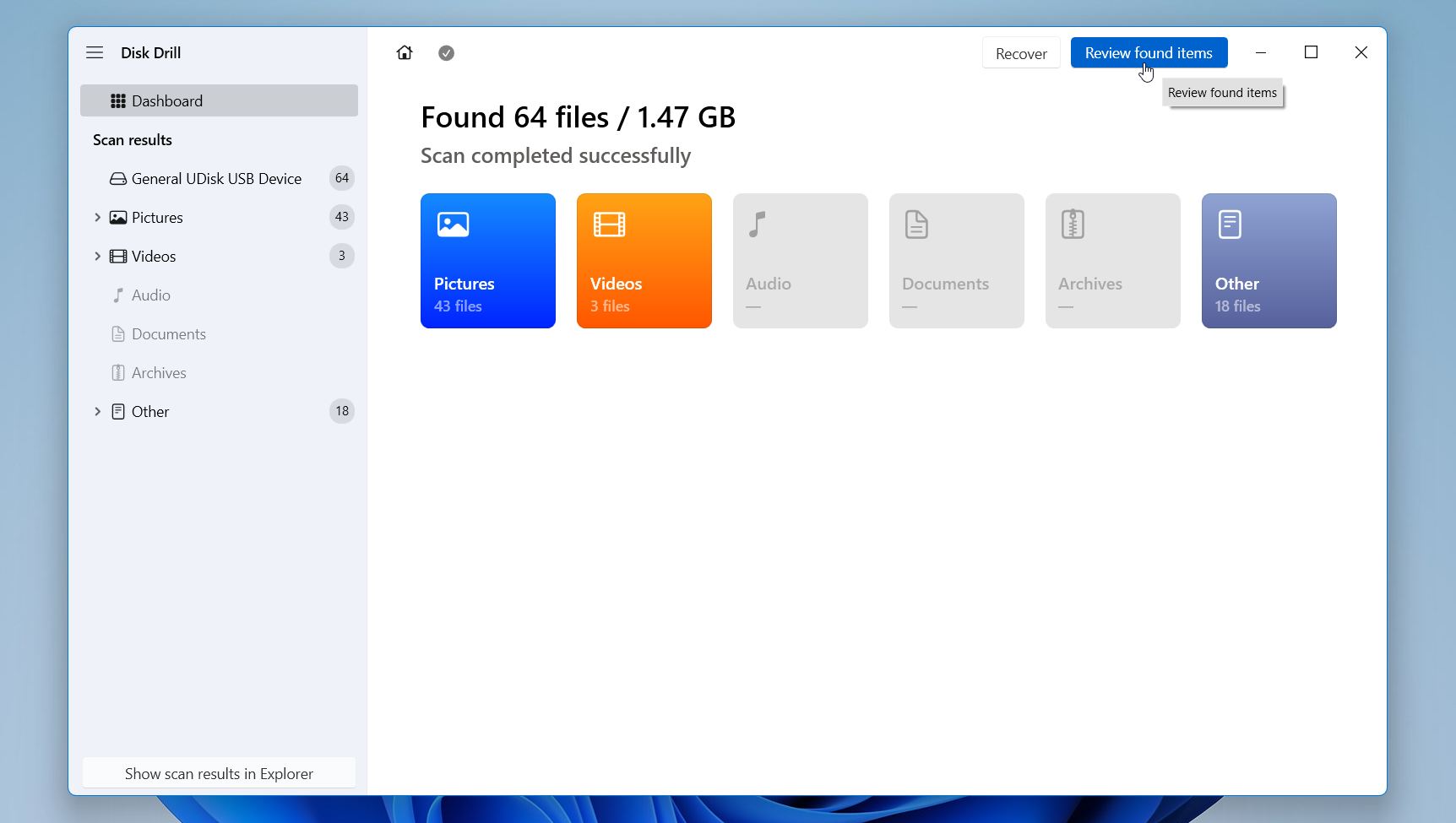
- Once the scan finishes, click on Review Found Items.
- Use filters (Pictures, Video, Documents, Archives) and the search bar. You can preview files to confirm they open and look correct. If the preview works properly, the files are recoverable.
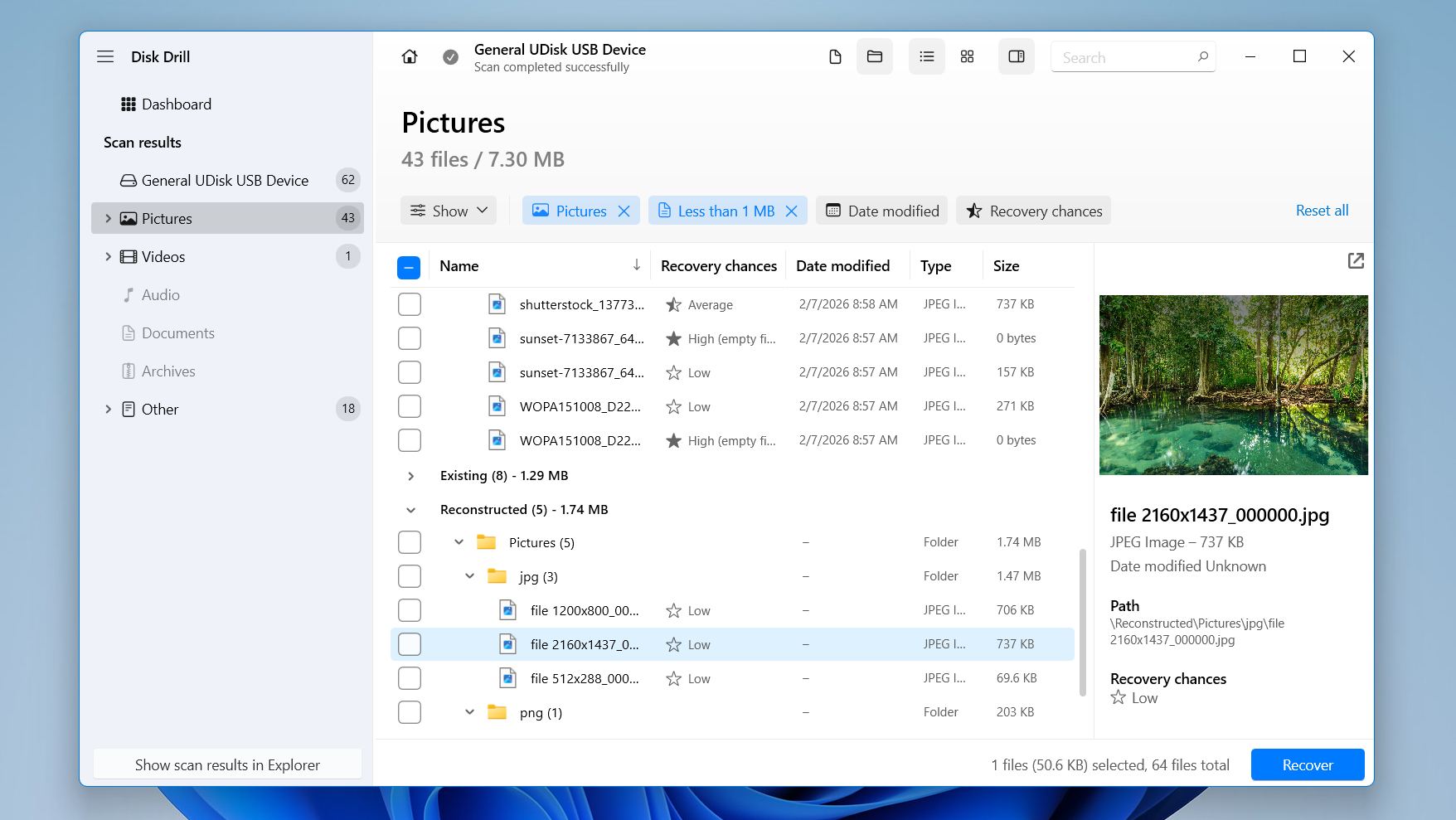
- Tick the folders/files you want to restore and click Recover.
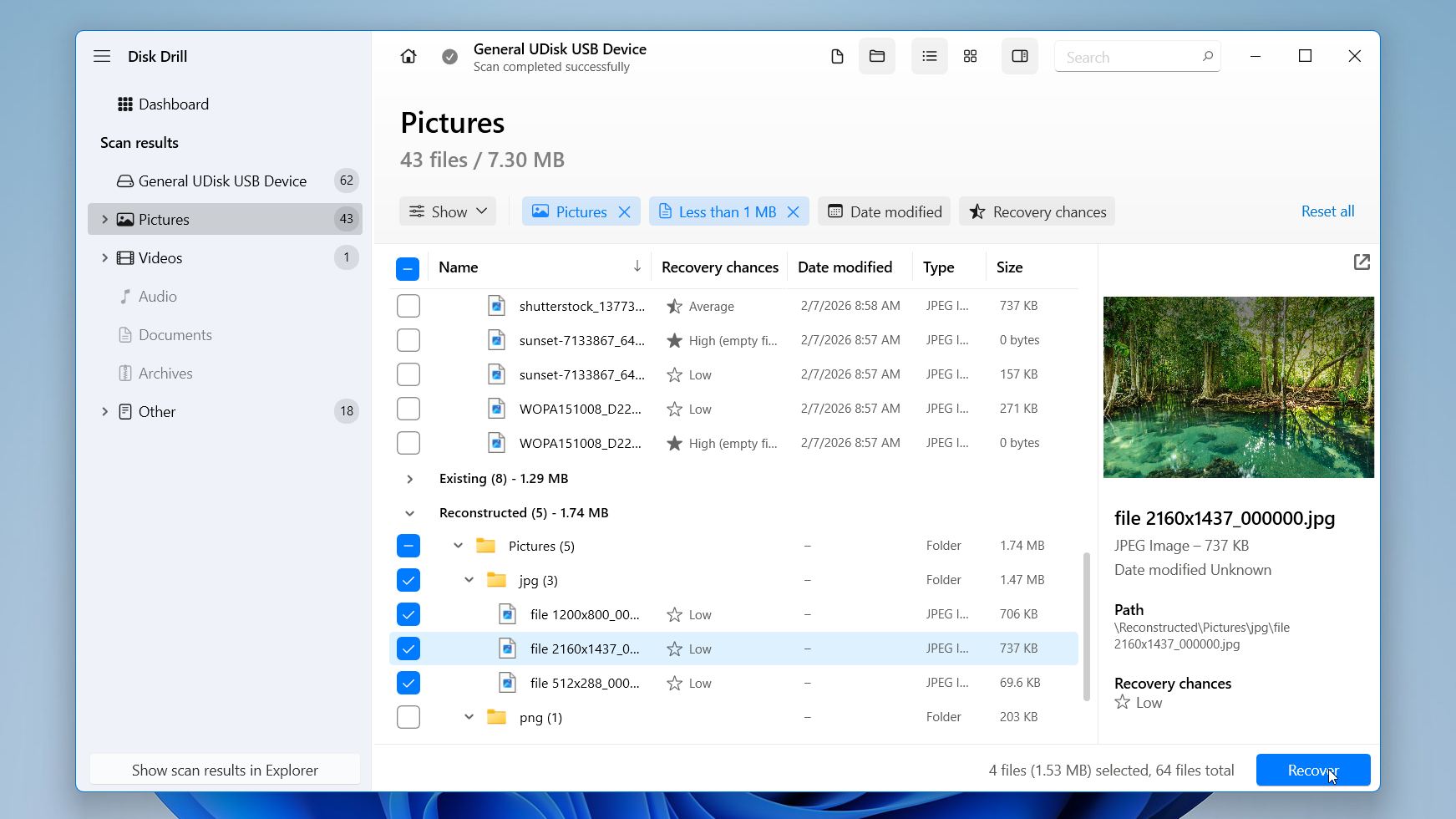
- Specify your data recovery destination and click on Next. Choose a different drive than the one you scan. Writing recovered files to the same device can overwrite other lost data that remains recoverable.
Open several restored files to confirm their integrity, with special attention to videos and RAW photos. For video footage, make sure the clip plays from start to finish and shows the correct duration, since partial playback often points to missing or damaged data.
Why Disk Drill is a strong option for recovering deleted photos from cameras, including Panasonic:
- Advanced Camera Recovery helps reconstruct fragmented photo and video files created by digital cameras
- File preview lets you verify RAW, JPG, and video files before recovery, so you know what you can actually get back
- Byte-level backups allow you to create a full image of the memory card and scan that image instead of the original card
- The free Windows version (100 MB) gives a way to check file integrity and recover some data before purchasing
The interface stays clean and predictable, which reduces the risk of mistakes when working with removable media. From our testing, it provides enough visibility into real recovery results before you commit. One license works for both Windows and macOS, so no separate purchase is required.
Disk Drill was also the savior in recovering deleted data from our Panasonic SD cards. And it also works like a charm for other popular cameras like Sony, Nikon, and Fujifilm. For more details, see our Disk Drill review.
Method 2: UFS Explorer
UFS Explorer is another data recovery tool that can recover deleted photos and videos from Panasonic cameras. It supports common file formats used on SD and CFexpress cards. The interface is more technical compared to beginner-focused tools, so it will not work for everyone. At the same time, it is still a solid option, especially for users who prefer more control over scan settings rather than ease of use.
How to recover files with UFS Explorer:
- Download and install UFS Explorer on your Windows or macOS system.
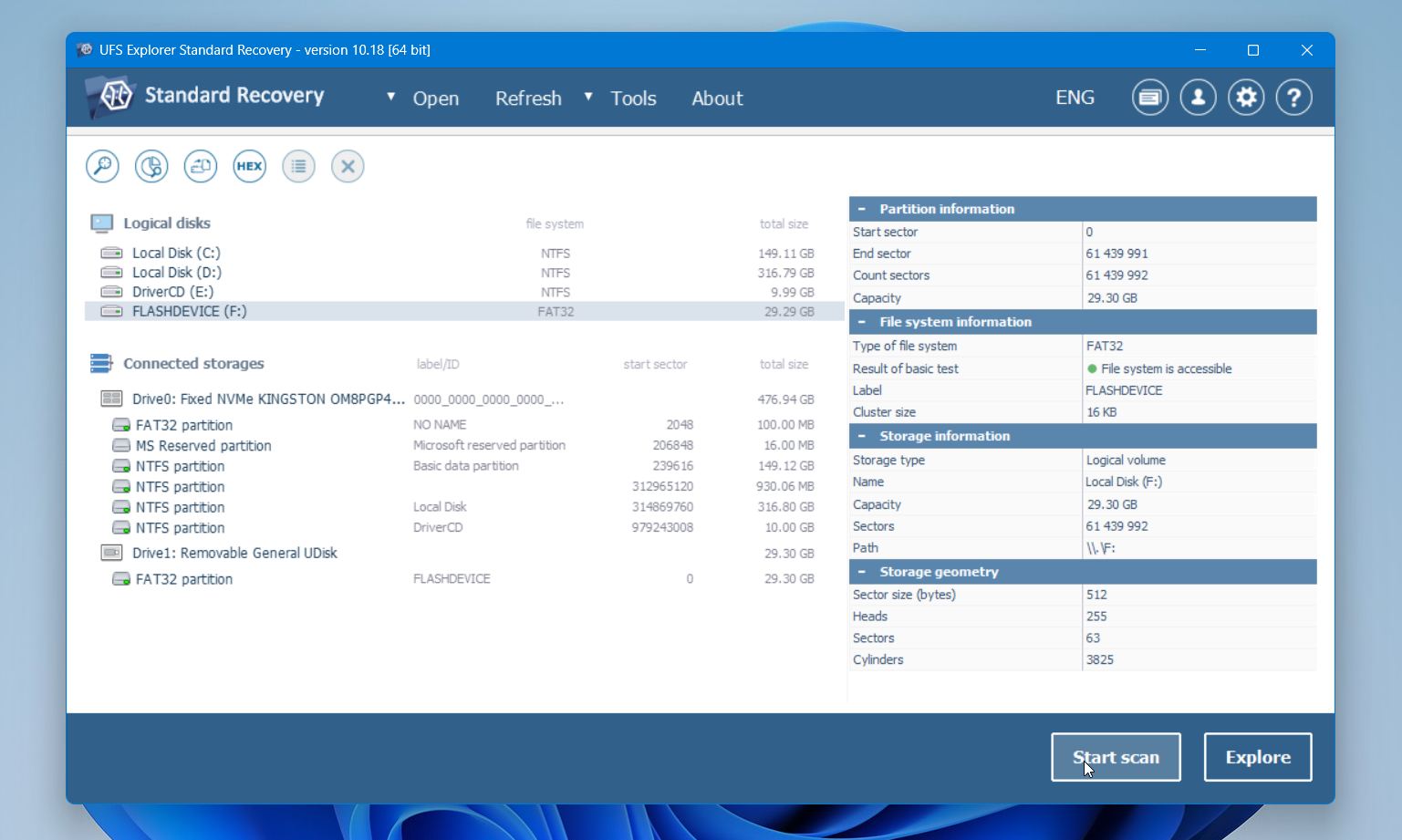
- Launch UFS Explorer and select your SD card from the left panel under Logical disks or Connected storages. Then click Start scan in the bottom-right corner.
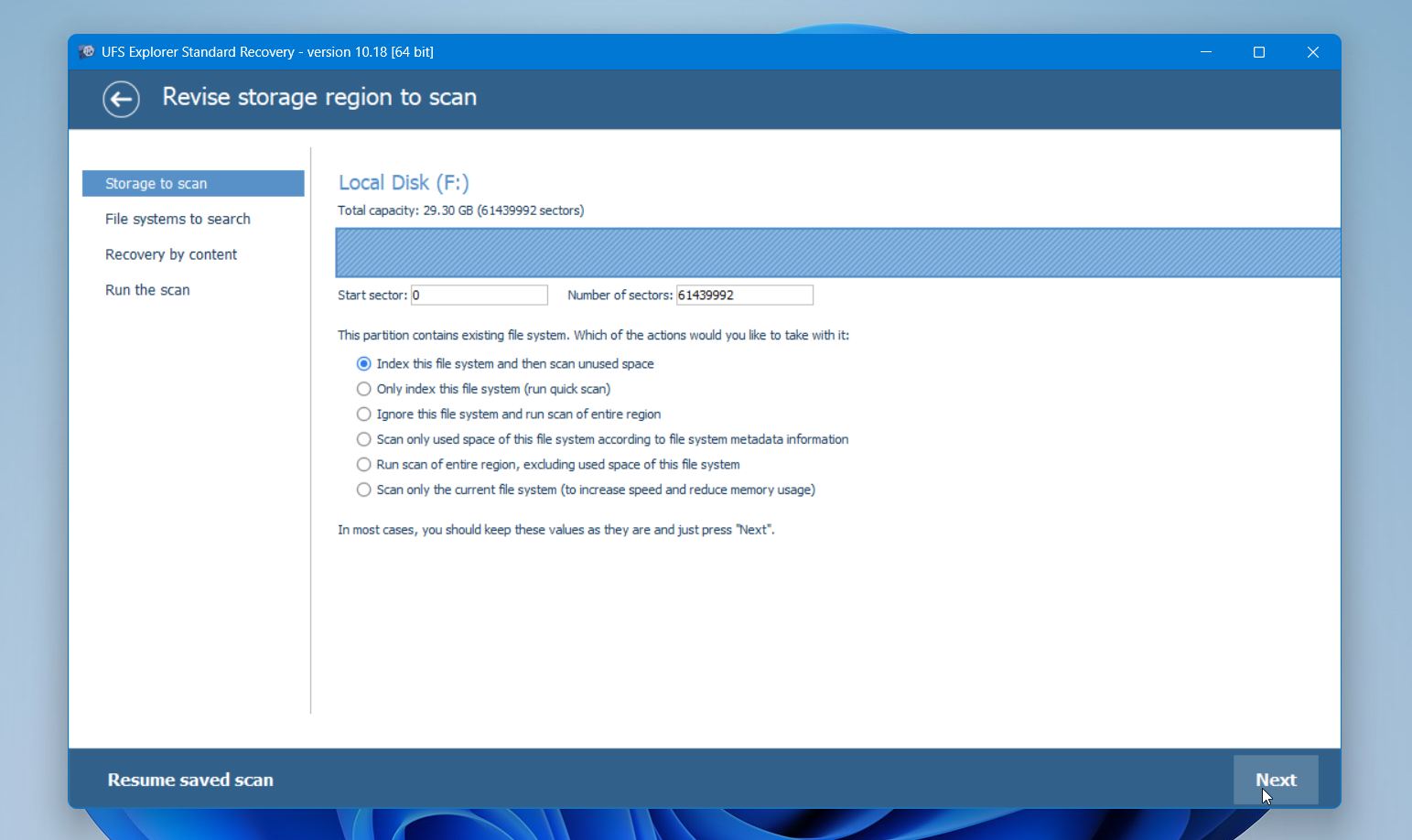
- In the Revise storage region to scan window, keep the default option selected and click Next.
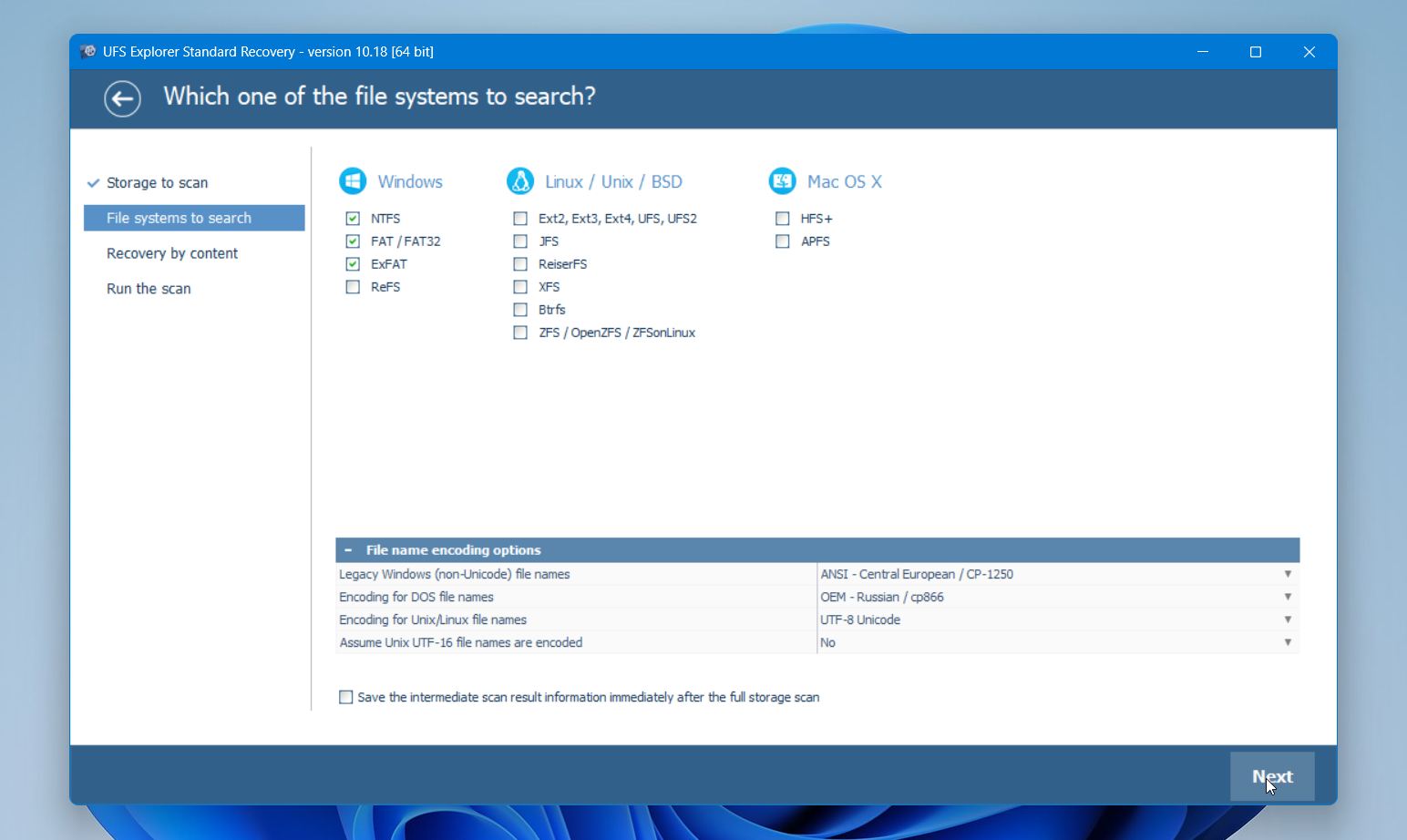
- In the File systems to search step, make sure the correct file system is selected (typically FAT/FAT32 or exFAT for SD cards used in Panasonic cameras). Then click Next.
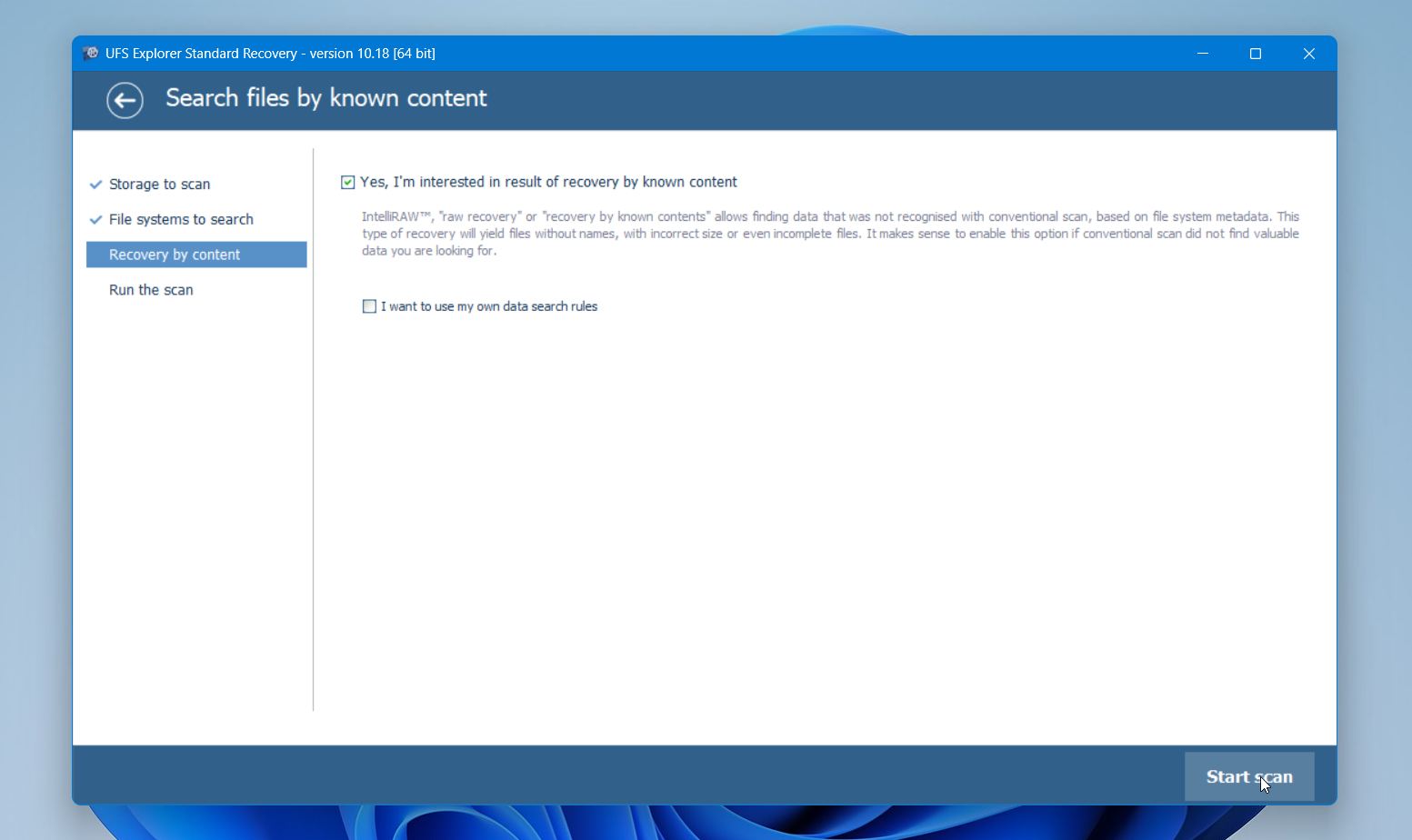
- In the Recovery by content section, leave “Yes, I’m interested in result of recovery by known content” enabled if you want a deeper raw scan. This helps detect files not found through file system metadata. Click Start scan to begin.
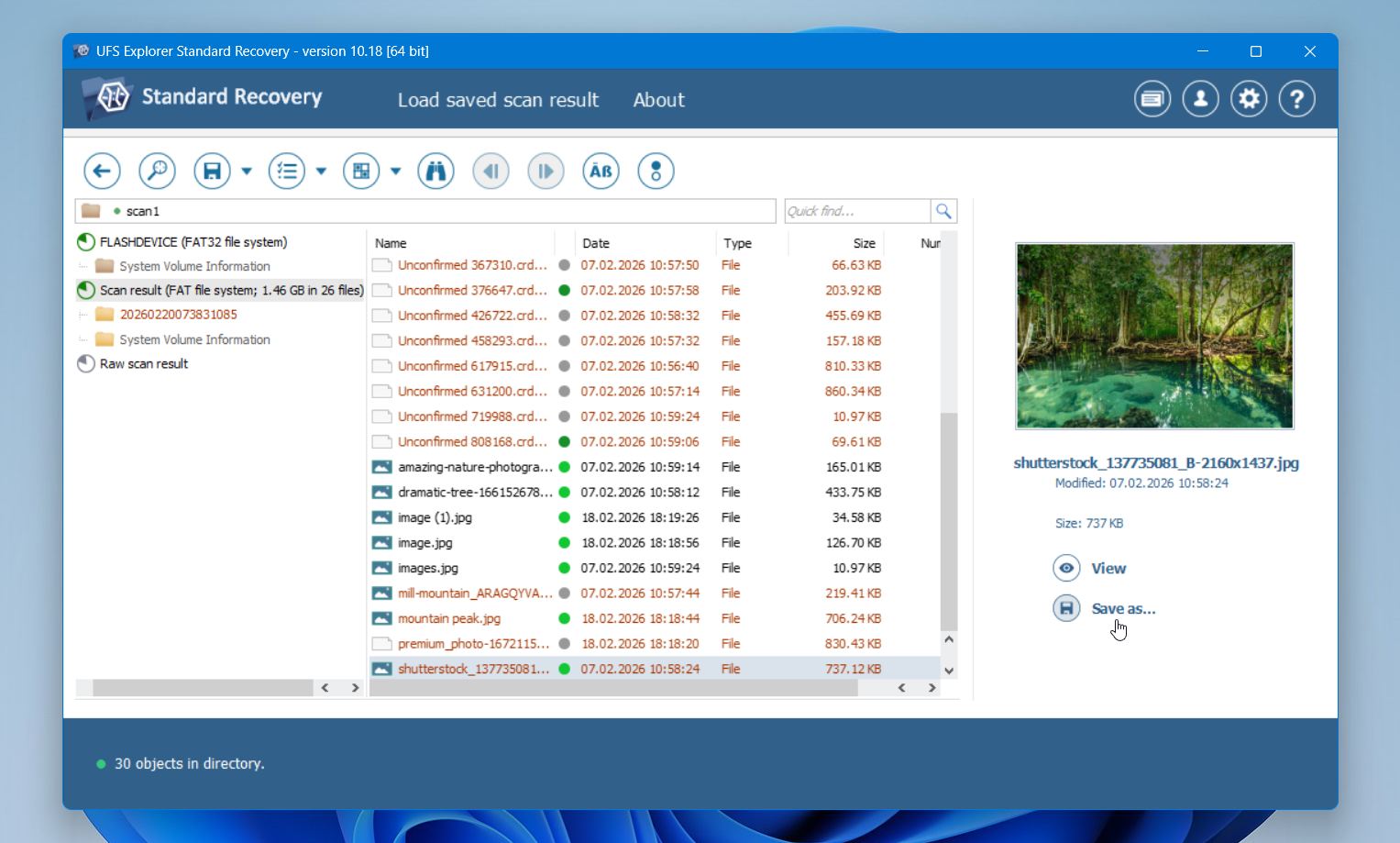
- Wait until the scan finishes. Use the built-in preview to verify image or video integrity. Select the file you want to restore and choose Save as.
- Select a different storage device as the destination. Do not save recovered data back to the same SD card.
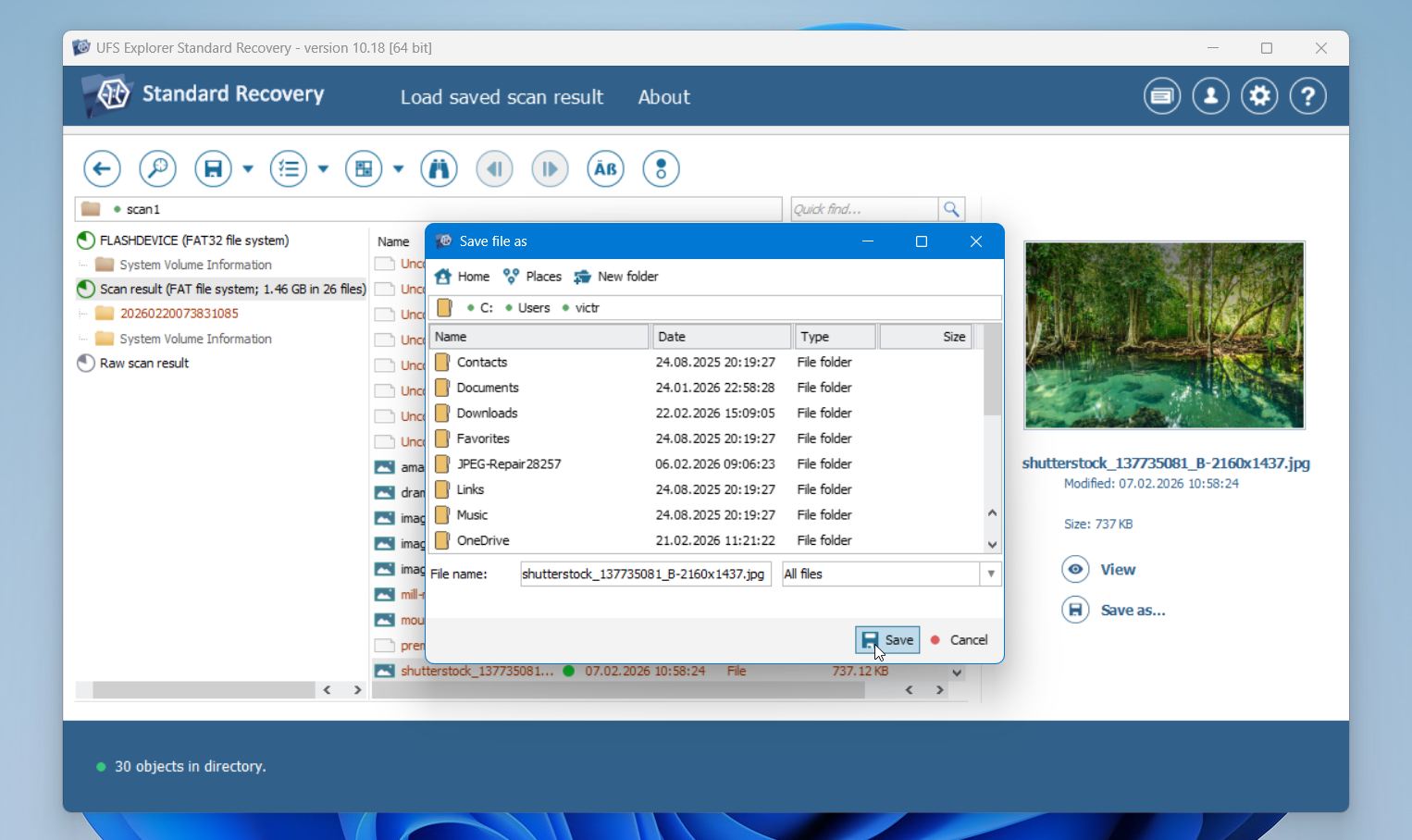
The trial version of UFS Explorer allows full scanning and file preview, but it only copies files up to 256 KB in size. You can use it to evaluate scan results and confirm file integrity before purchasing a license for full-size recovery.
Why UFS Explorer works well for photo recovery:
- Advanced file system reconstruction, which helps rebuild corrupted FAT32 or exFAT structures.
- Deep raw scan (file carving) support for JPG, RAW, and common Panasonic video formats.
- Accurate file preview that allows verification of image integrity before saving.
- Detailed scan configuration, which gives more control over how the scan runs and how results are grouped.
To see how UFS Explorer performs in real recovery tests, including corrupted SD cards, RAW file systems, and formatted media, check our in-depth UFS Explorer review.
Should You Try Panasonic’s Official SD Card Recovery Software First?
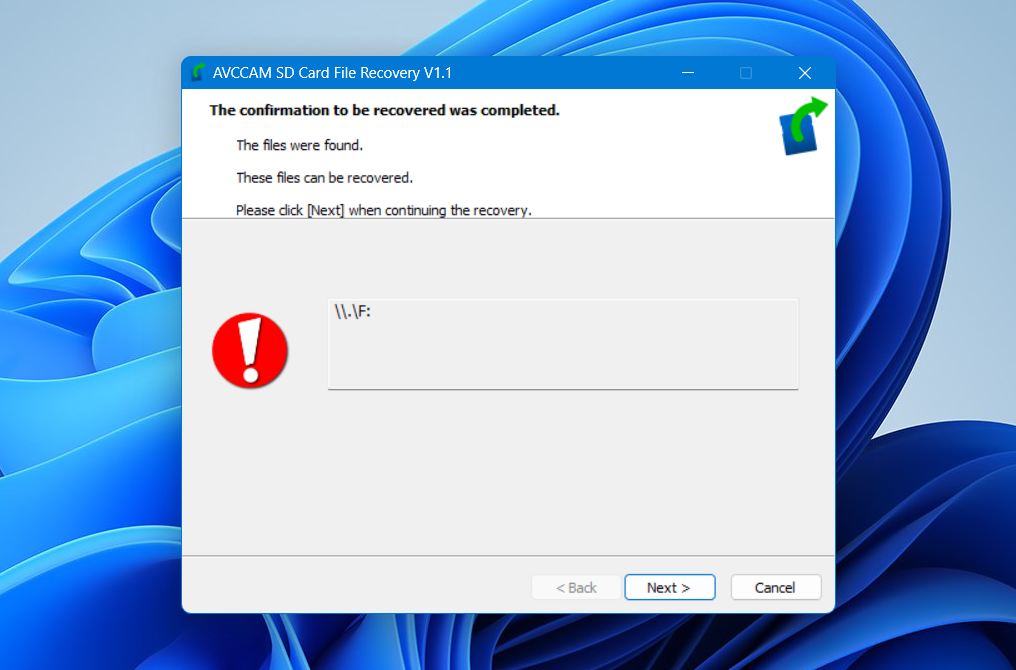
Panasonic provides its own SD Card File Recovery Software, primarily designed for AVCCAM users. The tool is intended to restore footage accidentally deleted from an SD memory card when both recording and deletion occurred on compatible Panasonic AVCCAM equipment. It is not positioned as a universal recovery solution for all Panasonic cameras or SD card issues.
The software focuses on simple in-camera deletion scenarios. It does not reliably recover footage deleted using the camera’s “CARD FORMAT” function, with only a few specific model-based exceptions. Panasonic also notes that recovery is not guaranteed even in supported cases. In some workflows, restored cards must be processed with a separate utility called AVCCAM Restorer before they become fully usable as AVCHD-compatible media.
We would not recommend this tool over the options listed above, since its compatibility is limited and it does not address common real-world scenarios such as formatted SD cards, RAW file systems, photo recovery from consumer Lumix models, or general corruption cases.
In most Panasonic photo loss situations, broader third-party recovery software provides more flexibility and better compatibility with current systems.
Does Panasonic Offer Data Recovery Services?
Panasonic does not provide direct data recovery services for damaged or failed SD cards. Its official support mainly covers device diagnostics, firmware updates, and software utilities, but not chip-level data extraction or advanced media reconstruction.
When software tools no longer help, or when the SD card shows clear signs of physical or severe logical damage, professional data recovery labs become the only realistic option. Typical warning signs include a card that does not appear in the system at all, shows incorrect capacity, or disconnects during scans.
In these cases, specialists work with dedicated hardware and controlled environments that go far beyond consumer tools. They can access memory chips directly, reconstruct damaged file systems, and rebuild photo or video data at a low level. This approach often makes sense for critical photos, commercial work, or unique footage that cannot be replaced.
For more on trusted labs and what to expect from professional support, see our guide on the best SD card recovery services.
FAQ
Can I recover deleted pictures from my camera memory card?
Yes, you can recover deleted photos from a camera’s memory card using data recovery software. While dealing with data loss, it’s important to act immediately to avoid data overwriting. It doesn’t matter what device you are on! Here’s the ultimate SD card photo recovery guide for Windows/Mac/Android.
Why are recovered Panasonic photos corrupted or partially grey?
Recovered Panasonic photos may appear corrupted or partially grey when parts of the original file were overwritten or damaged. The image header may still exist, that’s why the file opens, but some data blocks are missing, which results in grey areas. This often happens after continued camera use, formatting, or file system corruption. If the missing sectors were overwritten, the lost image data cannot be restored.
Can I recover Panasonic RAW files (RW2 format)?
Yes, in many cases you can recover Panasonic RAW files in the RW2 format, as long as the data has not been overwritten. RW2 files are standard RAW image files used by Panasonic Lumix cameras, and many professional data recovery tools support their file signatures during deep scans. If the photos were simply deleted or the SD card was quickly formatted, recovery software can often detect RW2 files through file system records or raw signature analysis. Preview support varies depending on the tool, but strong recovery software usually allows you to verify image integrity before restoring.
How do you format a memory card on a Panasonic Lumix camera?
You can format an SD card from the thumbnail screen on your Lumix:
- Select [FORMAT] from the menu > [CLIP].
- Choose [SD CARD] and press down on the camera analog button.
- Select [YES].
How to import photos and videos from a Panasonic camera to the smartphone?
Here’s how you can set up an automatic transfer of assets from a Panasonic camera to your smartphone:
- Pair the camera with your smartphone.
- Set [Auto Transfer] to [ON] on your camera.
- Hit MENU/SET > Wrench icon > Wi-Fi icon > [Bluetooth] > [Auto Transfer]>[ON].
- Confirm the incoming connection on your smartphone.
- Select [OK] on your camera.
This article was written by Joshua Solomon, a Contributing Writer at Handy Recovery Advisor. It was also verified for technical accuracy by Andrey Vasilyev, our editorial advisor.
Curious about our content creation process? Take a look at our Editor Guidelines.