

Did you lose a REDCODE (.R3D) file during a project or accidentally delete it? Video recovery can be more complex than restoring other files, especially when dealing with large RAW clips, but in many cases, it’s still doable. If you need clear guidance on R3D file recovery, we tested the available options and outlined the steps that worked for us so you can follow the same methods.
What Are .R3D Files and Does the File Format Affect Recovery?
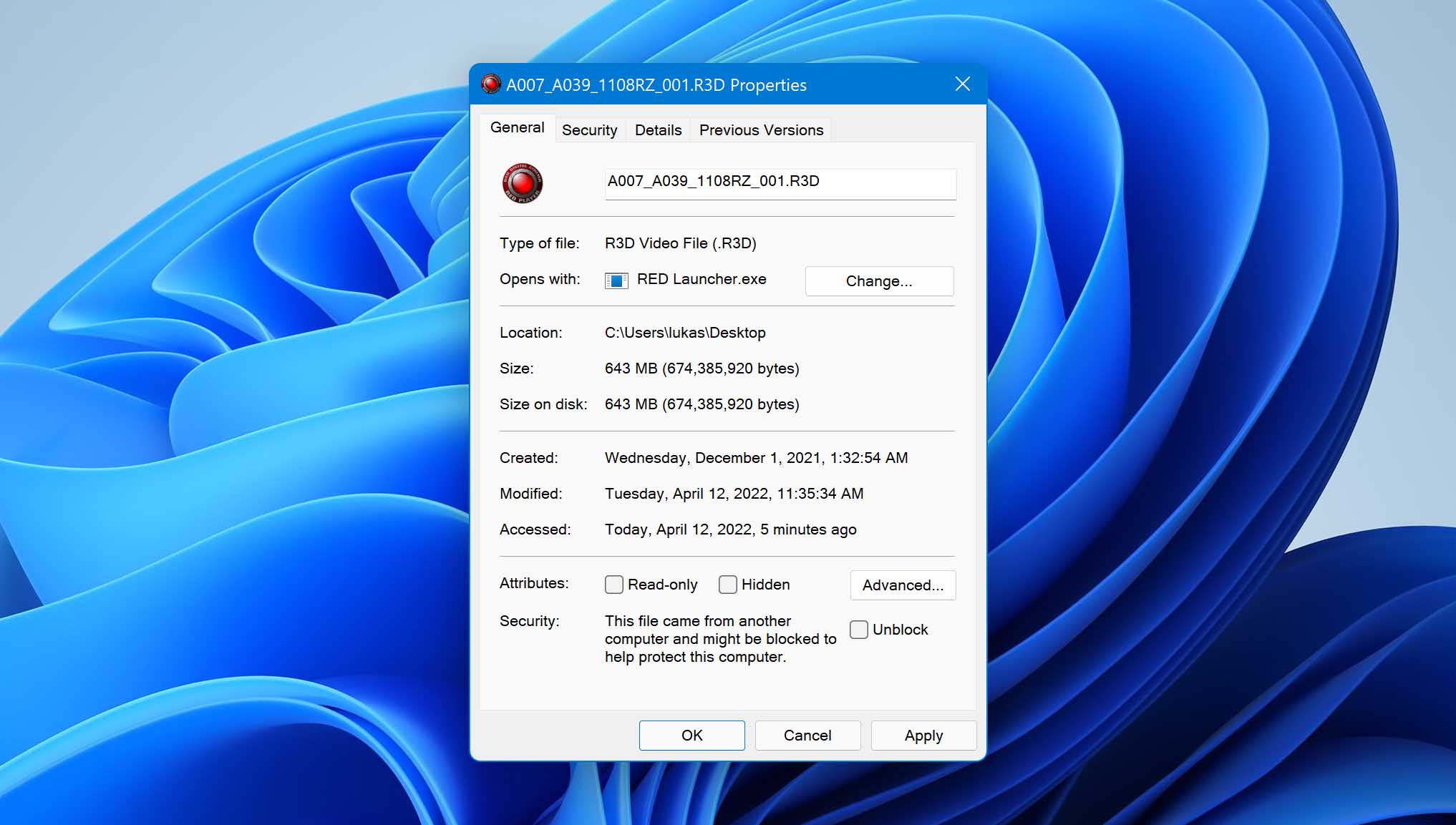 Before we get into the recovery process, let’s first remind what a .r3d file is. REDCODE or simply .r3d, is a video file type created by RED Digital Cinema Company. The cameras from this company record videos as .r3d files. They are large, high-bitrate RAW video files, which affects both recovery chances and recovery behavior compared to photos or standard video formats.
When an R3D file is deleted, the camera or operating system usually removes only the file reference. The actual video data often remains on the card or drive until new recordings overwrite it. Large file size and fragmentation mean that partial overwrites can affect bigger portions of footage, and successful recovery often depends on how intact the original data remains.
RED cameras are typically used in professional production environments, and most modern editing software supports .R3D files. At the same time, their size and structure make them more demanding both in editing and recovery scenarios.
Is it Possible to Recover a Deleted R3D File?
Yes, deleted R3D (RED RAW) files are often possible to recover. However, we should say that the outcome depends on how the footage was lost and what happened to the storage afterward.
Let’s take a look at recovery chances in different situations:
- 💾 Did you continue using the storage after deletion? Drive activity plays an important role. Each new recording or file operation can overwrite parts of deleted .R3D data. Due to the large size of RED clips, even a short test recording can replace a significant portion of the original footage. If the storage was not used after deletion, that’s ideal. Light use still leaves good chances, and new files do not always overwrite the exact areas where RED clips were stored. For more context on how overwriting affects recovery, see this discussion.
- 🗑️How did the file disappear? Files moved to the system Recycle Bin remain easy to restore with a simple action. Permanent deletion or in-camera deletion removes the file reference entirely and skips this safety layer, but it is still usually possible to recover files with a data recovery tool. The same applies to in-camera formatting and quick formatting, where data often remains recoverable in many cases.
- 🔧 On what type of storage were the files stored before deletion? Recovery chances depend on the original media. If the .R3D files were stored on removable media such as CFast, CFexpress, or an external HDD, chances are usually higher. If the files were on a system SSD, recovery is much harder due to TRIM, which can permanently clear deleted blocks at the flash level. There is a detailed forum discussion where users break this down.
This is mostly theoretical. You won’t know what’s actually recoverable until you scan the storage and check what can be found.
How to Recover Deleted R3D Files on Windows & macOS
There are a lot of tools that can help you recover R3D files. We will show two of them that have the most consistent results and support both Windows and macOS.
Method 1: Recover R3D files using Disk Drill
We recommend Disk Drill as a first choice for data recovery software when you need to get your .r3d files back. When it comes to video files, Disk Drill is among the strongest tools in the market due to its diverse file support and recovery capabilities.
Unlike the next tool, Disk Drill can scan the storage in two ways. If the file system is still intact, it analyzes it to recover files with their original names and folder structure. If the file system is damaged or missing, it switches to signature-based scanning, which searches for known file types directly across the disk. This makes it more flexible in different recovery scenarios.
You can read our detailed Disk Drill review for a deeper breakdown of features and test results. One of the main reasons we use it in this guide is the Advanced Camera Recovery mode. It is specifically designed to reconstruct large, fragmented video files recorded by professional cameras. In our tests with RAW footage, this mode delivered the most consistent and reliable results compared to other tools.
Here is how to recover R3D files using Disk Drill:
- Download and install Disk Drill on your computer.
- Open Disk Drill from the desktop or applications folder. On Windows, confirm the system prompt so the software can access storage devices for scanning.
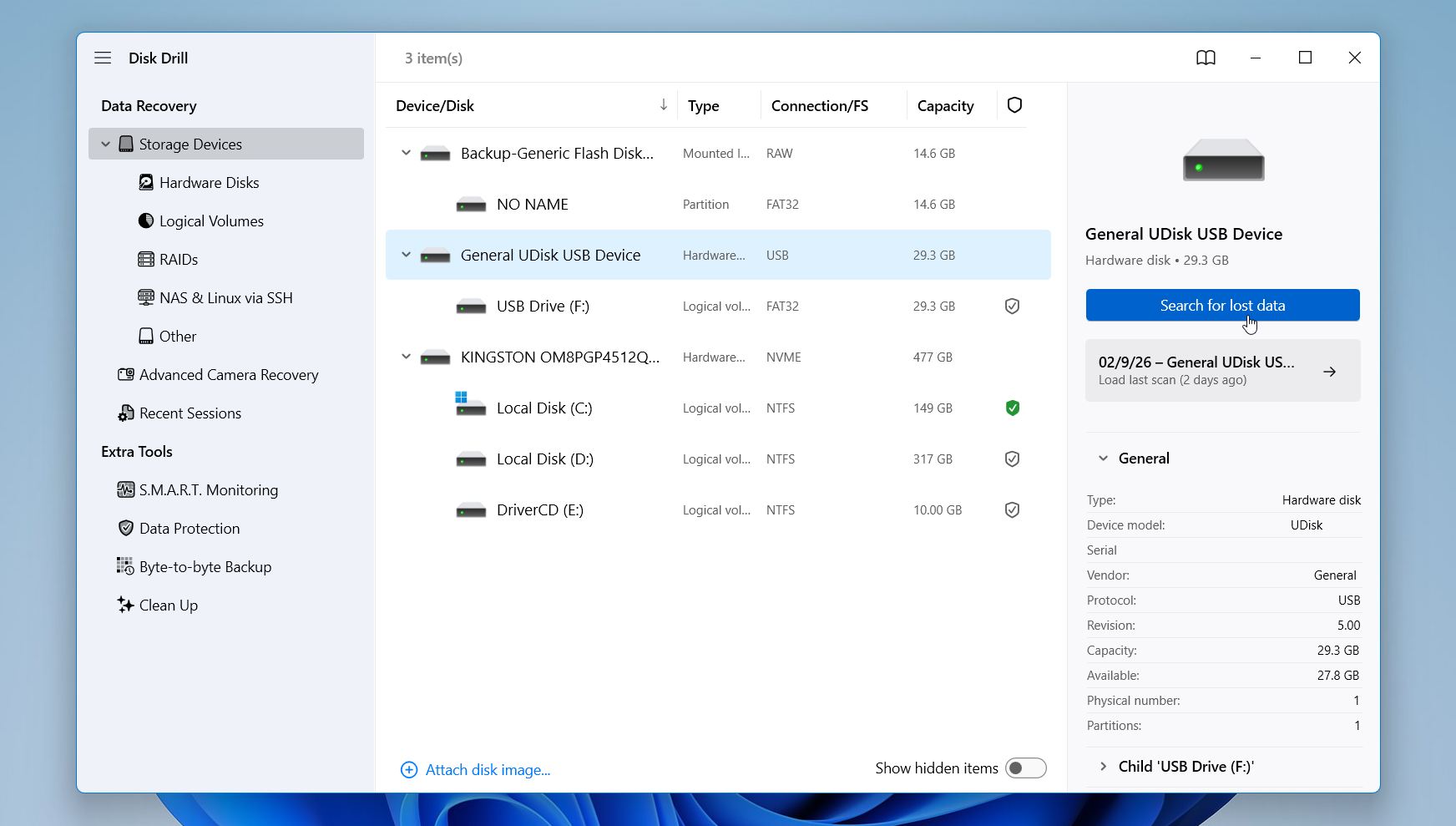
- Locate your RED media in the disk list. If the name is unclear, identify it by capacity, which usually matches the card or drive size.
- Click Search for lost data.
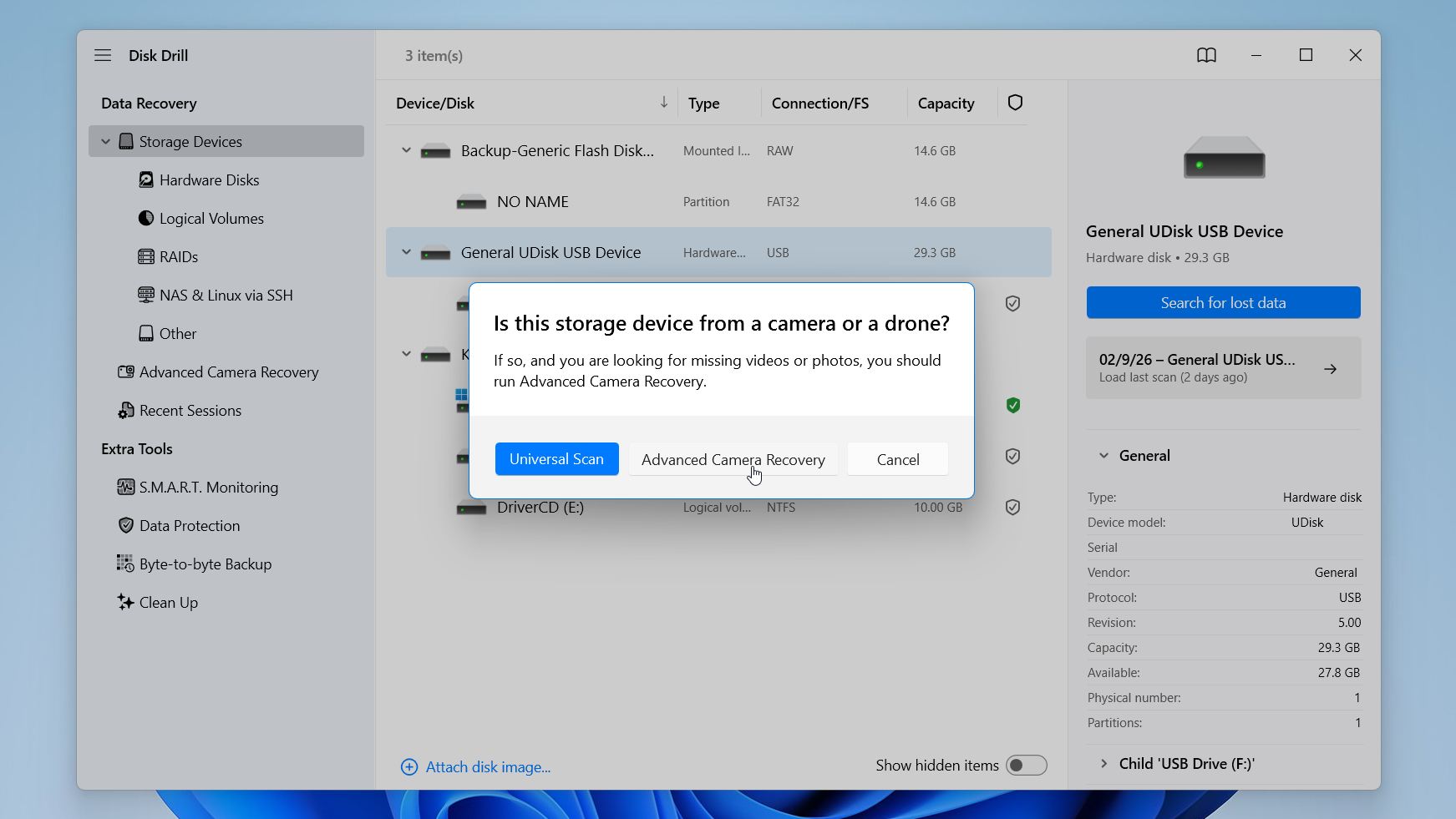
- Select the recovery mode. We recommend starting with Advanced Camera Recovery first, especially if videos were lost on the camera. Try the Universal Mode next if the ACR tool didn’t find your files.
- Once results appear, use the search bar and type .R3D or filter the results by file type, size, date modified, or recovery chances.
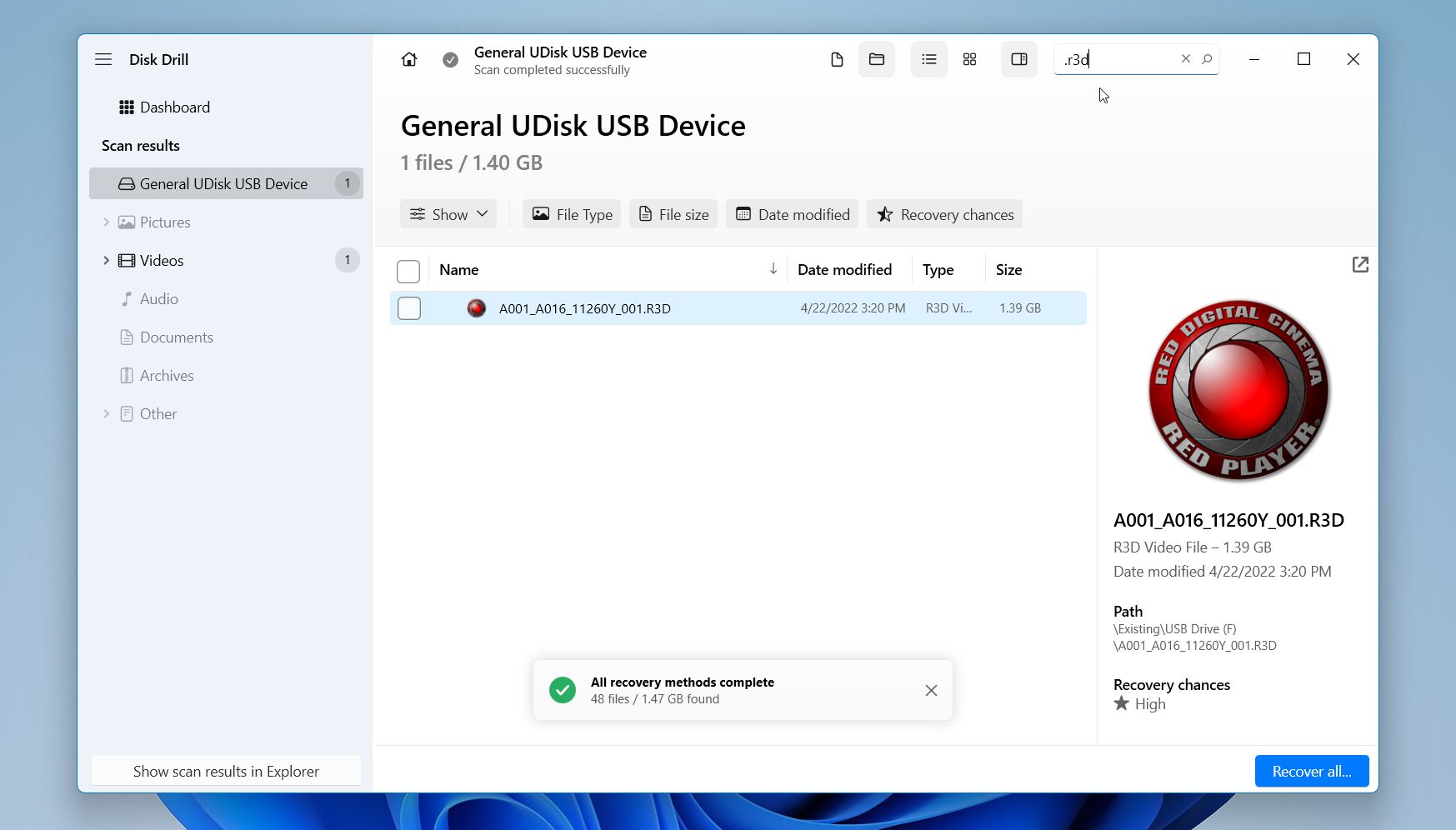
- Select the R3D files you need and click Recover. Choose a destination on a different drive, never the original card or drive.
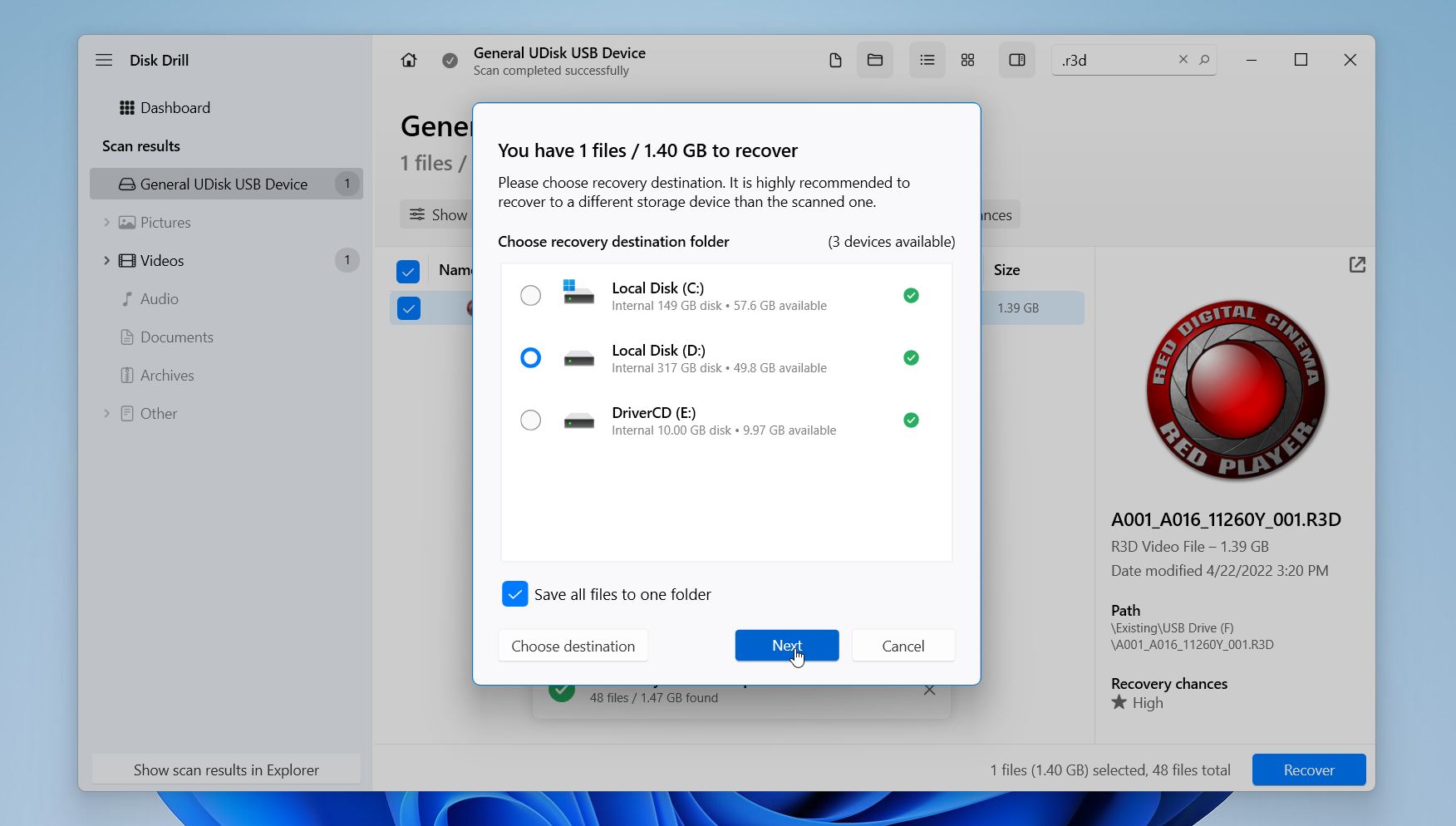
Disk Drill is available for both Windows and macOS. You do not need a license to test it first. The free version allows you to scan files, and on Windows you can recover up to 100 MB at no cost. This gives you a chance to check that your .R3D files are detectable and intact before purchasing a license. For this guide we will use the Windows version of the software, but the steps are relatively the same.
Some users occasionally ask how to use Disk Drill in practice. For example, in this community discussion on how to use Disk Drill users share questions and quick tips about the workflow. In reality, the process is simple, as shown above. The interface guides each step clearly, even for first-time users.
Method 2: Use PhotoRec to recover .r3d files
PhotoRec is a free, open-source data recovery tool that focuses on signature-based recovery rather than file system reconstruction. This approach allows it to recover R3D files even when the file system is severely damaged, the card appears as RAW, or the media is no longer readable by the operating system. PhotoRec works on Windows, macOS, and Linux, which makes it a universal fallback option when commercial tools fail to detect RED footage.
It is a great tool, but we also must warn you about its limitations. Due to its nature, PhotoRec does not restore original filenames or folder structures even if the file system is ‘alive’. All recovered files are saved with generic names and sorted into numbered folders. Because R3D files are very large, recovery can take significant time and requires plenty of free storage space.
Here is how to use PhotoRec for .r3d recovery:
- Download PhotoRec as part of the TestDisk package and extract the archive to your computer.
- Launch PhotoRec.
- Select the storage device that contained the R3D files form the list and click Enter.
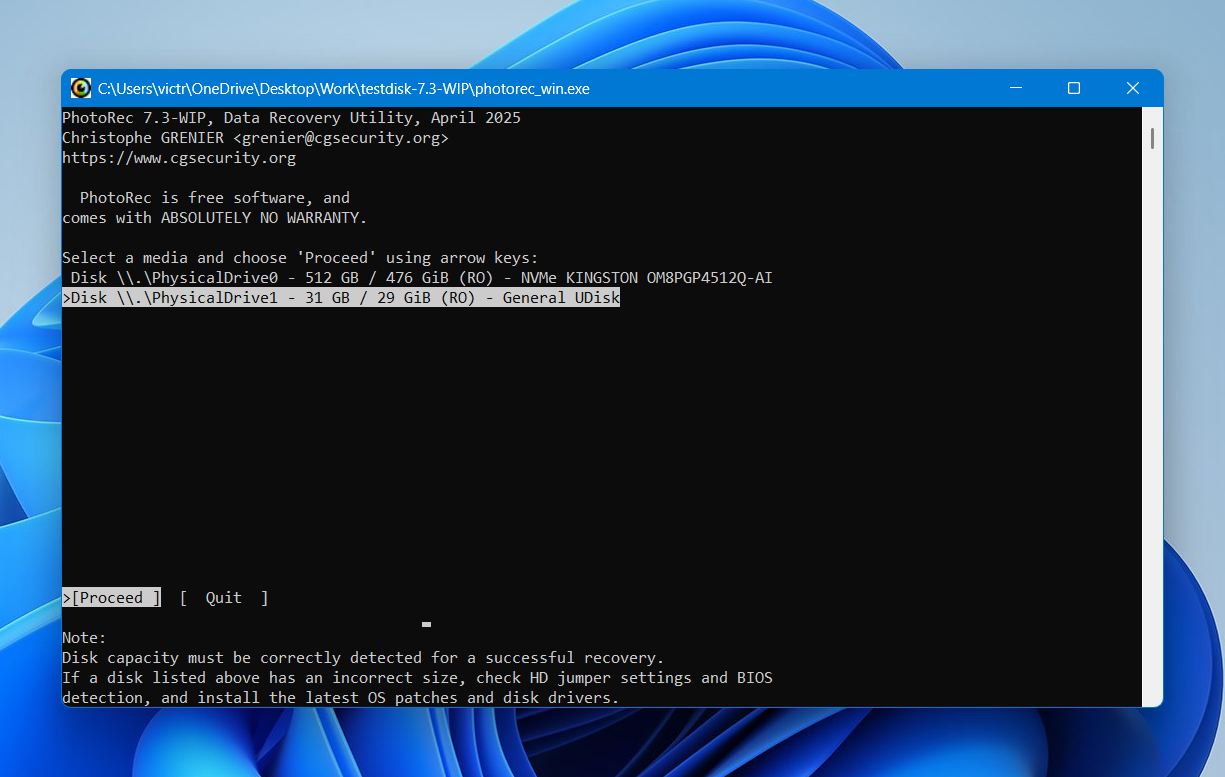
- Choose the correct partition or select the whole disk if unsure.
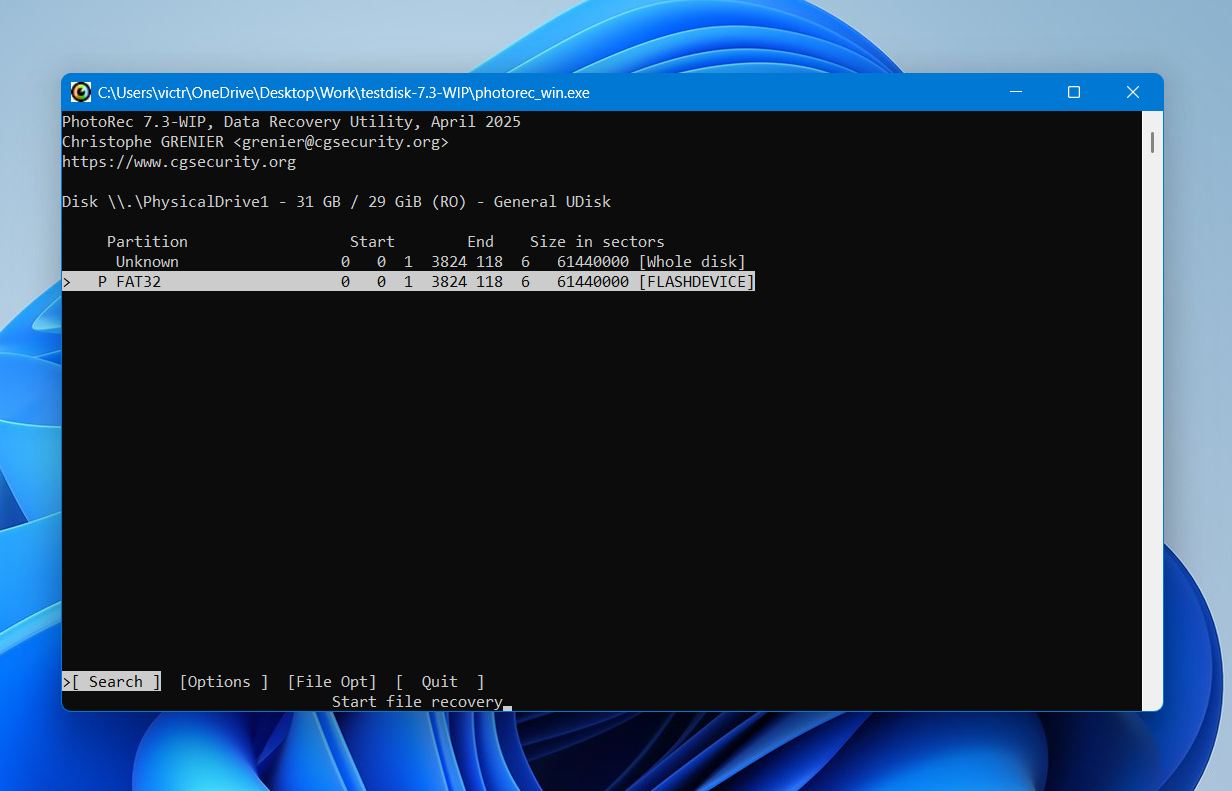
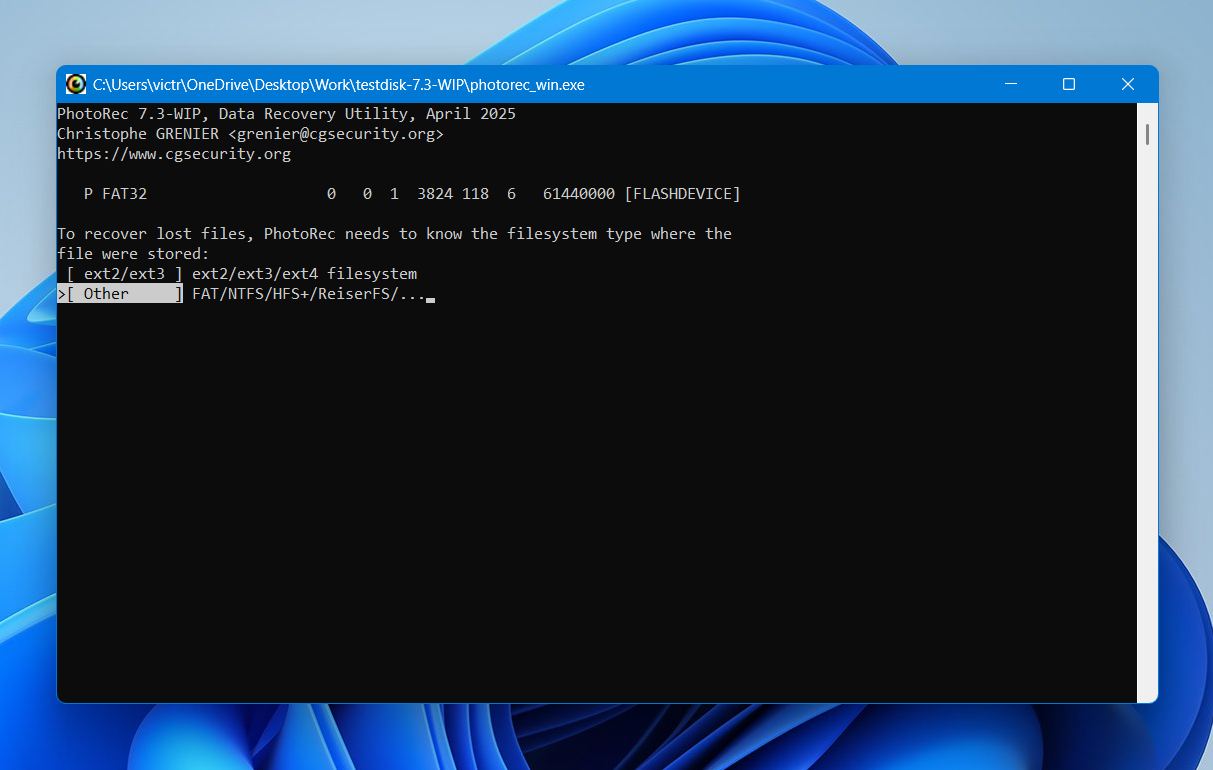
- Next, PhotoRec will ask to select the file system. Choose Other and click Enter.
- Choose a destination folder on a separate drive. Use arow keys to navigate the list. Click C, when you selected the right folder.
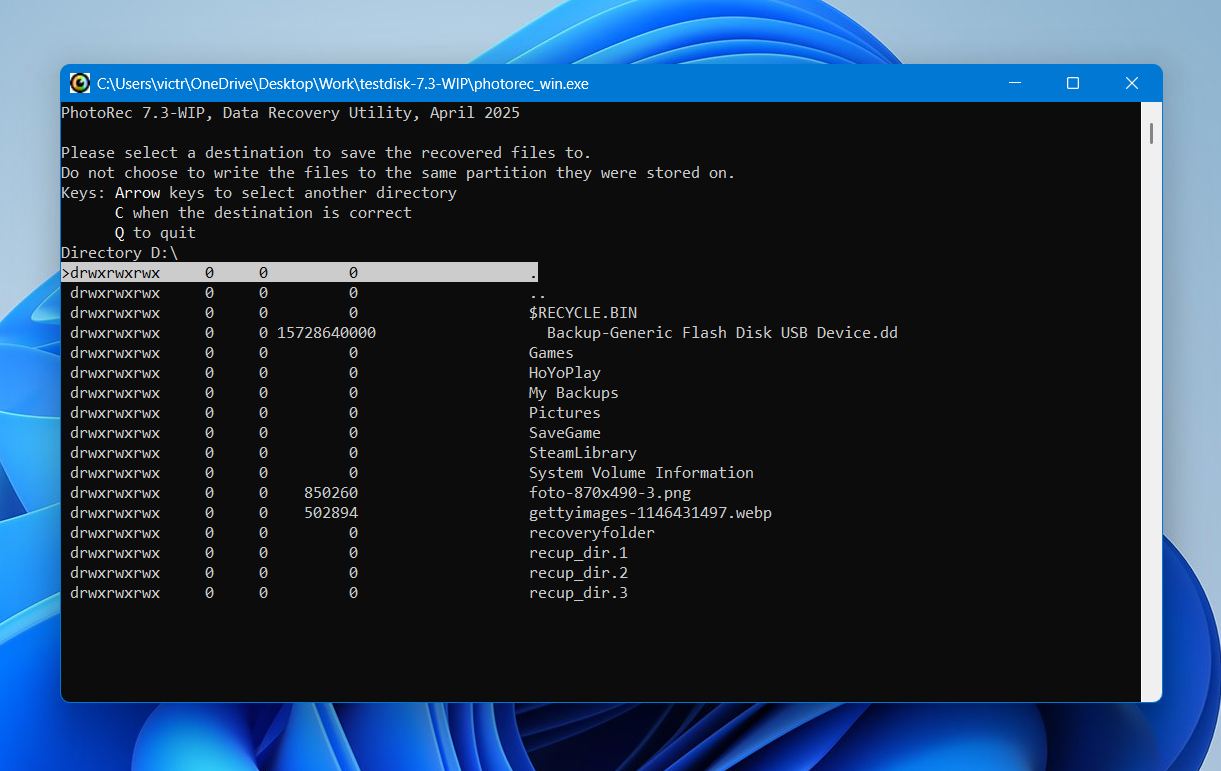
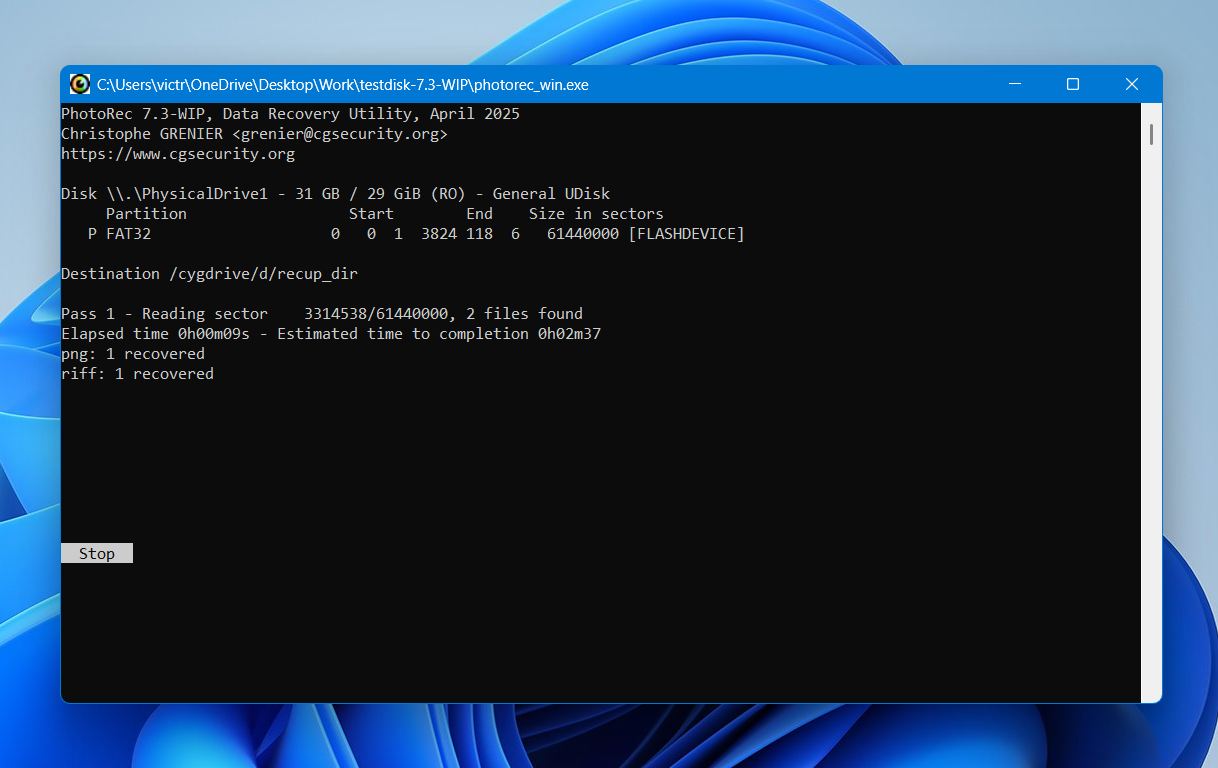
- Start the scan and wait for completion. Scans can take a long time on large cards or SSDs.
If you’re working on Windows and prefer a graphical interface instead of the command-line version, you can use QPhotoRec, which provides a simpler UI while using the same recovery engine. We covered it in our detailed review.
How to Recover Deleted R3D Files Without Software
Recovery of .R3D files without data recovery software is possible only in a limited set of situations where a copy of the footage exists outside the camera card. This approach depends entirely on system-level or cloud-based features that were already active before the deletion took place.
Here are 2 methods that may help you:
Method 1: File History
Recovery via File History works only when the .R3D files were copied from the camera card to a location that File History actually backed up, such as the default Documents, Pictures, Videos, or Desktop folders. File History cannot recover files deleted directly on the camera.
File History can restore backed-up copies of .R3D files stored in monitored folders, including older versions that were removed or overwritten later. It cannot help when the footage never left the card or was deleted before the next backup cycle completed.
To restore .R3D files using File History:
- Connect the drive that stores File History backups.
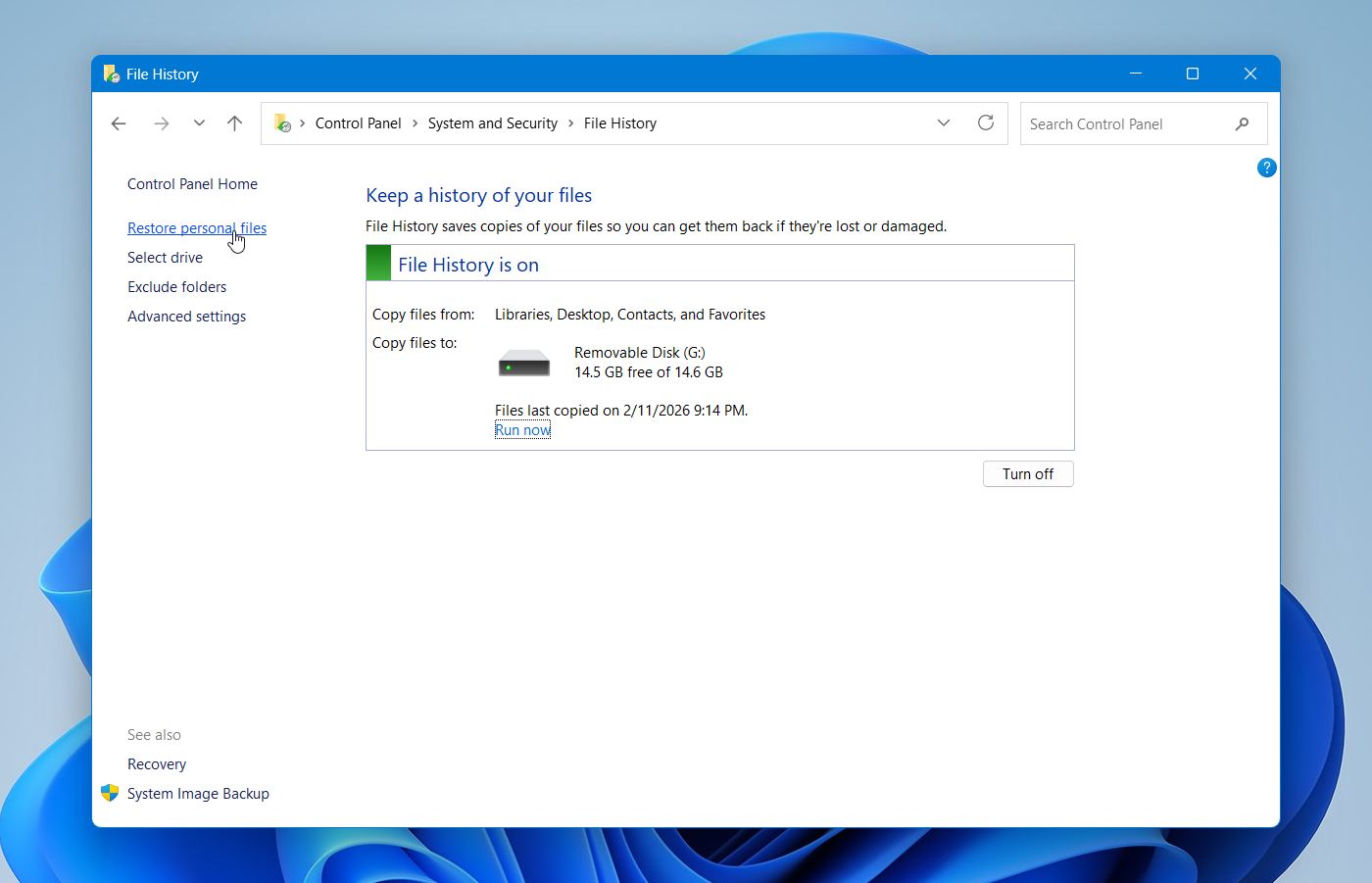
- Open Control Panel and go to File History.
- Select “Restore personal files.”
- Go to the folder where the .R3D files were originally saved. Use the timeline to select the correct backup version.
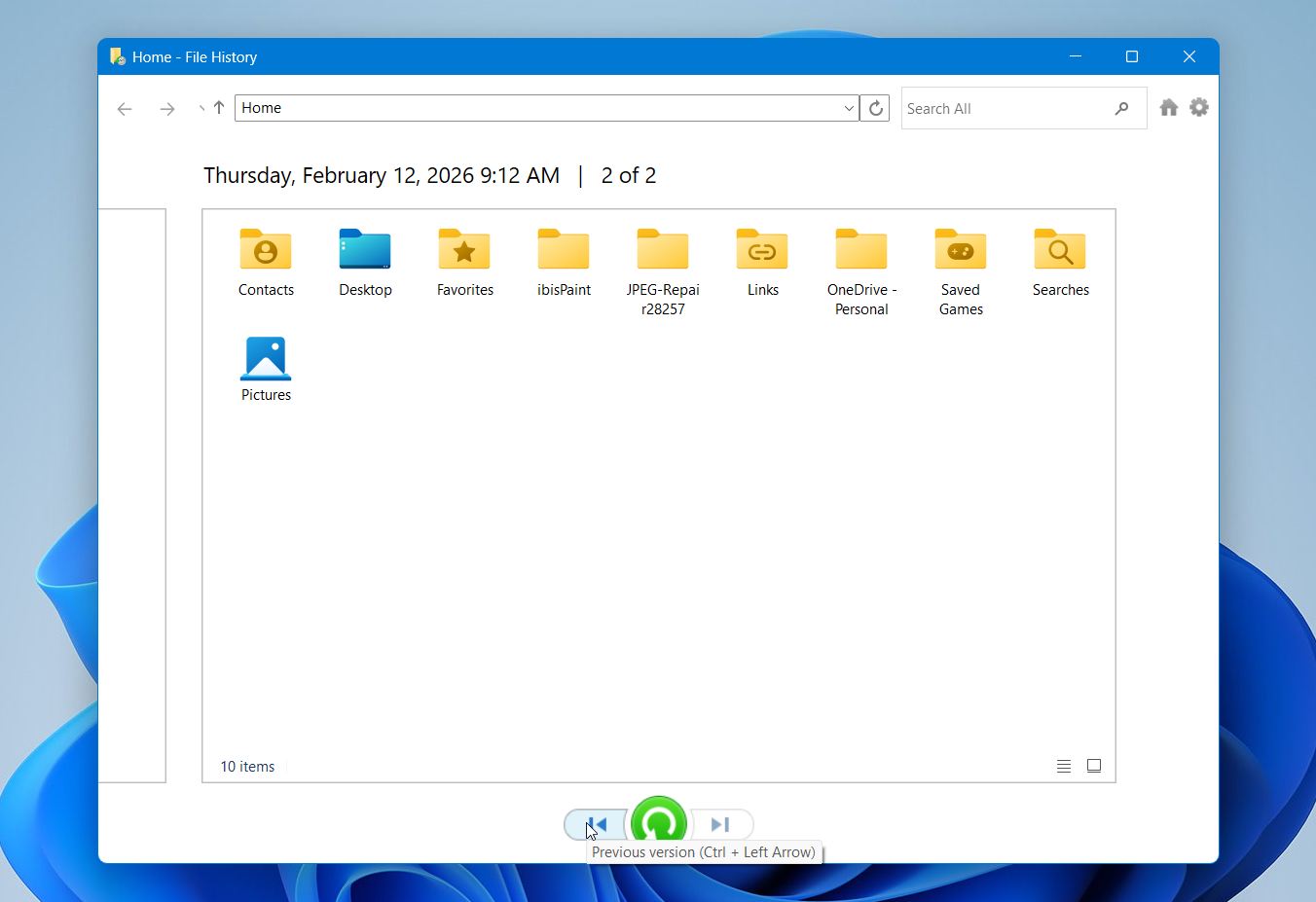
- Choose the files. Right-click the green button and select Restore or Restore to.
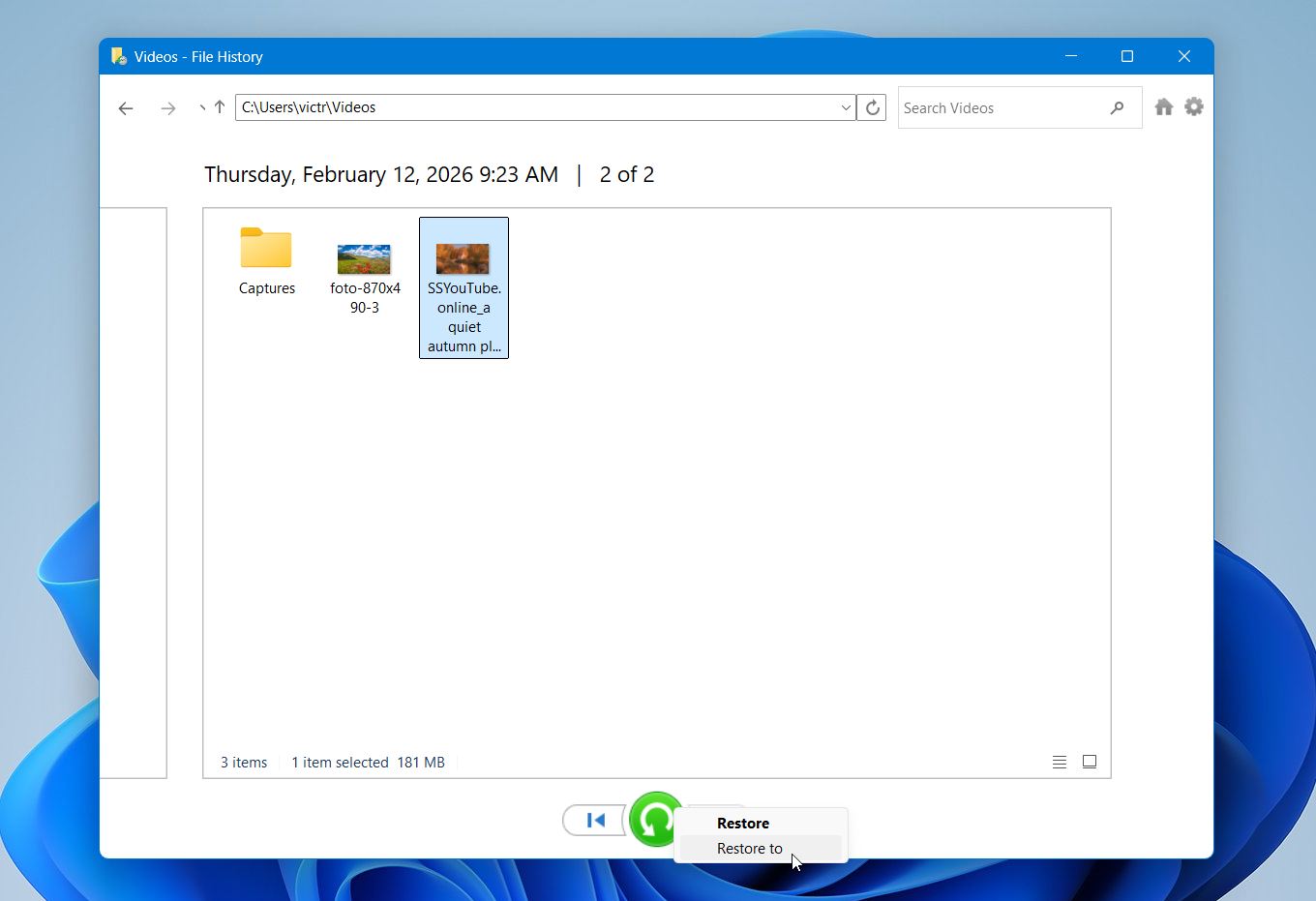
File History mainly helps when footage was offloaded to a workstation and later removed by mistake. It provides no value when the camera card is the only place where the files ever existed.
Method 2: Cloud Backups
Cloud backups like Google Drive can help recover .R3D files when footage was copied into a folder synchronized before deletion. This method restores cloud copies and does not recover deleted data from the camera card itself.
In most cloud backup systems, synchronization mirrors deletions. If a file is deleted on the computer and removed from the local Recycle Bin, it is also deleted from the cloud’s Recently Deleted section because the trash folders sync as well.
Google Drive behaves a bit differently. When a synchronized file is deleted on the computer, it may disappear locally without appearing in the Windows Recycle Bin, but a copy usually remains in Google Drive Trash. This desynchronization gives you an additional recovery window directly inside the Google Drive web interface.
To recover .R3D files from Google Drive:
- Sign in to Google Drive in a web browser.
- Open the Trash section.

- Locate the deleted .R3D files or folders.
- Right-click the deleted file to restore it to your Drive.
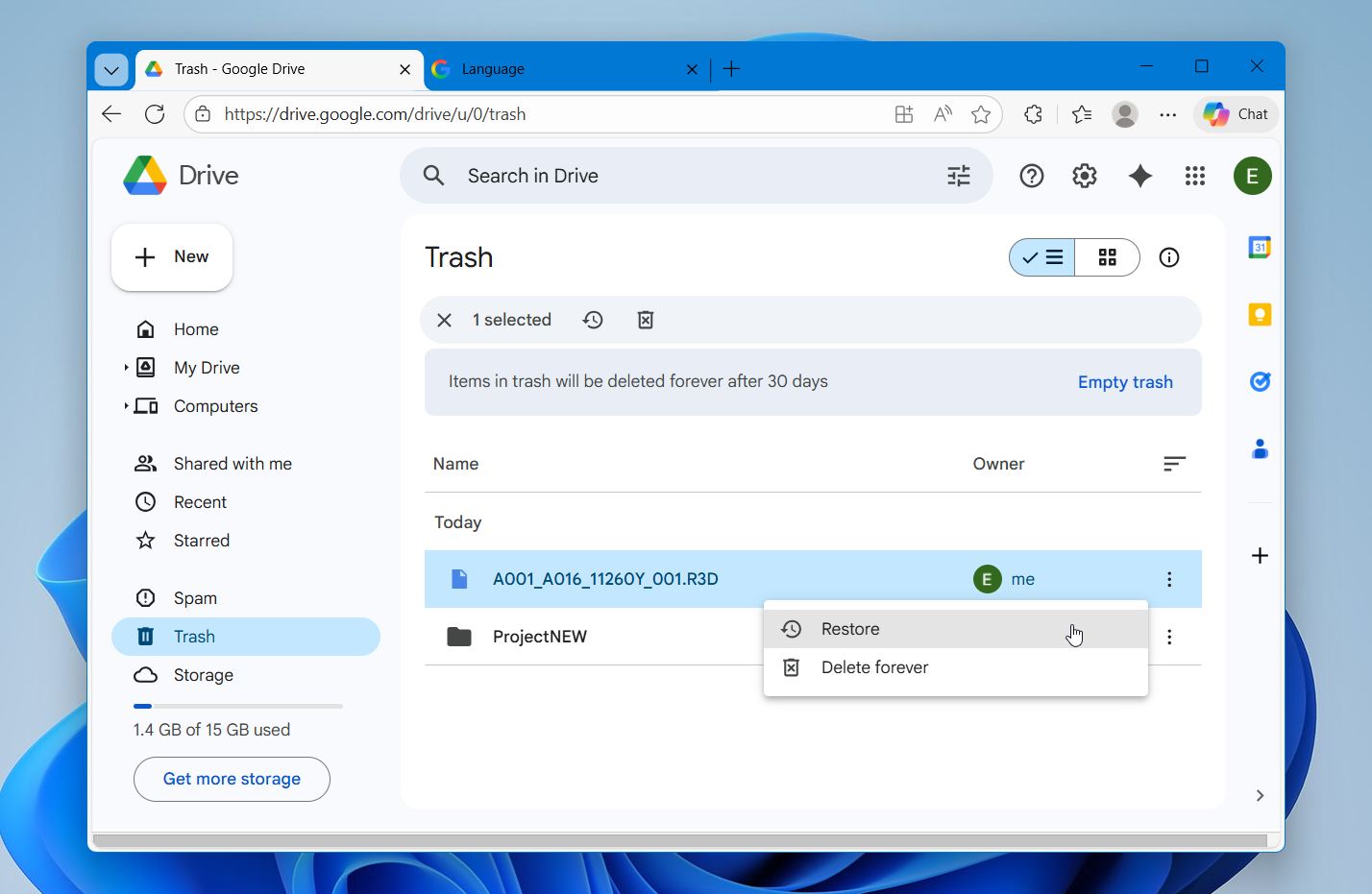
- Download the restored files to local storage.
Google Drive also maintains version history for some file types, which can help when files were replaced rather than deleted. However, very large .R3D files may not upload fully before deletion, leaving incomplete data that cannot be used. This method works only when synchronization is completed successfully. Files deleted directly on the camera or removed before upload finished cannot be recovered through Google Drive.
Conclusion
If you skipped straight to this section, here is the short version.
Deleted .R3D files are often recoverable, but your speed and storage activity decide the outcome. Stop using the card (or any other device that had your RED files) immediately. Avoid new recordings. The less you write to the media, the higher your chances.
For camera cards, start with professional recovery software. Disk Drill works especially well for fragmented RED footage thanks to Advanced Camera Recovery. PhotoRec is a solid open-source alternative, but it has a more technical interface and you’ll need to sort recovered files manually afterward.
File History or cloud backups only work when a copy of the footage already exists outside the card.
After recovery, store restored RED files on separate media and document the context: card type, camera model, and tool used. This prevents confusion in post-production and helps you diagnose future media issues faster.
FAQ
What is the best .r3d file viewer?
The most reliable viewer for .R3D (RED RAW) files is REDCINE-X PRO (free from RED). It is designed specifically for RED footage, shows accurate color and metadata, and lets you inspect RAW settings frame by frame. Many professional editing tools (like DaVinci Resolve and Premiere Pro) also display R3D clips natively, but REDCINE-X PRO remains the best standalone viewer for quality and control.
Is there any reliable .r3d file converter?
Yes. Several tools can convert R3D clips to editing formats:
- REDCINE-X PRO lets you export to ProRes, DNx, DPX, and other editorial formats with precise control.
- DaVinci Resolve can transcode R3D to common edit formats within your timeline or delivery presets.
- Adobe Media Encoder (via Premiere) can convert R3D to H.264, ProRes (macOS), DNx (Windows/macOS), and more.
These converters retain quality and let you choose codecs and resolutions suitable for editing or delivery.
Why did my RED footage become corrupted?
RED footage usually becomes corrupted due to interruptions during recording or issues with the recording media. Common causes include sudden power loss, battery removal, or card ejection while the camera writes data. File system damage caused by improper formatting or unstable media can also prevent R3D files from opening correctly. In some cases, corruption appears after deletion and partial overwrite, where new clips replace parts of older footage.
Can I open .r3d files in DaVinci?
Yes, DaVinci Resolve supports R3D files natively. You can import R3D clips directly into the Media Pool, adjust RED RAW parameters such as ISO, white balance, and color space, and perform full editing and grading without prior conversion. This makes Resolve a popular choice for color work and finishing on RED projects. Performance depends on system hardware, so proxy or optimized media may help on less powerful machines.
Can I open .r3d files in Premiere?
Yes, Adobe Premiere Pro can open and edit R3D files without conversion. Once imported, R3D clips behave like standard media in the timeline, and basic RED settings can be adjusted through the clip’s source settings. Premiere works well for editorial tasks, especially when combined with proxy workflows or intermediate codecs for smoother playback.
This article was written by Mako Young, a Contributing Writer at Handy Recovery Advisor. It was recently updated by Victoria Rybtsova. It was also verified for technical accuracy by Andrey Vasilyev, our editorial advisor.
Curious about our content creation process? Take a look at our Editor Guidelines.